Author: LauraLorek@gmail.com (Page 76 of 354)

LauraLorek@gmail.com

SKU Accelerator Selects Seven Startups for its Seventh Cohort

Husband and Wife Co-Founders Javier Marriott and Ruth Stedman with their pup, Lola, are the founders of Groccery Pup, a healthy and fresh dog food brand

By LAURA LOREK, publisher of Silicon Hills News

Austin is known as a high-tech hub of innovative startups.

But it’s also the birthplace of many consumer-packaged goods like Siete Family Foods, a Mexican-American food brand, that just landed $90 million in funding. It makes grain free chips, grain free tortillas, hot sauces, cashew queso and more.

Siete graduated from the Austin-based SKU Accelerator, which is a 12-week program with a stipend focused on helping consumer products-based startups expand.

Other products to launch out of SKU include Shade Tree Lemonade, Austin Eastciders, Seaweed Bath Co. and Sway Water to name a few.

This week, SKU officially launched its seventh accelerator cohort with seven startups at a meet and greet party Tuesday night at Meet at Relay in Springdale General on Austin’s eastside. SKU selected Bhoomi Cane Water, Grocery Pup, Lamik Beauty, Pure Active CBD, Stackables, White’s Pickle Salsa and YVY.

Lamik Beauty is a vegan, non-toxic cosmetic line for women of color. The SKU accelerator will help Lamik expand, said Kim Roxie, its founder. She’s from Houston and used to run a retail cosmetics store, but she shut it down to make her own cosmetics line. Lamik has participated in DivInc and the SputnikATX accelerator programs.

SKU picked Lamik and the other six companies from more than 400 applications for its latest cohort.

Ruth Stedman and her husband Javier Marriott are also in the program with their startup, Grocery Pup. They created a healthy line of dog food made with human grade ingredients in a USDA human food facility in Round Rock. They didn’t like the highly processed dog food with bad ingredients that they found in most grocery stores. So, they created their own for their pup, Lola, a three-year-old Pomeranian Husky.

“We wanted her to eat fresh foods like us,” Stedman said.

Grocery Pup is going to be sold at Whole Foods in Austin starting next week and is currently available online. It comes in frozen one-pound pouches, which sell for $8.95 or a bigger three-pound bags with three pouches with real beef, turkey and pork flavors for $29.99. The food is cooked sous-vide style to ensure maximum freshness.

“SKU has a lot of experience scaling brands,” Stedman said. The goal is for Grocery Pup to go nationwide via retail stores, she said.

Stackables is a portable and modular gas grill for tailgating or camping, said Megan Grigsby, marketing director. One-unit costs $399, and the company is currently taking pre-orders, she said.

“It’s a heavy-duty grill that has a large cooking area and is going to last you a long time,” Grigsby said.

What Stackables hopes to get out of SKU is to really narrow down its target market, Grigsby said. And establish a scalable go to market strategy, she said.

Third generation farmer, Jon Kelley, decided to diversify his crop last year from soybeans and wheat to industrial hemp at his family farm in Bartlesville, Oklahoma. His company is Pure Active CBD.

The Hemp Farming Act in the 2018 Farm Bill removed hemp, defined as cannabis with a low concentration of THC, from Schedule 1 controlled substances and made it a regular agricultural commodity. It became legal last December.

Hemp has a lot of uses, Kelley said. He’s extracting CBD oil from the plant and putting into CBD-infused carbonated watermelon and citrus flavored waters.

His water, KAVVA, is in development right now and he plans to have it available for a pilot run in the can by March 5th, Kelley said. It will be available for retail sale in Austin and that’s why he’s in SKU to help him roll it out through distributors and stores, he said.

His product, KAVVA, is going all the way from seed on his farm to shelf in the stores, Kelley said.

The other SKU companies are:

Bhoomi Cane Water which is made from cold-pressed fresh sugar cane from local farmers.

White’s Pickle Salsa, a women-owned business based in Waco, Texas that provides a unique alternative to traditional tomato-based salsa.

YVY, a subscription-based, home cleaning product that uses an organic formula that does not harm people, kids or pets.
The Defense Innovation Center Officially Opens at Capital Factory in Austin

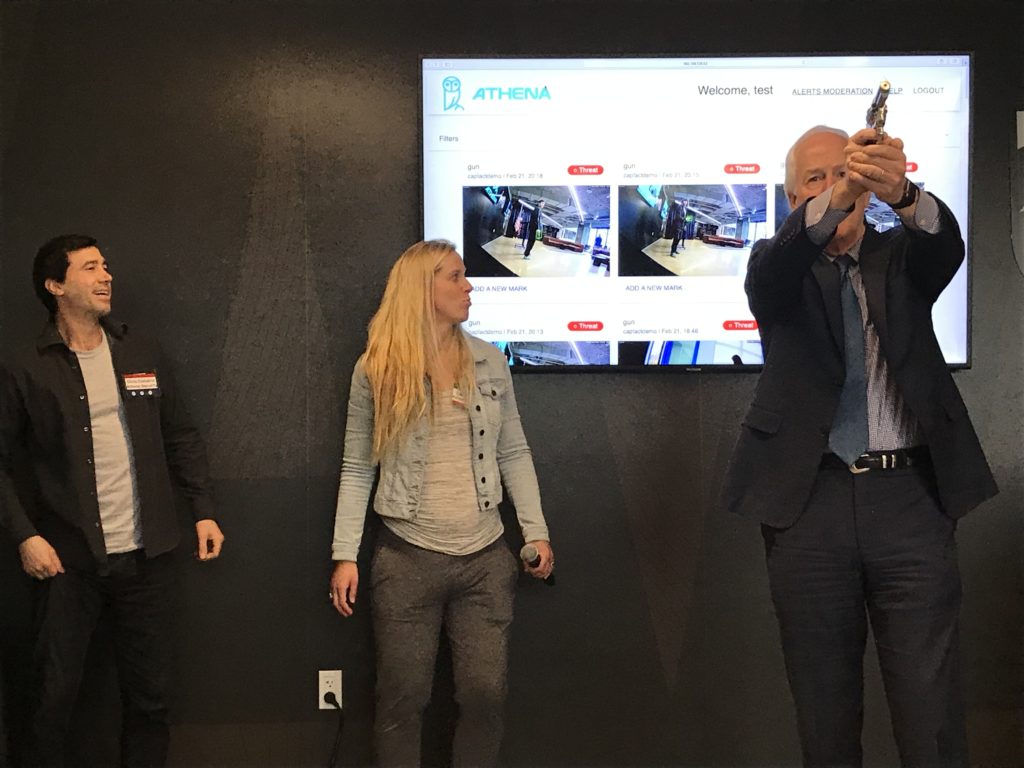
The founders of Athena Security demonstrating its gun detection technology with Sen. John Cornyn at the official opening of the Defense Innovation Center at Capital Factory

By LAURA LOREK Publisher of Silicon Hills News

Athena Security showed off its gun detection system at the official opening of the Defense Innovation Center Thursday at Capital Factory.

The startup uses existing security cameras coupled with its specialized software that relies on machine learning and artificial intelligence to identify guns in a public setting.

For example, if a person pulled out a pistol or an automatic rifle at a school or church, the system would immediately send an alert to law enforcement officials.

Sen. John Cornyn tested the system by pointing a handgun, which Athena supplied, toward the ceiling during a live demonstration of the technology Thursday afternoon.

Cameras captured the moment and flagged the handgun with a green square on a picture that flashed on a big screen immediately.

Athena Security, which moved to Austin recently, is run by Lisa Falzone, CEO and Chris Ciabarra, Chief Technology Officer. Their goal is to prevent a crime from occurring by identifying a shooter early on through their sophisticated artificial intelligence platform.

Athena is one of the startups that could potentially work with the military at its new Center for Defense Innovation at Capital Factory, on the eighth floor of the Omni Building in downtown Austin. The center had its official grand opening on Thursday afternoon with hundreds of people in attendance including dignitaries from local, state and federal government. They included Sen. Cornyn, Texas Speaker of the House Dennis Bonnen and Gen. John M. Murray, head of the U.S. Army Futures Command Center, based in Austin.

The Center for Defense Innovation has space for Army Futures Command, AFWERX, Defense Innovation Unit, the National Geospatial-Intelligence Agency and a team from Booz Allen Hamilton, a military contractor. Capital Factory is a co-working and technology accelerator in downtown Austin that is home to hundreds of startups and entrepreneurs. It also has a branch in Dallas and puts on programs geared to entrepreneurs.

Joshua Baer, CEO and Founder of Capital Factory, welcoming everyone to the official opending of the Defense Innovatin Center

“Capital Factory is the center of gravity for entrepreneurs working in Texas,” said Joshua Baer, its founder and CEO. “This is the place where entrepreneurs and innovators of all kinds come together to collaborate and build a better future using technology.”

Now with this new floor, Capital Factory is a new center of gravity of defense innovation, Baer said.

“This was not our idea,” Baer said. “We didn’t ask DIU, the Air Force or the Army to come here. They came to us.”

The entire Texas ecosystem, including San Antonio, came together to welcome the Army Futures Command to Austin, Baer said. Austin competed with more than 140 cities for the command which is based at UT and employs 500 U.S. Army personnel and civilians.

Another thing that makes the Center for Defense Innovation at Capital Factory unique is that it isn’t in a secure facility, Baer said.

“This is a place for collaboration, not for secrets,” he said. “Serendipity is an essential ingredient for innovation and it’s hard to have serendipity behind barb wire. And that’s why they came here.”

Sen. Cornyn said people don’t really think of the federal government and innovation together. In fact, the federal government is often thought of as antithetical to innovation, he said.

“So, I’m really excited to see the cross-cutting collaboration taking place here,” Cornyn said. “And I think it will help us be stronger, be better and be better stewards of the taxpayer dollar.”

The Center for Innovation tears down silos and forges a path into the future for military readiness, he said.

The Army Futures Command chose to come to Austin because it’s the best petri dish of innovation in Texas, Cornyn said. It is already home to hundreds of technology startups and the University of Texas which has one of the top ranked engineering schools in the nation, he said. UT also specializes in robotics, artificial intelligence, machine learning, augmented and virtual reality and other technologies the military needs, he said.

“When it comes to equipping our military with the best resources and technology possible, we have to think outside the box and that’s what the Army Futures Command is all about,” Cornyn said. “And I can’t think of better place for that ingenuity than Austin, Texas.”

The military and Texas have a 150-year history and strong bonds, said Texas House Speaker Bonnen. Texas provides the military with more than 174,000 members, more than any other state after California. The state is also home to 15 active military installations with a $100 billion economic impact, Bonnen said.

Austin is home to 6,500 tech companies, 36 incubators and tens of thousands of students and veterans, Bonnen said.


Gen. John M. Murray, head of the U.S. Army Futures Command Center, based in Austin.

The Army Futures Command is the largest reorganization of the Army since 1973, said Gen. Murray. The first part of a problem is addressing that there is a problem, and the Army has failed at modernizing its forces for the past 30 years, Gen. Murray said.

No one in uniform wants to fight another war, Gen. Murray said. They want to deter war and the way to do that is through strong defense and innovation, he said.

The center has great potential in allowing the U.S. Army to accomplish its mission to make sure soldiers have the tools they need, Gen. Murray said.

Wall mural at the new Defense Innovation Center

In a press conference, Gen. Murray said he knows there is interest from other companies in the defense industry to establish some presence inside Capital Factory. He doesn’t know how many companies will move here. That wasn’t the intention of the Army Future Command, he said. It wanted to be close to where innovation was happening and to work with existing startups to help it solve problems, he said.

In addition to Athena Technologies, Senseye also gave a demonstration of its lie detector technology at the event. Senseye, a four-year-old tech startup which moved from Los Angeles to Austin, has already worked with the U.S. Air Force to help train fighter pilots.

Aside from all the startup activity, defense contractors show up at Capital Factory daily since the Army Futures Command picked Austin, Baer said.

To get an idea of what might happen in Austin, look at Crystal City in the Washington, D.C. area, which has the nation’s largest concentration of military contractors because of the Pentagon, Sen. Cornyn said.

Already, Booz Allen Hamilton, a military contractor, plans to double its presence at Capital Factory. It currently has 35 employees and plans to have 70 within a year, said Karen Dahut, executive vice president at Booz Allen Hamilton, who leads its global defense business.

Booz Allen has been at Capital Factory for more than four years. It has worked with “creative director Mike Wikan and his Austin-based team to create Tabletop Commander, a virtual tabletop that uses immersive technology and artificial intelligence powered natural language processing to help the Air Force run virtual reality exercises,” according to news release.

Other products include Project Jellyfish, CodeLift and DataLift, to help the federal government collaborate more effectively with commercial clients, Dahut said.

The lockers at Capital Factory look a bit different since the military moved in

Austin Needs More Black People in Every Area of the Technology Industry

By LAURA LOREK,
Publisher of Silicon Hills News


The median net worth of a black family in the United States is projected to reach zero by 2053.

Today, the net worth of a black family is about $17,000, said Rodney Sampson, co-founder, and CEO of Opportunity Hub. While white wealth will continue to grow, black families’ wealth is on the decline, he said. The data comes from a Federal Reserve report released in September of 2017.

That’s why it’s critical to provide opportunities for black people in the technology industry, Sampson said.

Automation, artificial intelligence, machine learning, quantum computing, gig economy and what’s being called the fourth industrial revolution will shake up the workforce and leave a lot of people out of jobs, Sampson said. That’s why black people must obtain software development, technical sales, analytical and critical thinking skills for the new economy, he said.

“We’re not talking about grit,” Sampson said. “We’ve had grit for 400 years. Don’t assess black grit, please. It’s an insult. Poor people got grit, immigrants got grit. That’s not a challenge. But that is a skill set of the future that should be commoditized as our unfair advantage in the tech ecosystem.”

Sampson kicked off the Black in Tech Summit at Capital Factory in Austin on Wednesday.

Sampson’s organization, Opportunity Hub, based in Atlanta, focuses on reducing poverty and the racial wealth gap by ensuring people of color and people from socially disadvantaged communities are equitably included.

“Equity is the key word,” Sampson said. “Equity ensures that we are all equitably positioned from the cap tables to the conference rooms – all the way across at every level.”

The startup ecosystem, particularly in tech, is still having surface level discussions about inclusion and representation, Sampson said.

“I’m seeing the wealth on our cap tables continuing to escape our communities,” he said. “We’ve got to do something about it.”

Top priority is to get the word out about the fourth industrial revolution and the future of work, and the disruption technology is going to have on today’s workforce, Sampson said.

Imagine bus and truck drivers who make a good salary today. In the future, autonomous vehicles will do those jobs. Think about the fast food industry or retail industry, robots will replace cooks in the kitchen and at the counter or checkout. This is already happening in communities worldwide.

To deal with the changes, every year, Austin’s institutions must create 100 black engineers, Sampson said. There must be a density of talent here, he said.

“I don’t see in any city nationwide the density of diverse talent,” he said.

Next, Austin needs people of color who are focused on solving problems, Sampson said.

“Entrepreneurs solve hard problems that people are willing to pay for,” he said.

Also, train parents in technical skills, Sampson said. If the parent is going to learn to code, the children are going to learn to code, he said.

Austin needs to build out every part of the ecosystem from the pre-accelerator to the investment fund, Sampson said. It’s not about creating one or two positions but having a huge number of diverse talent involved in the technology industry. That creates synergy, he said. Also, it’s important to have allies in the white community to advance in the mainstream, Sampson said.

“We can’t drive people away,” he said. “We have to have the hard conversations.”

That was part of the focus of Austin’s inaugural Black in Tech Summit. It provided a lay of the land of what is possible and what needs to be done, said Preston James, co-founder, and CEO of DivInc.

 “It’s possible, and we’re making it happen,” James said.

DivInc, an early stage accelerator for women and people of color, has accelerated 36 companies of which 75 percent are still active and they have collectively raised more than $4 million, James said. DivInc provides resources to forge a pathway for underrepresented entrepreneurs, he said..

“We want to create a mindset shift within the startup ecosystem,” James said.

If young people see entrepreneurs, investors and mentors that look like them, they know what is possible, James said.

The day-long Black in Tech Summit at Capital Factory featured panels, workshops and keynote speeches on a variety of topics including fundraising, building a business, legal issues, and best practices for hiring. Capital Factory and DivInc put on the event. More than 500 people registered for the event.

DivInc Partners with Notley Ventures

DivInc, the Austin-based early stage accelerator for women and people of color, on Thursday announced it is partnering with Notley Ventures.

In addition, Notley is making a major philanthropic investment in DivInc.

“This transformative gift provides us with the resources to grow out capacity and capability, expand our accelerator programming and scale our community impact,” James Preston, co-founder and CEO of DivInc, wrote in a blog post.

The partnership means DivInc will move its operations to Notley’s Center for Social Innovation. And Dan Graham, co-founder of Notley Ventures, will join DivInc’s board. DivInc will also be able to use Notley’s services which include marketing, fundraising, finance, and operations.

Dan and Lisa Graham founded Notley Ventures in 2015. Dan Graham formerly co-founded BuildASign.com. Notley Ventures is creating a national social innovation ecosystem.

DivInc, founded two years ago, has had four cohorts with 36 companies including Lamik Beauty, JuiceBox Hero, and Reavlix. DivInc’s mission is to empower and enable founders of color and women to build highly scalable startups through its 12-week accelerator.

DivInc solves the challenges of access to opportunities, James said during a talk Wednesday at the Black in Tech Summit at Capital Factory.

“To remove the barriers,” he said.

To date, 75 percent of the companies that have gone through the DivInc accelerator are still active and they have collectively raised more than $4 million, James said. DivInc provides resources to forge a pathway for underrepresented entrepreneurs, he said.

At Notley Veures, DivInc will be joining other Notley partner programs including Women@Austin, Student Inc, as well as Huston-Tillotson University’s Entrepreneurship Center.

The playing field isn’t level for women and people of color, who face persistent barriers to building ventures, especially in technology, according to a post on Notley’s website announcing the partnership.

“For example, of more than 6 million companies owned by African Americans and Hispanics, more than 90 percent are sole proprietors,” according to Notley’s blog post. “Meanwhile, only 78 percent of non-minority owned companies are sole proprietors.”

“If African American and Hispanic entrepreneurs were to achieve parity by building scalable, high growth businesses, it is estimated they would generate 5.9 million new jobs and $871 billion in revenue for the U.S. economy,” according to Notley.

On March 1, DivInc and Notley are hosting the “Oscars of Diversity and Inclusion” in Austin with an inaugural event called Champions of Change, according to Josh Jones-Dilworth, who serves as chairman of the board for DivInc. A limited number of tickets are still available to attend the event which will honor executive of the year, diversity and inclusion leader of the year, program of the year, champion of the year, investor of the year, rising star of the year and nonprofit leader of the year.

Founder Institute Austin Graduates Six Startups

Brett Hurt, founder of Data.World, giving the keynote address at Founder Institute Austin graduation

By LAURA LOREK
Publisher of Silicon Hills News

The Founder Institute opened in Austin a little over a year ago and has already graduated three classes and helped dozens of entrepreneurs.

Martin Martinez, managing director, joined with fellow directors Elisa Sepulveda and Paul O’Brien to launch Founder Institute Austin.

They thought Austin needed more founders and they wanted to provide them with a jumpstart on their entrepreneurial journey, Martinez said. The program, which lasts four months and provides information on how to start and scale a company, takes place at Galvanize, which is a sponsor.

“We do this because we believe in this,” Martinez said.

Founder Institute is a global organization with the mission of teaching entrepreneurs how to succeed. At the event, Martinez recognized the mentors and guest speakers that helped the entrepreneurs throughout the process.

On Thursday night, six founders graduated from the program’s third cohort during a special event at the Native Hostel. For the latest session, Founder Institute Austin received 91 applications of which 52 were accepted and 24 enrolled and six made it all the way through, Martinez said.

Martinez also announced Founder Institute is branching out statewide and is accepting applications now for its Houston program which will kick off this Spring.

The graduation event featured a keynote talk from Austin Serial Entrepreneur Brett Hurt, founder of Data.World.

Hurt kicked off his talk by reading Theodore Roosevelt’s “Man in the Arena” quote.

“It is not the critic who counts; not the man who points out how the strong man stumbles, or where the doer of deeds could have done them better. The credit belongs to the man who is actually in the arena, whose face is marred by dust and sweat and blood; who strives valiantly; who errs, who comes short again and again, because there is no effort without error and shortcoming; but who does actually strive to do the deeds; who knows great enthusiasms, the great devotions; who spends himself in a worthy cause; who at the best knows in the end the triumph of high achievement, and who at the worst, if he fails, at least fails while daring greatly, so that his place shall never be with those cold and timid souls who neither know victory nor defeat.”

“This is what entrepreneurship is,” Hurt said.

Hurt, who grew up in Austin, has been an entrepreneur since the age of 24. He started programming at age seven. And he credits his mom who bought him a computer at seven for encouraging his interests in programming. He grew up with movies like Revenge of the Nerds and Weird Science.

“Growing up that way I got picked on a lot,” Hurt said.

His mom deflected the criticism from teachers and relatives and encouraged Hurt to pursue his passion of programming.

Hurt founded BazaarVoice in Austin and took the company public. And before that he founded Coremetrics, a web analytics and digital marketing company. Other ventures included an online MBA community and then a sports nutrition online startup. He is now on his sixth venture, Data.World, a public benefit corporation focused on building the platform for data sharing. He has also invested in 62 startups and 19 venture capital funds.

It’s way easier to go to work for an existing company like IBM, Dell, Oracle, Google or Facebook, Hurt said. It takes persistence and dedication to pursue entrepreneurship and it’s not an easy path, Hurt said.

“It feels like a unicorn without a horn,” Hurt said.

That’s a nod to the book his daughter, Rachel, 13, wrote. It’s called Guardians of the Forest, for children ages 6-14, about a unicorn, friendship. self-discovery and happiness. Unicorn illustrations from the book provided the backdrop slides for Hurt’s talk.

Data.World is now three years old and has become the world’s largest collaborative community for data sharing, Hurt said.

“We’re hiring like crazy,” Hurt said.

Entrepreneurship can have a ripple effect throughout a community, Hurt said. Ex-employees of BazaarVoice have gone on to found 42 companies, Hurt said.

He concluded his talk by wishing the best of success to Founder Institute Austin graduates.

Martinez, Sepulveda and O’Brien with the Founder Institute Austin then awarded graduation certificates to each of its founders. The following is a brief description of each venture:

Prowess Project – founded by Ashley Connell. The startup is an online marketplace of fractional employees. It finds educated and skilled employees and certifies them in project facilitation. It works with moms with MBAs who have left the workforce to raise a family. It then matches them to companies looking for help.

ISAJI Technologies – co-founded by Baba Nureni Yusuf. The Houston-based startup addresses the problem of out of stock items for retailers. It has created ItemSensor as a retail inventory tracking technology to help reduce out of stock items. It’s in pilot projects right now, Yusuf said.

A Mana Project – founded by Gina Morales. The project is looking to bring Science, Technology, Engineering and Math, known as STEM, resources to young children of the world. It is currently in product development. Morales is the founder of Austin STEM Academy, a STEM pre-school.

Bearable -founded by Harini Bhamidiapati. The startup provides a gamified app for chronically ill patients to improve their fitness and lifestyle. They plan to collaborate with doctors, hospitals on the app. She has two pilots in the works focused on lupus and chronic pain.

Innerwork – founded by Jonathan Aird. The startup created a fitness app for mental health. It helps people establish healthy daily habits that will bring happiness.

Check – founded by Michael Odiare. The Dallas-based startup is modernizing traffic stops. One of the leading causes of death for law enforcement is during a traffic stop. It’s also the cause of many deaths of unarmed motorists. He came up with the app after he was pulled over for having a missing front license plate and found himself staring down the barrel of a gun. He did 40 ride alongs with police officers to understand the problems of traffic stops. His app for law enforcement and motorists can initiate better communication during a traffic stop. It’s like Facetime for a traffic stop, Odiare said.

Founder Institute graduating cohort number three, photo courtesy of A Player Media, by photographer Nicole Eaton

Paradromics Moved from Silicon Valley to Austin and is Creating a Brain Modem

By LAURA LOREK
Publisher of Silicon Hills News

Imagine a nickel-sized device implanted in the brain to help treat chronic and severe mental disorders like schizophrenia, which affect how a person thinks, feels and behaves.

It’s not science fiction but a real device that is being developed in Austin.

The medical device is the brainchild of Paradromics, a pioneering startup developing a “modem for the brain.” And it recently moved its operations, staffed with 24 employees, many with PhDs, from San Jose, California to Austin.

“We are creating an implantable device that exchanges data between a brain and a computer,” said Matt Angle, Paradromics’ Founder and CEO.

With Paradromics’ technology, a lot of medical problems can be reframed as data problems,  Angle said. For example, a person who is blind does not have visual data coming into the brain, he said. Paradromics’ neuro-prosthetic device uses ultra-high broadband communication links with the brain with the goal of restoring lost functionality like eyesight.


Matt Angle, Paradromics’ Founder, and CEO

Angle began working on Paradromics core technology while doing post-graduate work at Stanford University. He previously received his bachelor’s degree in biology from Carnegie Mellon University and his PhD from the Max Planck Institute for Medical Research at the University of Heidelberg in Germany.

While at Stanford, Angle studied and developed neural recording technologies and he and his collaborators invented a new, powerful way of interfacing with the brain. He founded Paradromics three years ago to take his device to market. And since then, Paradromics has raised $7 million in funding from Venture Capital firms and received an $18 million grant from the U.S. Department of Defense Advanced Research Projects Agency.

Paradromics’ device is currently in preclinical development. It expects to enter human clinical trials in 2021 or 2022, Angle said. Before it becomes available to all patients, it must undergo the rigorous process of Food and Drug Administration approval, and the company anticipates that path should take four to seven years.

Eventually, Paradromics’ technology could potentially help with treating diseases like ALS which is a progressive neurodegenerative disease or addiction, and related mental illness disrupting a massive $100 billion pharmaceutical industry.

For ALS patients, Paradromics’ device would restore the person’s ability to communicate through recording data from parts of the brain and transmitting it, thus allowing a person to type at the speed of thought or even to speak.

That kind of big thinking and tackling of huge problems led the Wall Street Journal in January to name Paradromics as one of a handful of companies developing the next big thing in technology akin to changing everyone’s life like the smartphone. Magic Leap, a company with an Austin-based research and development lab, also made the list.

“Everyone appreciates the technology we’re building,” Angle said. Paradromics is essentially pioneering a new industry in Austin. It left Silicon Valley for the Silicon Hills because Austin has smart people and it is way cheaper to operate here and it’s a great place to live and it has an innovative culture.

 “A large part is the quality of life,” Angle said. “Austin has a lot of the things the Bay area has to offer, but for a fraction of the price.”

Austin has talented people and great universities like the University of Texas, Texas A&M. It also has a good startup ecosystem and good technical talent. And the cost of living is much lower. Getting high quality employees to work on a startup is much easier in Austin with lower housing prices than Silicon Valley.

“People basically come from all over the world to work with us,” Angle said. “The mission really resonates with people. We are working with a team of people that care about this.”

“There are no downsides to Austin,” Angle said. Except maybe traffic on Mopac as the company is headquartered in the Arboretum area.

Paradromics’ data come in the form of recording neural activity. Its system can harvest 30 Gigabytes per second of data

“It’s a really interesting time to be alive,”, Angle says. Delivering data as medicine will be the century’s next great leap in healthcare.

Other startups working on neuro implants include Neuralink, a company that is supported by Elon Musk. Based in San Francisco, the company is “developing ultra-high bandwidth brain-machine interfaces to connect humans and computers,” according to its website.

The tremendous advances in computing power, speed, and size have made it possible for Paradromics to do its research and development. It’s the beneficiary of Moore’s Law which states that the number of transistors on integrated circuits doubles every 18 months.

On one side, Paradromics’ nickel-sized device, the Neural Input-Output Bus, called NIOB, looks like a hairbrush with about 50,000 microwires that is modular, allowing for recording and stimulating up to 1 million neurons. The current state of the art in brain-machine interfaces (The Utah Array) records from approximately 100 neurons. The Utah Array is a neural prosthetic from Blackrock Microsystems, based in Salt Lake City, Utah.

“Everything that we do outside of the body is just turn key engineering,” Angle said.

On the software side, Paradromics is using machine learning algorithms that were invented by other companies and other academic groups for the kinds of things Facebook and Google use them for.

“We can happily adapt those tools and use them for our own purposes,” Angle said.

The same machine learning that allows people to recognize pictures of cats on the Internet, can be deployed by Paradromics to provide data to the brain. Eventually Paradromics technology will allow doctors to restore brain functions for people suffering from schizophrenia.

“It’s not today but it will definitely be happening sooner than you’d think,” Angle said.

And Paradromics goal is to work with payers or insurance companies, healthcare providers and Medicaid to make sure people can get the device and that they don’t have to pay huge sums of money out of pocket.

“For us to win, it has to be a device that can be reimbursed through insurance,” Angle said. Like how being prescribed a cochlear implant or pacemaker works today.

A team at Paradromics takes ethics very seriously and is working on an ethical statement about how the technology can be used, according to a company spokesman. It expects to publish that statement in the next few months on their website, he said.

Silicon Hills News Unveils the Companies Featured in its 2019 Austin Tech Startup Calendar

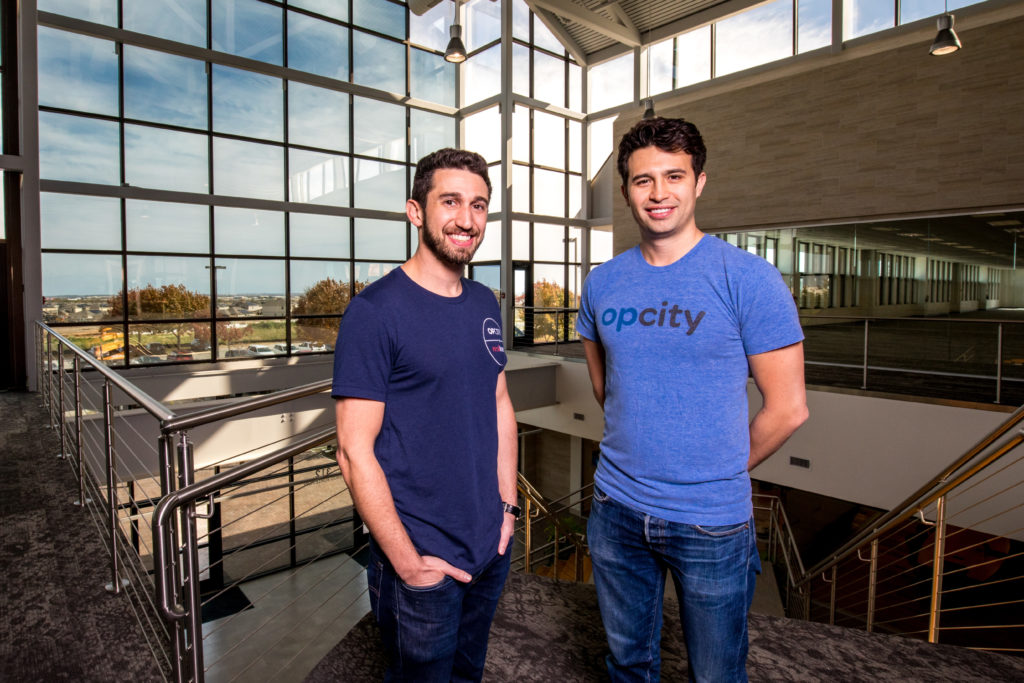
Ben Rubenstein and Michael Lam, co-founders of Opcity, featured in the Silicon Hills News 2019 Austin Tech Calendar, photo by Errich Petersen

Silicon Hills News’ 2019 Austin Tech Calendar Party took place on January 24th at Opcity in Austin.

At the party, Silicon Hills News gave away a desktop or wall calendar to 175 guests. To order additional calendars please visit our Eventbrite form for our lunch and learn event on February 24th. You don’t have to attend the event to buy a calendar. Silicon Hills News will deliver it to you. But everyone attending gets a desktop calendar.

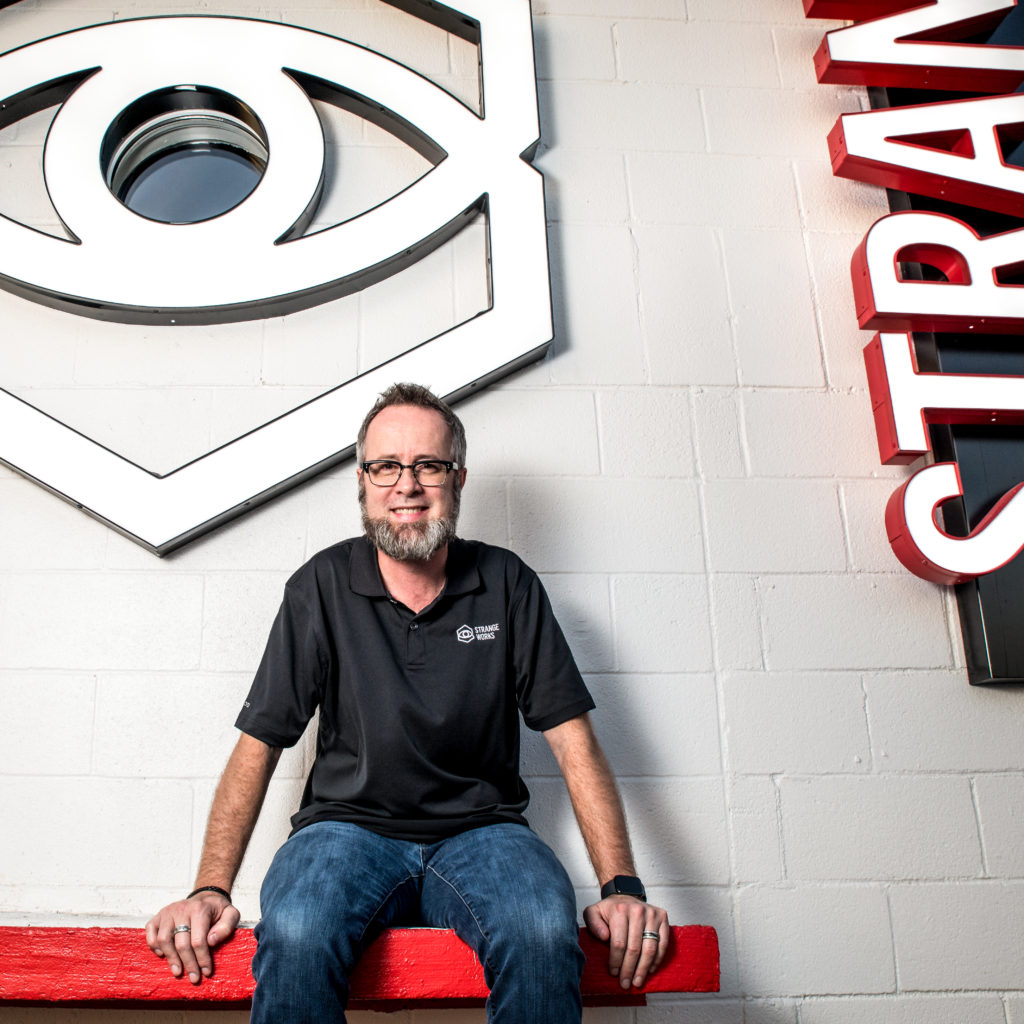
William Hurley, also known as Whurley, founder and CEO of Strangeworks and cover guy for Silicon Hills News’ 2019 Austin Tech Calendar, photo by Errich Petersen

This is the fifth time Silicon Hills News’ has created a tech calendar shining a spotlight on Austin’s most innovative startups and technology advocates. The event honored the following 2019 calendar subjects:

Rocket Dollar: Henry Yoshida, Rodney Martinez, Thomas Young, Rick Dude, Dan Kryzanowski, Chris Palmisano, BackRow: Colton Lowry, Nikacia Shear,
Ryan Martinez and Krista Goralczyk. Photo by Stephen Olker

January: Rocket Dollar 

February: Hypergiant: Ben Lamm, John Fremont and
Will Womble, co-founders of Hypergiant, Photo by John Davidson

March: Strangeworks: David Cardona, William Hurley, Justin Youens, Co-founders of Strangeworks

April:  Female Founders: Laurie Felker Jones, Heather Wan, Adrianna Cantu, Alex Porter, Leah Cohen, Tarica Navarro, Angela Hein, Sherry Shamrock and Lav Chintapalli

May: Mark Phillip, Founder of Are You Watching This?

June: Madhu Basu, Founder Unnanu

July: Smarter Sorting Team

August: Sherry Shamrock  Founder and CEO of FIT 2 CHEER, Adrianna Cantu, Co-founder & CEO of Revealix, Tarica Navarro, founder of Kinn Home, and Lav Chintapalli, Founder of Alcye & Pathway Power and Alex Porter, co-founder of Underminer Studios.

September: Sean Spector, CEO and Co-founder Dropoff

October: Nathan Hackley and Will Young, Co-founders of Sana Benefits

November:   Ben Rubenstein and Michael Lam, Co-founders of Opcity

December: OwnLocal: Lloyd Armbrust and Jason Novek, Co-Founders of OwnLocal

SHN2019AustinTechCalendarPartyRecap

A recap from Silicon Hills News’ 2019 Austin Tech Calendar Party at Opcity.

Egan Nelson and Silicon Hills Lawyer and Swyft sponsored the food: appetizers from Mama Fu’s Asian House.

Entertainment sponsors included PythonTek,, Justworks, Chastain Partners.

Drink Sponsors included Lumen Insurance Technologies and Active Capital.

And a big thank you to our host and venue sponsor: Opcity.

Other sponsors included Tito’s Handmade Vodka, 512 Tequila, Shade Tree Lemonade.

The event featured entertainment by Adam Lazoya, the Travelling Pianist, and Scott Andrew James, the Typewriter Poet.

Silicon Hills News 2019 Austin Tech Startups Calendar

Austin-based startups featured in the 2019 Austin Tech Calendar produced by Silicon Hills News

San Antonio-based Active Capital Raises $21.5 Million VC Fund

Pat Matthews, CEO and Founder of Active Capital, courtesy photo

Active Capital, a San Antonio-based venture capital firm, announced it has raised a $21.5 million fund focused on providing seed stage funding to business to business software companies.

Originally, Pat Matthews, Active Capital’s founder and CEO, set out to raise a $15 million fund, but it was oversubscribed.

“We closed on the fund Dec. 31st and we’ve made 20 investments so far, really all over the country,” Matthews said.

Active Capital is 100 percent focused on leading seed rounds for business to business, software as a service companies, known as B2B SaaS companies, Matthews said.

In Austin, Active Capital has invested in Pingboard, Servable, Living Security, CloudSnap, and Prosper Ops. And in San Antonio, Active Capital has invested in FunnelAI and SendSpark. Its other investments span from coast to coast and include Agave in San Francisco and PhoneWagon in New York.

“B2B SaaS is the kind of business I’ve been building my whole life,” Matthews said. “I stopped doing stuff outside of my expertise.”

Matthews, a former Rackspace executive, knows the pains entrepreneurs face early on in founding a company. He was a co-founder of Webmail.us, which sold to Rackspace in 2007. He has also invested as an angel investor in more than 50 startup companies.

Matthews is passionate about working with entrepreneurs who are building amazing businesses.

“For the companies we’re investing in it allows them to have one major investor in the seed stage round – as opposed to 15 or 20 investors to put together over time,” Matthews said.

“Pat is one of the rare founders that has built a successful company from scratch, had a great exit, and then had equal success as an executive in a large, fast-growing company,” Graham Weston, co-founder and former chairman of Rackspace, and an investor in Active Capital, said in a news release.  “Pat has a unique ability to relate to founders and really knows how to leverage his experiences to help them through the process of building a great company.  He really has a lot to offer today’s entrepreneur.”

“I’ve been working with Pat since I invested in Webmail in 2005,” Pat Condon, co-founder of Rackspace, board partner and investor in Active Capital, said in a news release. “Pat has an amazing way of connecting with entrepreneurs and I enjoy collaborating with him and the founders we invest in.”

In 1999, Matthews along with Bill Boebel and Kevin Minnick, founded FieldParty.com, which created searchable city event directories. They dropped out of Virginia Tech University just 20 hours short of getting their degrees to work on the business full time. FieldParty.com raised $120,000 in angel money, largely from friends and family, and on March 10, 2000, the website launched – the same day the Nasdaq started crashing when the great Dot Com bubble burst.

They pivoted the business from a dot com to a B2B SaaS company. It was very tough time for the Internet economy overall and for the company, Matthews said.

“I sold books door to door in Southwest Virginia,” Matthews said. “I worked in many different sales jobs.”

Matthews also had to figure out how to manage $100,000 each in credit card debt.

“It really has shaped a lot of what I do today,” Matthews said. “I’m attracted to companies that are capital disciplined. Companies that have made a lot of progress on very little capital. Founders who have got product to market and have generated revenue and raised little capital to date. They are only raising money relative to the size of the opportunity in front of them.”

Matthews’ journey buys him a lot of credibility with founders, he said.

“It allows me to give them tough feedback when needed,” Matthews said.

“I want to use my experience to help them where I can. I really want to invest in great founders and inspiring founders that are building great companies,” Matthews said. “The right investors and the right advisors can really help founders not screw up the company along the way.”

Editor’s note: Active Capital was one of the sponsors of the Silicon Hills News’ recent 2019 Austin Calendar Party and Silicon Hills News is hosting a lunch and learn in Austin with Chris Saum of Active Capital later this month.

Cirrus Logic and Ten Other Austin Companies Make the 2019 Best Workplaces for Commuters List

Cirrus Logic Shuttle, courtesy photo

It’s no secret that driving in Austin, especially for downtown workers, has become one of the biggest aggravations about working or living in the city.

Austin ranked 14th among the most congested cities in the U.S. in 2017 with commuters spending 11 percent of their driving time in congestion, according to a study last year by INRIX, a global transportation research institute. That translates to 43 peak hours spent in traffic congestion in 2017.

But Cirrus Logic and some other Austin-based companies have taken measures to make the commute easier for their employees and they are being recognized for it.

Cirrus Logic is among a select group of U.S. companies named to the 2019 Best Workplaces for Commuters list by the Center for Urban Transportation Research.  Cirrus and the others earned the honor by offering alternative ways to get to work besides driving to employees. Other Austin companies on the list include Athena Health, Car2Go, Google, IBM, Merck & Company, Silicon Labs, Texas Mutual Insurance Co, the Thrival Company, University Federal Credit Union and Whole Foods.

 “We’re really excited to be recognized as a Best Workplace for Commuters,” said Jo-Dee Benson, vice president and chief culture officer at Cirrus Logic.

About 20 percent of Cirrus Logic’s 800 employees use the alternative transportation options on a regular basis, she said.

Cirrus Logic moved from the Westlake area in 2012 to its downtown headquarters. To ease the burden of the commute for its workers, Cirrus Logic designed a “suite” of transportation alternatives, Benson said.

One of the moves Cirrus made was to set up a network of private Wi-Fi enabled “park and ride” shuttles. It operates a morning and afternoon Orange Line for employees in South Austin and a Green Line for those in North Austin. A third shuttle, the Blue Line operates throughout the day downtown and transports employees between the company’s offices and Capital Metro downtown train station and bus stops.

Other transporation benefits at Cirrus include:

  • 100 percent employee expense reimbursement for Cap Metro passes, whether bus or train.
  • Bike lockers, free bi-annual bicycle repair service and locker rooms with showers to promote a bike-friendly commute culture. The company was also a founding sponsor of Austin B-Cycle.
  • Support for electric vehicles through onsite charging stations.
  • Promoting a safer, enhanced downtown urban trail network as a major corporate sponsor of the Shoal Creek Conservancy and with financial contributions to the Austin Trail Foundation, for projects such as the Boardwalk installation along Lady Bird Lake and renovations to Vic Mathias Auditorium Shores.

Cirrus Logic is also a member of Movability Austin, which focuses on transportation solutions for Austin. The City of Austin also made the Best Workplace for Commuters list. In Texas, the only government agencies or cities to make the list were from Austin and San Antonio with the Alamo Area Metropolitan Planning Organization. Other Austin agencies included Capital Area Metropolitan Planning Organization, Capital Metropolitan Transportation Authority, Downtown Austin Alliance and Travis County.

RigUp Raises $60 Million in Additional Funding

Austin-based RigUp announced it has raised $60 million in funding.

The company, founded in 2014 as an online marketplace for services and labor for the energy industry, has raised $123.8 million in funding to date. Founders Fund, based in San Francisco, led the Series C funding round with participation from existing investors Quantum Energy Partners, Global Reserve Group, and Bedrock Capital .

RigUp plans to use the money for product development.

“We’re preparing to rapidly expand our products and services in response to a fast-growing customer base,” CEO and co-founder Xuan Yong said in a news release. “When we started in 2014, we knew there was a huge opportunity for modernization in the industry, and we’re proud of the impact we’ve had in five years. With this round of funding, we’re positioned to see that impact grow exponentially.”

The company has created an online digital platform for oilfield services and personnel. RigUp expects about half of the oil and gas workforce to retire in the next five years. It has created the platform for pre-qualified contract oilfield workers to find a job quickly and easily.

RigUp estimates its platform can save companies time and money.

“RigUp is solving interesting process problems in a part of the energy industry that hasn’t always been quick to adopt new technology. The platform has quickly gained traction in the market, and we feel that they’re well positioned for continued growth,” Napoleon Ta, Partner at Founders Fund said in a news release.

« Older posts Newer posts »

© 2026 SiliconHills

Theme by Anders Noren — Up ↑