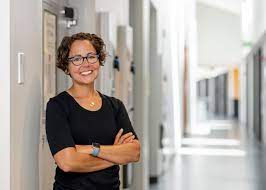
Shapiro’s joining Colossal full-time will help the company meet its de-extinction and species preservation goals.
Shapiro, an internationally renowned evolutionary molecular biologist, is a leader in paleogenomics and ancient DNA and will oversee the continued expansion of the company’s de-extinction and conservation science teams. She is also a MacArthur “Genius Grant” Award winner and National Geographic Explorer.
“Our efforts to apply our de-extinction technologies to help save critically endangered species is just as important to us as bringing back the iconic mammoth, thylacine, and dodo,” said Ben Lamm, Co-Founder and CEO of Colossal.
Lamm founded Colossal Biosciences in 2021 with George Church, a Harvard geneticist and pioneer in personal genomics and synthetic biology. Today, Colossal has 128 employees, more than 30 funded postdocs in major academic labs, and 60 advisory board members. The company is based in Dallas but has offices in Austin, Boston, Santa Cruz, California, and Melbourne, Australia.
Shapiro previously served as Howard Hughes Medical Institute Investigator, Professor of Ecology and Evolutionary Biology, and lead of the Paleogenomics Lab at the University of California, Santa Cruz. Lamm said she will continue to work out of Santa Cruz and travel to Colossal’s other labs and offices as needed.
“Beth and I have developed an incredible relationship over the past few years. I’m extremely impressed by her intellect, drive, and the rigor of her scientific research,” Lamm said in a news release. “I know she will continue to push our scientific research programs further and is the best fit for the role. It’s a dream to work so closely with Beth, and I know our species leads feel the same.”
“I’ve been an advisor to Colossal since just after the company launched and am excited now to step in full-time to support the team’s groundbreaking work,” Shapiro said in a news release. “It’s thrilling to see the research we’ve been doing in the labs not only seeing the light of day but being applied to science that will positively impact the planet.”
As an advisor to Colossal for the past two years, Shapiro helped launch the company’s Dodo and Avian Genomics Group. She also developed, along with Colossal team members, the international scientific advisory board. And she served as the lead paleogeneticist. In that role, she secured samples and generated DNA data that Colossal uses as part of all species groups.
“I have worked with Beth for over 20 years and am continually impressed by her contributions to the field of paleogenetics. I cannot be more excited about Beth joining Colossal, as this will not only help accelerate Colossal’s de-extinction efforts but will also provide an even more direct link between my ancient mammoth research and Eriona’s and George’s teams. I look forward to continuing our collaboration with Colossal to refine our target list of which genes make mammoths unique compared to other elephant lineages,” Dalen, Professor of Evolutionary Genetics at the Swedish Museum of Natural History, one of the research leaders at the Center for Palaeogenetics in Stockholm, and leading Woolly Mammoth expert, said in a news release.
Apollo, a humanoid robot designed and made in Austin, will soon assist in Mercedes-Benz’s manufacturing line.
Apptronik, which makes Apollo, signed a deal with Mercedes-Benz to provide its Apollo humanoid robots in logistics to bring parts to the production line for workers to assemble, according to a news release. Apollo will also deliver the totes of kitted parts later in manufacturing.
Apptronik’s Apollo humanoid robots can be used in Mercedes-Benz’s existing plants, so the carmaker can deploy them immediately without redesigning its plants. This allows the carmaker to automate some physically demanding, repetitive, and dull tasks for which it is increasingly hard to find reliable workers.
“When we set out to build Apollo, an agreement like the one we’re announcing today with Mercedes-Benz was a dream scenario,” Jeff Cardenas, Co-founder and CEO of Apollo, said in a news release. Mercedes plans to use robotics and Apollo to automate some low-skill, physically challenging, manual labor—a model use case that we’ll see other organizations replicate in the months and years.”
Apollo is a 5-foot, 8-inch-tall robot that weighs 160 pounds and can lift 55 pounds. It is built to operate alongside people in industrial spaces. According to the company, Apollo’s computing power allows leading AI companies to solve use cases outside the ones that Apptronik will initially solve.
“To build the most desirable cars, we continually evolve the future of automotive production. Advancements in robotics and AI have also opened up new opportunities for us. We are exploring new possibilities with the use of robotics to support our skilled workforce in manufacturing. This is a new frontier, and we want to understand the potential both for robotic and automotive manufacturing to fill labor gaps in areas such as low-skill, repetitive, and physically demanding work and to free up our highly skilled team members on the line to build the world’s most desirable cars,” Jorg Burzer, board member of Mercedes-Benz Group AG, production, quality, and supply chain management.
Apptronik, founded in 2016, spun out of the University of Texas’ Human Centered Robotics Lab. The company initially developed general-purpose robots for NASA.
Michael Dell sold stamps at auctions to make extra money as a kid.
At 16, he started driving his parents’ old station wagon to the Harris County courthouse to collect data on marriage licenses to target newlyweds and sell newspaper subscriptions. He then hired some of his high school buddies to check the filings in the surrounding counties and get more addresses.
“It worked really well,” Dell said.
It was the humble beginning of what would later become the global computer maker Dell Technologies, which reported revenues of $102 billion in 2023. Round Rock-based Dell is also one of Austin’s largest technology companies, with more than 14,000 local employees. According to the Bloomberg Billionaires Index, Dell has become the world’s 12th richest person, with a personal fortune of $104 billion.
At 19, Dell started his eponymous computer company in his freshman dorm at the University of Texas. He later dropped out. This year, the company turns 40 years old, and Dell, 59, spoke about his entrepreneurial journey during a fireside chat on Thursday at South by Southwest. The featured session: “Businesss, Life and the Magic of Austin: A Conversation with Michael Dell.”
Dell said he’s learned a lot throughout the years, especially how to build a team, surround himself with intelligent people, and keep learning
“I learned that integrity and reputation are the most valuable things, and it takes a long time to build them up, and it’s really easy to destroy them,” Dell said.
He said Dell’s success was due to its customer-focused approach. He learned from customers’ challenges, problems, opportunities, and unmet needs.
Dell said making mistakes, iterating, trying new things, and experimenting contributed to the company’s success.
Dell said he was fortunate to attract great people to sign up for Dell’s grand adventure, and Austin was a great place to attract people.
Today, Dell is the leader in infrastructure products and server storage, but its first couple of attempts at creating those products could have been more successful, Dell said. Dell had its version of Unix, and that turned out not to be a great idea. Dell also tried to get into the smartphone business, but that did not work. In his latest book, “Play Nice, But Win,” Dell recounts many failures and learnings, he said.
Dell said it’s OK to make mistakes but not repeat them; learn from them.
Dell said he remembered going to Japan a lot in the ’80s, and they were developing amazing things, but nobody needed them. Dell iterated into this idea of pragmatic innovation. The customer can’t consistently articulate what the future solution is, but they can usually articulate the pain or the problem they’re having and trying to solve, he said.
“But you have to be agile, flexible, and continually adaptive because you’re going to get it wrong. Just accept that, deal with it, and be able to change quickly and iterate,” Dell said.
Along the way, Dell Technologies went from a public company to a private one. At one point, people threatened to take the company away from Dell.
Going private was a way of liberating the company, reinvigorating the entrepreneurial spirit, and accelerating Dell’s transformation,” Dell said.
He said There were awkward moments when Dell was curious if he was supposed to go to the office or talk to the management team. The uncertainty inflicted on Dell’s team and its customers was painful, but Dell managed to get through that.
“Going private was a way of accelerating the transformation, and then a couple of years later, we got to the point where we were experiencing once again strong positive growth and momentum, and so returning to the public markets allowed us to simplify the capital structure and the ownership structure,” Dell said.
Dell said another part of Dell’s success is creating a good company culture that fosters innovation. The culture that allows Dell to develop great products, he said.
He said that bringing artificial intelligence to the enterprise is Dell’s enormous priority for the future.
“And it’s a big platform shift, and it’s just beginning,” he said.
Dell’s customers also want to bring AI to their data and not the data to their AI in a public cloud, so that’s undoubtedly a massive priority, he said.
“That’s on top of all the things we’re doing around modern data centers and multi-cloud edge, which is a really big deal because you know everything in the physical world is becoming intelligent and connected,” Dell said. He said about 75% of enterprise data is still on-premise or on devices and the edge.
Dell also sees AI empowering creators. He says he’s a technology optimist. AI is happening ten times faster than the Internet.
“In almost no time, we will have 5 billion people with PCs and phones accessing AI, and that’s pretty cool,” Dell said. And if you think about this, the cost of having a cognitive superpower as your friend enabling whatever you’re trying to do is approaching 0, and that’s a really interesting thought.”
Dell said AI will tremendously impact education, healthcare, science, and every aspect of humanity.
“Nobody knows what the true impact of AI will be, Dell said. “But I’m very excited about it and optimistic because technology has always been about enabling human potential, making us healthier, making us safer, making us more successful in everything we’re trying to do.”
Dell also said AI regulation should encourage innovation rather than slow it down.
“Any time you have an emergent technology that’s evolving super-fast, it’s a big challenge for regulators because if you think about regulation, let’s say last year regarding AI, just look at the dizzying pace of improvement that occurred last year. It’s gonna be hard for the regulators to imagine how fast it’s evolving,” Dell said.
In addition to the technology, Austin has evolved incredibly, doubling in size every decade for the past four decades, Dell said.
“But I think it’s kept a lot of its character, and it’s been an incredible attractor of people with talent,” Dell said.
Dell said technology has played a major role in all the great things that have happened in the world and certainly here in central Texas.
SXSW started with music, then moved to film and television, and now it is interactive with technology. In Central Texas, you have this great combination of innovative businesses, Dell said. Texas’ great universities and 1.6 million college students fueled the region’s growth.
“I believe entrepreneurs go where their ideas can flourish and are welcome,” Dell said. Talent goes where there’s opportunity. Capital goes where it’s treated well, and it turns out Texas is a great place for that.”
Dell said Austin has been a hub of innovation. It has attracted the best and brightest minds, new ideas, companies, and opportunities.
Dell also mentioned that the Michael and Susan Dell Foundation started 25 years ago and that they donated to Austin.
“Much more to come on in the future, by the way,” Dell said.
Dell said the last 40 years have been incredible and exciting.
“But I think it’s all just the pregame show for what’s to come,” he said. “When I think about the future and all the technology will play in the world, I think about the incredible innovations we’re already starting to see in healthcare driven by technology. As we use all this cognitive power and explore the mysteries of the universe, maybe with the combination of quantum technology, wow, there’s never been a better time to be alive right now.”
When asked where he sees Austin in 25 years, Dell said it will continue to grow.
“Will it double every decade for the next three decades? I don’t know, maybe,” Dell said. We certainly have land in the broader area to do that, and if you think about the overall country, populations have been moving South and southwest for quite some time.”
Dell said Texas has been an amicable environment, and that’s why all this migration and growth are happening. Dell said the University of Texas and other universities in Texas have played a critical role in its development.
” If you find great companies, there’s always a great university nearby,” Dell said.
Dell said finding the right balance between growth, development, and livability is essential, and Austin has managed that pretty well.
“All the things that make our city great and wonderful, all the things that I loved when I first came here a little over 40 years ago, and a lot of those things are still there,” he said.
Lisa Su has led Advanced Micro Devices as its Chief Executive Officer for a decade to much success.
AMD’s revenues were $5.5 billion in 2014 and $22 billion last year.
Among its other accomplishments, today, an AMD CPU powers the world’s fastest supercomputer, Frontier, at Oak Ridge National Labs.
Although the company’s headquarters are based in California, Su lives in Austin and runs AMD from its sprawling campus on the Southside.
On Monday, she joined Ryan Patel on stage as the keynote speaker at South by Southwest. She talked about AMD’s role in technology innovation, its commitment to partnerships and open collaboration, and its vision for the future of Artificial Intelligence and computing.
To start, Su recounted her time as a student at MIT and her love of semiconductors from the beginning of college.
“Yes, that’s true; I was a nerd at heart,” Su said.
In one of her first jobs in college, she worked in a semiconductor lab, making tiny chips the size of a dime or quarter.
“I was just amazed at everything you could do with them,” she said. “I was in semiconductors when it wasn’t sexy, and I would say I don’t know that it’s sexy now, but it’s sexier.”
AMD’s chips and technology are used in Hollywood to make films. In a surprise appearance, director David Conley appeared on stage to discuss AMD’s technology in filmmaking. The night before, he was at the Academy Awards, where his film War Is Over! Inspired by the Music of John & Yoko, won best animated short film.
“It’s so great to be working with the best in the industry, and that’s what we enjoy,” Su said.
She said making feature films requires special effects that require tremendous computing power, and AMD chips are used in the process. Films like Avatar 2 used AMD chips.
Conley said he wanted to highlight the work that AMD is doing to help filmmakers create images that are more fantastic than they could have even thought about 30 years ago.
“These images are possible because we have a partnership with a company like AMD that gives us the leverage and the insights. They work with our teams, and we work with their teams to help optimize everything,” Conley said.
Conley said using AI in the entertainment industry is still a sensitive subject. Many people misunderstand it.
“I also want to make sure that artists understand that AI is a tool and that this is not about replacing artists,” Conley said. He said the future of films is more active entertainment with the intersection of games because gaming visual effects and movie-making are all the same.
“I want to jump from video games to movies,” he said. “I want to go from active entertainment to passive entertainment, and I want to go into real-time entertainment, and that is where films are going to be in three to five years, and we’re not going to be able to do that with the help of companies like AMD where we get real-time processing and real-time rendering and a lot of AI.”
AMD also partners with Adobe to optimize hardware and software for content creators. Generative AI can bring the whole content creation process to the next level, Su said. It gives creators more products so they can do more at a higher quality in less time.
Su said AI is the most critical technology that has come on the scene over at least the last 50 years. AI, and generative AI, has become the most important thing, and there’s a good reason for that, frankly, she said. ChatGPT came on board 14 months ago, and it just captured everyone’s imagination, she said.
“AI has always existed, but the ability to make AI so simple that you can just say, hey, you know, I want to know what I should do in Austin, TX, this weekend, for example, having that possibility only comes with a tremendous amount of computing power,” Su said.
Su showed one of AMD’s latest generation processors, a generative AI chip called MI 300, which has 153 billion transistors.
AI PCs aim to ensure that everyone has their own AI capability and doesn’t have to go to the cloud. But they can operate off their data. You can ask it questions, and it’ll answer for you faster in a private manner because maybe you don’t want your data going everywhere, Su said.
“It’s just the beginning of what I think is the ability to make us much more productive,” Su said.
AMD also partners with Microsoft, leading the way with Copilot, which runs Azure in the cloud. AMD is also partners with HP and Lenovo.
“Our goal is to make this super easy for all of you guys to use, and that’s the promise of AI PCs,” Su said.
“One of the things about AI that I’d like to say is that people are worried that AI is going to replace people’s jobs and stuff like that,” Su said. That’s not the way I think about it. Companies that learn how to leverage AI will win over companies that are not leveraging AI.”
Su said AMD wants to be at the forefront of using AI in every aspect of its business. “We’re using it to design chips,” she said.
Su said AMD is using AI to design faster chips and make them more reliable. It is also using AI to build better software. Su told AMD’s engineering team to increase the number of products the company can produce annually using AI. AMD also uses AI in HR, finance, and customer service.
This is a way of moving up the food chain because we’re allowing our team to have AI do some of the less fun things so that we can add higher value for our employees.
Su said everyone needs an AI strategy. It’s OK if it’s not perfect because everyone is learning.
“I’m learning new things about what technology can do and how we need to shape our entire ecosystem, our work, and our next-generation products as well, so that’s what makes it fun,” Su said.
Su uses Microsoft Copilot to summarize meetings and track action items, but she doesn’t use it to write her emails. She said she’s still experimenting with the software.
Su said AI is moving incredibly fast, and AMD’s approach is to have an open ecosystem and support open source.
“We believe that no company has the answer to everything,” she said.
Only one percent of VC capital invested in Austin goes to women founders.
Carla McDonald said that’s despite Austin being number six in the country regarding deal count and dollars invested.
“There is something very broken here,” said McDonald, who chairs Austin Mayor Kirk Watson’s Task Force for Women Entrepreneurs.
McDonald said that only 21 percent of all Small Business Administration loans go to female founders.
McDonald said the Austin Women Entrepreneurs Task Force’s primary focus is getting more funding for female founders. She spoke Sunday with other task force members at Capital Factory on a panel focused on the mission to make Austin the leader in female entrepreneurship.
Jennifer Cuello, partner with EisnerAmper, moderated the panel, which included Sara Brand, founding general partner of True Wealth Ventures; McDonald, founder of Dynabrand Ventures; Mellie Price, executive director of Texas Venture Labs at the University of Texas McCombs School of Business; and Patricia Green, a professor with Babson College.
According to panel members, Austin seeks to become the best place for women to launch and grow their companies.
McDonald said the primary objectives of the Austin Women’s Task Force are to identify the community pillars that support female entrepreneurs, including education institutions, companies, nonprofit organizations, and more, and to make Austin the best city in the world to found and build companies.
“There is a real opportunity for Austin, which has entrepreneurship in its DNA,” she said.
The Austin Women’s Task Force comprises 21 women, including McDonald, and reflects the ethnic and racial diversity of the community. She said it comprises leaders in their field and pragmatic thinkers. The recommendations to the Mayor have to be workable and actionable.
“The final thing is that I wanted people with a long history of advocating for female entrepreneurs,” McDonald said.
Price, an entrepreneur who has been in Austin for 35 years, said local organizations have done great work to lay the foundation for female founders. She is also a co-founder of Capital Factory.
Another trailblazer is Brand, who founded True Wealth Ventures with Kerry Rupp in 2016. Two years later, they closed their first $20 million fund, which was the largest fund ever raised with a gender diversity focus, Brand said. Today, one-third of True Wealth Ventures’ investments are in Texas, with over $60 million worth of assets under management.
Entrepreneurship has also been the focus for Greene, who released one of the first reports on women in venture capital in 2004 with the Kauffman Foundation. She was also an entrepreneurship professor at Babson College, where she became the founding national academic director of Goldman Sachs’ 10,000 small businesses. She also served as global academic director for 10,000 women, helping women in developing countries. She was the director of the Women’s Bureau for the U.S. Department of Labor, where she worked to build a platform for women entrepreneurs. Now, she’s back in Austin, investing in and advising startups.
Greene said that many small businesses led by women are working on a new product or service but don’t know where to go for help with innovation, prototypes, IP, and other related matters.
The Women’s Task Force is interested in promoting diversity, inclusion, equity, and economic development. McDonald said that if women entrepreneurs are supported in Austin, they will contribute an additional $6 billion to $12 billion in gross domestic product locally.
Price also said having the right funding structures available for the business is essential. Venture Capital is fantastic for the right company, at the right time, with the right objective.
McDonald said the Austin Women’s Task Force plans to get its report to Mayor Watson by March 25th. The report includes 12 pragmatic and actionable recommendations to address the needs of female founders, she said. Those needs include access to capital, access to a broader network, and access to affordable goods and services that help them build their businesses, she said
“Success looks like making a difference,” McDonald said. “This is a call to action for the entire community. Success would look like everyone leaning in and recognizing this is something everyone needs to solve. This is the right thing to do.”
Brand also believes that women should be investors. She says that getting more female general partners is the fastest way to change the dynamic of the two percent of all VC dollars invested annually going to female founders.
“When a woman is at a firm, they are twice as likely to invest in a female founder,” Brand said. “The way to get more female GPs is to have more female LPs. For our fund one, we found out that 80 percent of our LPs were women in Texas.”
Brand said that by 2050, women will control two-thirds of investible assets. She said it’s essential to get capital to women entrepreneurs, and the way to do that is to get more women investing in a fund.
McDonald sees a bright spot in Angel investors providing funding to female founders. She said Angel investors invested $23 billion in 2023, so it’s an essential part of the ecosystem.
According to the panelists, if investors were looking at the data, they would invest in women founders all day. Statistics show that women-led startups use less capital, exit faster, and provide good returns to investors.
Despite that, some conservative groups have targeted funds granting capital to black women founders. In particular, the American Alliance for Equal Rights has filed a lawsuit against the Fearless Fund, an early-stage venture capital firm that only funds Black women founders, accusing the fund of racial discrimination in its grant program.
In November 2023, America First Legal sued Hello Alice, a Houston-based company that helps small businesses get funding and services, over a program with Progressive Insurance Co. that gives grants to Black-owned commercial vehicle companies.
When asked about the backlash, McDonald said, “This is a wrong that needs to be righted.”
“It’s motivating and infuriating,” Brand said.
“It also makes the work we are doing all the more important,” McDonald said. The solutions are not one-offs; rather, they are woven into the fabric of this city, so no entity can attack it like they are doing with these funds.
“If we do this right, everybody wins,” she said.
During the Q&A, Barbara Jones Brown, founder and CEO of Atlanta-based Free Returns, said she raised $5 million for her startup, 80 percent of which came from women and 70 percent from black women.
When Moriba Jah started tracking space junk orbiting the Earth, there were 26,000 objects ranging in size from a cell phone to the space station.
Of those, 1,200 were working satellites providing services.
“Everything else was garbage,” Jah said. “So, 96% of all human-made objects at that time were junk.”
He saw pollution on Earth and in the oceans, and he saw the same thing happening in space, which prompted him to become a space environmentalist.
So much debris now hurtles throughout our orbit, and it worsens daily. The space race began in 1957 when the Russians launched Sputnik, the first human-made object in orbit.
Today, Jah is tracking upwards of 50,000 objects ranging in size from cell phones to the space station, out of which a little over 5,000 are working, and everything else is garbage, he said.
Out of the 5,000, half are working satellites that belong to Starlink, a company founded by Elon Musk, who also founded SpaceX and Tesla.
“If you didn’t know, he’s launching 60 to 100 satellites every three weeks,” Jah said. “So, in a busy year, we used to launch a satellite a month. Maybe we’re launching over 12 satellites per week, on average, to provide the Internet and all these other things.”
Jah spoke in a fireside chat with Neo4j’s Sudhir Hasbe at South by Southwest Tuesday morning in a session titled “How the Tech That Tracks Space Junk Will Save Life on Earth.” Jah is the co-founder of Privateer, based in Maui, Hawaii. His co-founders are Steve Wozniak, Co-founder of Apple, and Ripcord CEO Alex Fielding. Privateer maps satellites and debris in Earth’s orbit. Jah is also an associate professor of Aerospace Engineering at the University of Texas at Austin and the winner of a MacArthur Fellowship called the Genius Grant. He received the grant for creating the world’s first real-time streaming of near-miss collisions and activity in space.
The privatization of space travel has led to more and more companies putting satellites in orbit. Jah said that more regulation is needed to govern how they operate once they get there and what happens when they no longer function. On average, a satellite lasts five years, he said.
To track objects in space, Jah set up ASTRIAgraph, which assigns a dot to every human-made object it detects. The data can be accessed through Wayfinder, a program Jah created to allow everyone access.
At SXSW, Jah projected all the objects orbiting Earth on a giant screen in real time. He showed what he calls a “super spreader event,” in which an object explodes in space and creates a massive trail of debris. There are 2,000 more of these “ticking time bombs in orbit,” Jah said.
Jah showed a dot identified as junk; its removal from space would cost an estimated $20 million.
“Most of the stuff that we put up there either never comes back, or it takes decades to centuries to burn up in the atmosphere, and it pollutes the atmosphere,” Jah said.
Jah said part of the problem is that satellites are not recyclable and reusable. All that junk threatens other objects in space and the Earth.
“When things die in orbit, they continue to go at very high speeds because we don’t have this off-ramp kind of stuff, and so we just send up another thing and another thing,” Jah said. So these orbital highways are becoming congested mostly with dead stuff, and bad things happen when two things meet at the same place simultaneously with different speeds, he said.
Jah can’t track things the size of a bullet or a speck of paint. Still, those debris objects exist in space and can travel 15 times the speed of a bullet and damage a satellite or astronaut on a spacewalk, Jah said. If that happens, “It’s game over,” Jah said.
Jah said the data he relies on for ASTRIAGraph comes from everyone from amateur telescope operators to the U.S. Department of Defense and other governments, like a Russian Database.
If a company launches another satellite, it must know which objects are where and at what speed they are moving; Jah said all those calculations must be done to continue space exploration. Jah said there are no standards or taxonomies for cataloging junk in space.
Jah’s company is spinning out Gaiaverse, which will take ASTRIAGraph and link data and information from the land and sea with air and space because Mother Earth, Gaia, is a holistic system of systems, Jah said.
“Indigenous populations inspire my work,” Jah said. “Indigenous people still believe that all things are interconnected in an intergenerational contract of stewardship with the planet.”
Jah wants to provide humanity with evidence of the interconnectedness so he can delay the knee-jerk response of saying that’s not my problem.
“If you look deep enough, you will see that true independence doesn’t exist, and while we may escape some of the consequences in our lifetimes, the people we love and those they engender will not,” Jah said. “Our collective decisions are currently leading to our self-extinction.”
Through the Gaiaverse, Jah hopes to raise consciousness and allow people to recognize they have the power to control outcomes and make better choices regarding the stewardship of the planet.
Jah’s Privateer Space company also works with the National Geographic Society to create the Glint Evader. It will collect satellite data to develop software that predicts and helps astronomers anticipate when sunlight reflecting off satellites may interfere with their observations.
Jah expressed frustration at the absence of government funding to solve the space junk problem. He emphasized the need for a collaborative effort.
Jah said there’s a huge need for space regulation. People must learn to live with space debris as a reality and work in a circular space economy where satellites are reusable and recyclable.
“We have to learn how to live within the filth of our bathwater, so to speak, and we can clean up some stuff,” Jah said.
Jah said it’s not if but when a black swan event will occur in space that brings global awareness to the problem posed by space junk.
Ridesharing companies have had a difficult time historically in Austin.
In 2015, Uber and Lyft didn’t operate during South by Southwest because of regulatory hurdles.
Ridesharing companies shut down operations the following year after Austin voters passed a proposition requiring driver background checks. The companies appealed to the Texas legislature, and Austin’s Mayor Kirk Watson, who served in the Texas Senate then, voted against Uber.
“We’re in a different place now,” Watson said Monday morning at a featured session at SXSW: A Conversation with Uber CEO Dara Khosrowshahi.
Khosrowshahi said he wasn’t with Uber then, but looking back at what happened, he said Uber’s communication with local and state leaders could have been more collaborative.
Today, Austin is one of Uber’s top cities, Khosrowshahi said.
Watson said Austin embraces new people, ideas, and concepts. Its ethos is to keep Austin weird, which means keeping Austin open to new ideas, he said. The key is that disruptors must embrace communication and collaboration with city leaders and citizens, he said.
“As the new ideas come into play, people will need to make sure they focus on the values and that they communicate and collaborate,” Watson said.
In addition to traditional Uber rides, Uber offers micro-mobility choices through its app, Watson said.
Uber has a partnership with Lime that allows consumers to book an eScooter ride on the app. Khosrowshahi said Uber is about multi-modal transportation and giving consumers a choice. He said scooters are popular with people who must go less than three or two miles.
Watson said Austin wants every tool in the toolbox for transportation, including scooters. “People are voting with their feet.”
Watson said that in 2023, there were over 130,000 rides in just under 130,000 miles of travel in Austin. Most of the trips were around three-fourths of a mile.
Watson said Austin’s universities serve as a fountain of youth for the city, providing many young people who are focused on sustainability and want better transportation options.
Austin is compelling and aggressive in protecting the environment, Watson said.
Transportation is at the center of sustainability for the city, Watson said.
It’s evident that transportation is the hub of a multi-spoke wheel,” Watson said. “If we do transportation right, we do the environment right. If we do transportation right, we do affordability right.”
Watson said one of the biggest pushes for sustainability in the city is preserving Austin’s light rail system, Connect, which is under assault.
“It’s key to protecting the environment,” he said.
“Unfortunately, in Texas, the word Rail is a four-letter word,” Watson said.
Watson said that Austinites are asking for clean transit.
Khosrowshahi said Uber Green is a big part of its offerings. However, when it comes to paying a premium for a green offering, consumers believe it is an investment that the government and private industry should make.
Khosrowshahi said Uber will be emissions-free and all-electric in Europe by 2030 and worldwide by 2040. Uber has the largest fleet worldwide, with over 125,000 electric vehicles. Uber also invests over $800 million to fund drivers’ switch to EVs and is helping to build the charging infrastructure in cities. In Austin, he said, the penetration of EVs is almost 9 percent.
Watson said that with the growth of Austin, autonomous vehicle technology offers a lot of potential.
“I see a lot of promise in those vehicles, but we’re not there yet,” Watson said.
Watson has been in office for 14 months. He said that for the first six months, some autonomous vehicle group wanted to come in and meet with him to tell him how they would change the world. But autonomous vehicles present safety issues, he said.
“Safety is the number one issue,” he said.
Watson said autonomous vehicles were not responsive to emergency vehicles and were parked in the wrong places. Cruise recently halted its AV rides in Austin and nationwide after safety issues arose in California.
“Accessibility is also an issue,” Watson said.
Human drivers cause more than 35,000 fatalities on the road nationwide every year, Khosrowshahi said. So, should an AV be as safe as a human being or five or ten times safer? Khosrowshahi asked Watson.
Watson said he didn’t know. But he compared riding in the back of an AV to riding on a motorcycle. He was impressed with the vehicle’s operation and attention to potential road hazards.
Khosrowshahi said Uber doesn’t have its own AV technology but partners with others, and those partners want to be multiple times safer than human drivers.
Khosrowshahi said Uber is focused on affordability worldwide. It also wants to build an on-demand logistics Uber delivery network that will allow local businesses to deliver packages to consumers on the same day. He said Uber wants to empower every business to send packages. AVs will be part of that.
Austin aims to be one of the nation’s top hubs for the life sciences industry, which includes biotechnology, biochemistry, genetics, cellular biology, medical devices, and more.
To that end, a prestigious panel gathered Friday afternoon at SXSW at Antone’s Night Club on Fifth Street, which the University of Texas took over and renamed the Hook’ Em house.
Jay Hartzell, president of the University of Texas at Austin, said the life sciences industry is one of the most significant opportunities for the University of Texas and the Dell Medical School. In April 2023, UT announced plans for the UT Austin Medical Center with the University of Texas MD Anderson Cancer Center and a UT Austin hospital.
Hartzell led the SXSW panel, which included Jim Breyer, founder of Breyer Capital, Andre Esteva, Founder and CEO of ArteraAI, Thomas J. Cahill, Newpath Partners LP, and Claudia Lucchinetti, Dean of the Dell Medical School and senior vice president for medical affairs at UT Austin.
“What we are seeing for the first time is the depth and maturity of AI and computation applied to the life sciences and healthcare,” Breyer said.
In addition, visual computing is becoming increasingly important in healthcare, he said. If healthcare workers harness these technologies, they will save people’s lives and improve lives so people live longer and better, he said.
Lucchinetti said technology’s impact on healthcare is transformative. It’s more than fixing a broken healthcare system; it’s about reimagining healthcare.
“You also think about what people want from healthcare, and they want a much more personalized, tailored experience,” she said. Data is the rocket fuel.”
Lucchinetti said the convergence of AI, computers, data, and machine learning leads to an accelerated discovery rate. The other significant change is that in medical school, students used to have to memorize a lot of information, but now that’s not the case anymore, she said.
“The EQ side of training our future physicians is even more important,” Lucchinetti said. Doctors also need to know data science. The workforce training across the board is changing. The healthcare industry is not prepared for the transition to human and machine care delivery, she said.
“The opportunities are endless,” she said.
Austin can learn a lot from Boston, the country’s number one life sciences hub, with 253 startups and 145 percent growth, Cahill said. The Boston life sciences hub grew partly through government incentives, including $115 million in tax deductions for biotech companies that are still being used today.
Cahill founded Arena BioWorks, a biomedical research institute in Boston. Breyer could open a second office in Austin. It’s like a Bell Labs for biotech, Cahill said.
Today, Breyer said that some of the nation’s top cancer scientists don’t even use computers. But in five years, he said most patients will not go to a specialist who doesn’t rely on deep AI and computational systems.
Breyer said these technologies are essential for drug discovery. They also enable doctors, nurses, and patients to understand more fully what’s wrong and what can be done about their health to live longer and better.
Also, today, few people own their medical data, but five years from now, 90 percent of all people should have the right to their medical data and the medical data of their close relatives, Breyer said.
“You need to see the data, and that just doesn’t exist today,” Breyer said. “Put it in the hands of patients, doctors, and nurses, and great things will happen.”
Good data is essential to healthcare discoveries, Cahill said. Finland is the best place in the world right now for the availability and quality of health data, he said. Cahill encouraged Austin to create its own data bank that would attract researchers and companies. He said he often travels to Helsinki to access its health data vaults.
In the late 1970s, Finland’s leadership started taking blood samples and patient data from everyone. Cahill said that the Finnish databank has led to most discoveries about genetics and disease, especially in the autoimmune space.
“The general public is not seeing it right away – CRISPR solved sickle cell disease – one of the biggest health issues – 6 percent of the population carries that,” Cahill said. “It’s going to be gone in the next ten years because of these drugs. That happened in Boston, and you can do a similar thing here with the leadership.”
Lucchinetti said she’s most excited about the potential to bring engineering and technology to medicine in concrete ways that solve medical diseases like MS, which she sees as an electrical engineering problem.
“Solving the greatest unmet needs of our patients in healthcare will require a transdisciplinary approach,” Lucchinetti said. There’s something special here at the University of Texas at this time in Austin.”
Breyer moved to Austin four years ago. He said what makes the city special is the ability to gather 10 people from UT, VCs, technologists, healthcare experts, and other disciplines around a dinner table to discuss ideas.
“That doesn’t happen in most other places where it’s a mix of skills and tremendous comradery,” Breyer said.
Esteva, founder and CEO of ArteraAI, said the four key ingredients for a health sciences startup hub are venture capital, entrepreneurs, talented engineers, and a top-tier research university, and Austin has all of them.
ArteraAI, based in San Francisco, created tests for prostate cancer. Esteva formed a company in 2021 that raised $110 million and has 100 employees.
Hartzell urged Esteva, a graduate of UT, to move back to Austin and even jokingly offered him two tickets to the UT vs—Georgia Football game. .
Most people separate de-extinction from species preservation, said Ben Lamm, Colossal Biosciences Co-founder and CEO.
“But the problem is that conservation works. It just doesn’t work as fast as we need it to, and how fast we are destroying the planet,” Lamm said.
He said de-extinction is a way to look at a systems problem rather than just preserving land or stopping poaching.
“We have to invent crazy technology that we can bring back animals that we are losing every single year,” Lamm said. “I think it’s pretty important for us to have a de-extinction toolkit and not need it rather than not have a de-extinction toolkit and need it.”
Lamm spoke Friday afternoon at South by Southwest in a session titled “How the Science of De-Extinction is Helping to Save Species.” Actor Seth Green interviewed Lamm. The talk was similar to one he gave at SXSW in 2023. Still, the company has had some scientific breakthroughs since then and hired a documentary film crew to film the process from lab to rewilding extinct species like the Woolly Mammoth, Thylacine, and Dodo Birds back to their natural habitats.
Colossal Biosciences, founded in 2021, has raised $235.5 million to de-extinct species. Lamm founded the company with George Church, a Harvard geneticist and pioneer in personal genomics and synthetic biology. Colossal also spun out Form Bio, a software platform, which raised $30 million. The company is based in Dallas but has offices in Austin, Boston, Santa Cruz, California, and Melbourne, Australia.
Lamm said Colossal is building technologies and tools behind de-extinction that create a higher framework that all conservationists can use. He said no research and development dollars are going into the conservation category, so everything Colossal does is free to that community.
To that point, this week, Colossal Biosciences announced that their Woolly Mammoth team had achieved the first global induced pluripotent stem cell breakthrough.
The IPSC cells represent a single-cell source that can propagate indefinitely and give rise to every other cell type in a body. According to the company, the IPSCs extend far beyond this de-extinction project and hold tremendous potential for studying cell development, cell therapy, drug screening, and synthetic embryos.
Lamm said this allows Colossal to take stem cells, perform a fundamental process, and turn them into new products.
He said, “We can make unlimited numbers of rhino heads and never have to put that animal at risk.”
Lamm said early critics of Colossal’s research are beginning to see its benefits. The company publishes everything it does in science papers and makes it available to other scientists.
“Everything we do is open source, Lamm said.
Green asked about the rewilding part of reintroducing Woolly mammoths, Thylacines, and Dodo Birds back into the environment, which are the three species Colossal Biosciences is working on.
Colossal Biosciences will not be able to change the environment overnight, but these species can restore pieces that have been removed from the ecosystem and add incredible biodiversity, Lamm said. For example, Yellowstone reintroduced wolves in the national park, and Lamm said the rewilding experience had been highly successful.
Lamm said Colossal plans to make about 100 Woolly Mammoths. The Mammoth embryos will be implanted into Asian elephants, serving as surrogates. The elephants share 99.6 percent of the genetic makeup of a Woolly Mammoth.
Lamm said a Colossal lab uses ex-utero embryos and engineers them to grow outside an animal.
Lamm said that eliminating an animal from the environment can have a detrimental ripple effect throughout the ecosystem.
For example, he said there used to be 50 million beavers, but now there are 5 million. If the ecosystem adds 5 million more beavers, those wetlands they create will capture more carbon than the carbon-capture air systems people spend billions of dollars on worldwide, Lamm said.
“The planet works well,” Green said. “It’s just these humans that have jacked it up.”
Lamm predicts the biodiversity economy will mature in the next ten years. Increasingly, people are putting a value on protecting animals, he said.
Man hunted the Thylacine into extinction in 1936. It was the largest apex predator. They are about the same size as a wolf at eight pounds, Lamm said. They clean up the ecosystem, he said. If you lose an apex predator, you have many sick animals, Lamm said. For example, some of the Tasmanian Devil population in Australia have legions on their faces and carry a transmissible cancer today, he said. He said that if Thylacine existed, it would have eliminated the sick animals before they became widespread and problematic.
Green asked Lamm about the ethical implications of creating tools and technology that can manipulate genetics and modify traits and the threat of eugenics.
Lamm said that genetic engineering is not allowed in the United States. But in China in 2019, a scientist used CRISPR technology to edit a set of twin girls’ genomes to prevent them from contracting HIV from their fathers.
Lamm said global regulation is needed when manipulating human genomes. He said Colossal doesn’t work on humans, only on endangered species.
Colossal recently hired James Reed, director of the Oscar-winning Netflix documentary “My Octopus Teacher,” and his company Underdog Films, to produce a multi-year docuseries. They have exclusive access to follow Colossal as it works to bring back the Woolly Mammoth, the Thylacine, and the Dodo Bird and to rewild them into their natural habitats.
On International Women’s Day, attendees at South by Southwest stood in line for more than an hour to get into the main ballroom, and hundreds of others piled into the overflow ballrooms.
They turned out in masses for the keynote session “Breaking Barriers, Shaping Narratives: How Women Lead On and Off the Screen.” The panelists included Meghan Markle, the Duchess of Sussex; Model and Movie Star Brooke Shields; Journalist Katie Couric; Sociologist and Pop Culture Expert Nancy Wang Yuen and Errin Haines, Editor at Large with The 19th News.
“This is the day where we celebrate just how far we’ve come,” Haines said. “But we also reflect on the work that we still have yet to do in a lot of our fields, whether that’s media, entertainment, or the movies – women’s representation still falls short, particularly for women of color and from others, so we’re here today to talk about those gaps and what we’re going to do to fill them.”
Markle said she was interested in supporting the report to help understand women and their stories, lived experiences, and shared experiences. She also wants to ensure that women’s portrayals in the media reflect who they are and how they move through the world.
Markle said there’s a lot of work to be done to support women and moms, beginning with paid leave and equal pay. Women still earn only 62 cents for every dollar a man earns in the same job.
One of the findings of the report is that on television, moms are represented as thin young, white, and not working outside of the home, which is a patriarchal fantasy, said Wang Yuen.
“This is not our real lives, and it erases the fact that the U.S., out of all the wealthy countries, is ranked second to last when it comes to childcare and parental leave policies,” Wang Yuen said. She said finding secure, affordable childcare for her first baby in graduate school was harder than researching and writing her dissertation.
Movies and television are perpetuating negative or wrong stereotypes when they could be perpetuating positive images and representation, Wang Yuen said.
Markle said that representation is a critical driver for social change.
“We can all agree that representation matters. If you’re a young girl and you see yourself in a position of power, strength, or leadership, you can believe that that is possible,” Markle said. “If you look out on the screen or you look out in the world and you see no one that looks like you, it is incomprehensible for most people to imagine that they can have that level of success or joy or strength or whatever it may be.”
It’s also not a zero-sum game, Markle said.
“Just because someone else has the same advantage you do doesn’t mean you’re losing anything,” Markle said. “And it actually creates an environment that is so fair but also inclusive where people feel as though they have a seat at the table as they should.”
Markle also recounted a story about when she was 11 years old and saw a TV commercial for dishwashing liquid that proclaimed women all over America were fighting greasy pots and pans. At the time, the boys in her class said, “Yeah, women belong in the kitchen.”
“And at 11, I just found that infuriating,” Markle said. She wrote a letter to P&G and got them to change the commercial from women to people. It just goes to show that if you know that there’s something wrong and you’re using your voice to advocate for what is right, that can really land and resonate and make a huge change for a lot of people.”
In a moment that drew a lot of laughter, Shields pointed out that “this is one of the areas where we are different. When I was 11, I was playing a prostitute.” She played a child prostitute in the ’70s movie “Pretty Baby.”
A recent study from the University of Southern California Annenberg found that of the 100 top-grossing movies in 2023, the year of Barbie movie, only 30 featured female-identified lead or co-lead actors, Wang Yuen said.
“That’s a number that hasn’t been that low since the mid-2010s,” Wang Yuen said.
“There are actually less women on screen in the year of Barbie,” she said. “I feel like we are living in the world of Ken.”
Courts and lawmakers have rolled back reproductive rights across the country; they’ve eliminated affirmative action in higher education and eliminated diversity, equity, and inclusion centers across the country, Wang Yuen said.
A disturbing study that came out of the U.K. recently showed that Generation Z boys and men are more likely than boomers to believe that feminism does more harm than good, Wang Yuen said.
Pretty Baby, the documentary about Shield’s life, came out on Hulu last year. It painted a picture of what it was like to be a young girl working in Hollywood in the 1970s and 1980s. The documentary is about the sexualization of young women in the U.S., and Shields was at the center of it.
“I was promoting it, and I was doing it, and I was lucky because I was surrounded by a very strong mom,” Shields said.
The community around here protected her from bullying and becoming a statistic of Hollywood.
“Hollywood is predicated on eating its young,” Shields said. “That’s what it wants to do. It wants to build you up and then devour you.”
From a young age, she learned the importance of education. She went to Princeton University and got her degree because she knew no one could take that away from her.
“It’s gotten better but we still have a long way to go and one of the things the documentary I think did was start the conversation,” Shields said.
Today, Shields, 58, said the documentary doesn’t come from anger but from a place of understanding and harnessing lessons learned to help women now. Shields said that social media can make life difficult for young women today because social media networks constantly bombard them with messages.
Couric said she entered the T.V. news business in 1979 when she joked, “Harass was two words instead of one, and it was not a particularly hospitable place for women.”
She joined the Today Show as co-anchor in 1991 and negotiated a 50/50 division of labor with her co-host, Bryant Gumbel. At the time, she was 34 years old and five months pregnant.
“I think just making that demand eventually, I think I had as much power and took on important jobs on the Today Show,” Couric said. She knew little girls were watching, and she was a role model for them.
The industry has changed a lot over Couric’s career.
“I think we’ve made tremendous progress. I mean, I think we have miles to go before we sleep, but you know, if you look at the 19th, what you all are doing is amazing,” Couric said.
Couric said the presidents of the ABC, NBC, CBS, MSNBC, and Fox news divisions are all women, and two of them are women of color.
“Unfortunately, this is happening as linear television is declining and its significance and as these outlets gravitate towards streaming,” Couric said.
She said the heads of the major streaming platforms are five white guys. Digital media is much, she said. She said only 20 percent of editors of the most popular international online publications are women. Women make up 50 percent of podcast listeners, but 79 percent of the podcast hosts are men.
“So, there are still a lot of inequities that we have to approach, but we’re definitely making progress,” Couric said.
Haines also cited the USC Annenberg Study that found that only three of the top 100 grossing films of 2023 had a lead female actor who was 45 or older. She asked Shields about whether that tracked with her experience in Hollywood today.
“It definitely tracks with my experience. I mean, the interesting thing is that I have. We don’t just feel this ageism in Hollywood. At 58, you’re too old to be the ingenue, but you’re not quite the granny yet, and they don’t know what to do with you,” Shields said. So, if you’re not a sexy woman at the bar, you’re in depends or dentures, she said.
The industry needs to quit pigeonholing women into dated stereotypes and portray them as they are with their depth of knowledge and experience.
“There’s just so much richness that can be given to roles when you have an actor who can bring that level of experience,” she said.
She said that even in the beauty industry, it’s not all about anti-wrinkle cream.