Author: LauraLorek@gmail.com (Page 129 of 354)

LauraLorek@gmail.com

UT Austin Professors Commercialize Technology to Detect Cancer, Etch Silicon Chips and Abate Underwater Noise

UT Austin Professor of Chemical Engineering Roger T. Bonnecaze, also Chief Technology Officer of Sandbox Semiconductors.

UT Austin Professor of Chemical Engineering Roger T. Bonnecaze, also Chief Technology Officer of Sandbox Semiconductors.

By LAURA LOREK
Reporter with Silicon Hills News

University of Texas at Austin Chemistry Professor Livia Eberlin is creating a better way for surgeons to rapidly perform and diagnose cancer biopsies.

With a new pen-like medical device with a mass spectrometer, surgeons can extract molecules from tissue and test samples in real time. The sample is analyzed through a database to identify patterns of molecules that would match positively with different types of cancers. Eberlin is currently testing the device with thyroid, lung and ovarian cancer.

Eberlin spoke last Thursday evening at the monthly StART Studio put on by the Innovation Center at the University of Texas at Austin and held at the Ernest Cockrell Jr. Building on campus. She was one of three professor-led startups with plans to commercialize technology spinning out of their labs.

The monthly gatherings are sponsored by the Greater Austin Chamber of Commerce, the University of Texas at Austin Office of Technology Commercialization and WeWork Austin.

With the MasSpec Pen, the idea is to make the fully automated disposal pens cheaply, Eberlin said. She received a $200,000 grant from the Cancer Prevention and Research Institute of Texas earlier this year to develop the device, software and database. Her team has also received funding from the National Institutes of Health.

The MasSpec Pen would be considered a new medical device and it would require U.S. Food and Drug Administration approval. The device has a 97 percent accuracy rate. That compares to the method surgeons use right now in which they have a 22 percent error rate by taking a tissue sample, Eberlin said. Her team is evaluating whether to form their own startup or license the technology to a company that makes spectrometers.

Next up, Professor of Chemical Engineering Roger Bonnecaze, co-director of NASCENT, presented Sandbox Semiconductor, which just won the Idea to Product Competition at the University of Texas at Austin. He serves as Chief Technology Officer of the company and UT Graduate Student Meghali Chopra serves as Chief Executive Officer. Her twin sister, UT Graduate Student Sonali Chopra is the company’s Chief Operating Officer. The company’s product is RODeo, which provides rapid recipe development for plasma etching. With RODEo, creating an etch process is up to three times faster than traditional methods. It is also much less expensive and more accurate.

Mark S. Wochner, Phd, president and CEO of AdBm Technologies with UT Professor of Mechanical Engineering Preston WIlson.

Mark S. Wochner, Phd, president and CEO of AdBm Technologies with UT Professor of Mechanical Engineering Preston WIlson.

Lastly, Professor of Mechanical Engineering Preston Wilson introduced AdBm Technologies, an underwater noise abatement company. The initial research for the startup spun out of research Professor Wilson did in 2008 for the U.S. Navy on detecting sea mines during the first Gulf War.

Mark S. Wochner, a Phd student in Professor Wilson’s lab, now serves as president and chief executive of AdBm. In 2014, the startup, which is a portfolio company of the Austin Technology Incubator, received $1.3 million in financing from the Central Texas Angel Network, known as CTAN. The company has also received grants from Shell, NASA and others.

AdBm has created a noise abatement system that allows businesses to meet underwater noise regulations while installing offshore oil rigs, wind turbines, foundations for bridges and other applications. The system is an air bubble curtain that mitigates subsurface noise that can be harmful to marine animals.

The company’s next step is to do a full-scale demonstration of its technology, Wochner said. So far, it has done three smaller scale demonstrations with two in the North Sea and one in Alaska, he said. During tests, AdBm’s technology has resulted in underwater noise reduction of 50 decibels, Wochner said.

7 Takeaways from InnoTech Austin’s Creating a Welcoming and Inclusive Workplace for Women in Tech

img_0487At InnoTech Austin, a day long series of sessions focused on Women in Technology. It included one on one mentoring meetings and lots of talks designed to help women succeed in the technology field.

In the afternoon, Barbary Brunner, Chief Executive Officer of the Austin Technology Council, moderated a panel discussion on creating a welcoming culture and being inclusive in the workplace. The panelists included Kristin Janik, senior manager and software applications engineer at Charles Schwab, Lisa Fritsch, speaker, author, strategist and servant entrepreneur and Tracy Briscoe, senior director of enterprise information and business systems at Whole Foods Market.

Here’s seven key takeaways from that panel discussion:

AUTHENTICITY – Create an environment where every person can be their authentic self, Fritsch said. “Be who you are. Bring your values. Bring your insight.” That means women shouldn’t have to act like men to succeed in the workplace. Companies must value everyone’s skills and contributions to better recruit, train and retain women in tech, Fritsch said.

PROVIDE TRAINING – Get rid of the notion that there is a best candidate, that simply doesn’t exist, said Fritsch. “If we want to intentionally increase diversity we have to begin with presence and then we have the perfection come later,” she said. Make sure when you do recruit women or women of color that they have the tools, training and support to perform, she said.

ACKNOWLEDGE BIASES – “Each of us have to own your own bias,” Fritsch said. If you tell people they have biases, people don’t want to hear that. People must conquer that bias on their own and intentionally, she said. Create an environment where people acknowledge their own biases and then get training to deal with them in the workplace.

OUTREACH TO YOUNG WOMEN – Today, 60 percent of undergraduate degrees are earned by women but just 13 percent of those degrees are in computer science, Janik said. “We need to start younger to get girls interested in technology.” Groups like Girls in Tech, Girls Who Code and others help to encourage girls to enter Science, Technology, Engineering and Math, known as STEM, fields.

CRITICISM – Women criticizing other women in the workplace for how they dress, wear their hair and put on their makeup can lead to a hostile work environment. Women should be allowed to show up and be who they need to be to be successful, Briscoe said. Women need to make a conscious effort to lift other women up in the workplace, Fritsch said. “Find one or two other folks you can get behind and help them find their voice so they can succeed,” she said. “Don’t engage in conversations when someone is being negative about another woman. Find something good and valuable about that person and talk about something good they bring to the table. That’s something we can do to protect ourselves from being gossiped about. It also helps to embolden other women.”

ADVOCATE – “In school, you get a good grade, you get acknowledged, the workplace doesn’t work that way,” Fritsch said. Women must learn to speak out and toot their own horn. They must advocate on their own behalf and ask for what they want. It’s not good enough to just work hard and do a good job. Women must also promote themselves. Ask for more than you’re willing to accept, Briscoe said. “Ask for the next big thing and let folks know you’re willing to take it on.” Don’t be complacent. Never stop learning and growing and developing yourself, Janik said.

MENTORSHIP – Find a mentor and turn your mentors into your sponsors, Brunner said. They will advocate on your behalf and lead to career advancement.

img_0490

InnoTech Austin’s Beta Summit Showcases Five Innovative Startups

Gibran Gaytan and Nina Ho with Jackrabbit Mobile, show off Face Labs at InnoTech Austin's Beta Summit.

Gibran Gaytan and Nina Ho with Jackrabbit Mobile, show off Face Labs at InnoTech Austin’s Beta Summit.

By LAURA LOREK
Reporter with Silicon Hills News

The InnoTech Austin Beta Summit is where Austin startups go to get exposure – many for the first time.

In the past, Bryan Menell, Chief Operating Officer at AngelSpan, has hosted companies like Spredfast, OtherInbox, Trust Radius and Compare Metrics. The Beta Summit has a good track record of picking and spotting things that turn out to be really cool, he said.

“These are ideas that are just getting off the ground,” Menell said. “They are probably things you have not seen before. Many of these companies just launched or just announced or are just about to launch.”

On Thursday, five companies gave six minute presentations each which included a live demo of their product. The companies included Stacks, Get Involved, Cingo, Meretz and Face Lab by Jackrabbit Mobile.

Ian Clarke, founder and Chief Executive Officer at Stacks, a financial technology startup, kicked off the presentations.

In 2015, Clarke founded Stacks, which is based at Capital Factory, as an app that connects to a person’s bank account and other data sources and then uses machine learning to figure out ways to save and cut personal finance expenses.

Stacks is the fifth venture-backed startup that Clarke has founded or co-founded including OneSpot, Thoof, Revvr and the Freenet Project.

When people get a salary, and have limited time they don’t keep good tabs on where all of their money is going, Clarke said. When Clarke left his previous company a year and a half ago, he decided to audit his expenses to find out where all his money was going. He ended up shaving hundreds of dollars off his monthly expenses just by eliminating unnecessary charges like a credit reporting service and negotiating for a lower rate on his cable and cell phone bills.
“At the end of it I was able to save $400 a month,” Clarke said.

He commissioned a survey to find out if others experienced the same problem. He found that on average, people waste $100 to $200 a month on unnecessary expenses. That is the problem he set out to solve with Stacks, an iPhone app, that keeps tracks of monthly expenses. The app is free and makes money from advertisers and sponsors.

It’s like Google Search for your own financial data, Clarke said. The app is in beta testing right now. It will be launching in about a month, he said.

Next up, Eric Abrahams, Chief Executive Officer and Co-Founder of Meretz, gave a demonstration of his company’s app that provides rewards to gamers for exercising throughout the day.

Obesity is a huge epidemic in the U.S. and worldwide, said Abrahams.

“The problem is people would rather be playing games than working out,” he said.

That’s the problem Meretz seeks to solve. It provides gamers with points or rewards for being active. People can trade those points in for virtual currency in a game or other perks. The app connects to a fitness tracker like Fitbit or through Health tracker apps on a mobile phone.

The Meretz platform is free. The app makes money from game developers that pay fees for Meretz users who connect their games. The points can also be used toward gym memberships, restaurant discounts and merchandise.

Meretz, with five employees, is also based at Capital Factory. The app launched in February and is currently in beta testing.

Carol O’Brien, founder and chief executive officer of Get Involved and Michael Wisor, founder and chief operating officer

Carol O’Brien, founder and chief executive officer of Get Involved and Michael Wisor, founder and chief operating officer

The third startup to present, Get Involved lets people contribute to fundraising campaigns by volunteering time, sharing campaigns on social networks, creating wish lists of items needed, money and other resources.

Carol O’Brien, founder and chief executive officer, came up with the idea for Get Involved and enlisted her brother in law, Michael Wisor, founder and chief operating officer, to help bring the idea to reality. The site launched two weeks ago and has users raising money for a block party and a band booster club.

The penultimate startup to present, Cingo, is a customer service application that provides technology for companies to engage with customers in real-time through messaging, chat, voice and video chat within one app. The product is designed so conversations can go from chat to voice to video and even from different devices like mobile to desktop without a hitch, said Kobus Marneweck, Cingo’s Co-Founder and Chief Executive Officer.

Lastly, Jackrabbit Mobile, a mobile app developer and design firm, demonstrated Face Lab. The Android app captures photos every few seconds and aggregates data based on those photos along demographic lines including age range, sex and mood. The app can give retail store owners information about customers while they are in the shop. It can even connect to a customer’s purchase history and more. Gibran Gaytan, Android developer, created the app at Jackrabbit during his 20 percent time, in which employees get to work on new projects of their own creation. Nina Ho, manager of strategic partnerships at Jackrabbit Mobile, showed a demo of how the data analysis software works.

Cancer Therapy and Research Institute Lands $5.8 Million in CPRIT Grants

Abstract molecular nanostructure modelThe Cancer Therapy & Research Center at the University of Texas Health Science Center at San Antonio just landed a $5.8 million in grants from the Cancer Prevention & Research Institute of Texas.

The center plans to use almost $4 million to fund five additional years of cancer research training at the health Science Center, according to a UT Health Science Center post. It will also fund a summer program focused on cancer research.

The center will use another $900,000 grant for breast cancer research associated with preventing breast cancer. Yanfen Hu, Ph.D., associate professor of molecular medicine and a CTRC member, leads that project.

And a third grant for $900,000 over three years will focus on lymphoma. Ricardo C. T. Aguiar, M.D., Ph.D., professor of medicine and a CTRC member, leads that project.

The Cancer Therapy & Research Center at The University of Texas Health Science Center at San Antonio is one of the elite academic cancer centers in the country to be named a National Cancer Institute Designated Cancer Center, and is one of only four in Texas.

Curiosity, Confidence and Fearlessness Shaped Fashion Icon Diane von Furstenberg’s Life

Diane von Furstenberg speaks at the 'Keynote Luncheon' during the 'Texas Conference For Women. (Photo by Marla Aufmuth/Getty Images for Texas Conference for Women)

Diane von Furstenberg speaks at the ‘Keynote Luncheon’ during the ‘Texas Conference For Women. (Photo by Marla Aufmuth/Getty Images for Texas Conference for Women)

By LAURA LOREK
Reporter with Silicon Hills News

As a little girl in Brussels, Belgium, Diane von Furstenberg did not know what she wanted to do when she grew up but she wanted to be a woman of independence who could pay her own bills and drive her own bus.

She got what she wanted.

Fashion Mogul Diane von Furstenberg created a global fashion luxury brand and invented the iconic knit jersey wrap dress.

But her advice to the more than 7,000 women attending the Texas Conference for Women on Tuesday at the Austin Convention Center was to be curious.

“Just give everything a chance,” she said.

Early in her career, she worked at a textile scarf manufacturing plant in Milan, Italy and through that experience she learned so much about the fashion industry.

During a trip to visit her boyfriend in New York, von Furstenberg started looking at fashion in a different way. When she returned to the factory, she got inspired to make something out of the jersey fabric that the Milan designer was pioneering to use for fashionable T-shirts.

Shortly after that, von Furstenberg got married and moved to New York. She also had two babies. She took fabric from the Milan factory and she made it into samples of a top and a matching skirt and that went well. That inspired her to create the wrap dress.

“It was immediately a huge success, why I don’t know,” von Furstenberg said. The dress empowered women and gave them confidence, she said.

“It was proper but it was also sexy,” she said. “The guys liked them and their mothers didn’t mind.”

The rest is history, she said. It’s all detailed her in book: “The Woman I Wanted to Be.”

“The dialog that is the most important is the one that you have with yourself,” von Furstenberg said. “The most important relationship you have in life is the one you have with yourself. If you have that, every other relationship in life is a plus and not a minus.”

The other important person in her life that led her to become the woman that she is today is her mother, von Furstenberg said. Her mother was a Holocaust survivor. She was in the Auschwitz Nazi concentration camp for 13 months. When she came out, she weighed just 49 pounds. She returned home and married her fiance. Doctors told her not to have a child for five years because she might not live and her child would not be normal.

“I was born nine months later and I was not normal,” von Furstenberg said.

Her mother and those experiences shaped her life. The torch of freedom is what von Furstenberg carries in her hand. Her mother taught her fear is not an option.

“What I have learned over the years is all women are strong,” von Furstenberg said. “I have never met a woman who is not strong. Sometimes there is a brother, a father, a religion, but most often it is themselves. They are afraid to show their strength.”

During the next 10 years, von Furstenberg said she plans to use her voice for people who have no voices. She wants to create a network of people who advocate on behalf of others. She has created an email address for people to register at voices@dvf.com

Spotlighting the Need for More Women in Tech at the Texas Conference for Women

By LAURA LOREK
Reporter with Silicon Hills

 Karen Quintos speaks at the Texas Conference for Women (Photo by Marla Aufmuth/Getty Images for Texas Conference for Women)

Karen Quintos speaks at the Texas Conference for Women (Photo by Marla Aufmuth/Getty Images for Texas Conference for Women)

The Texas Conference for Women is not a technology conference.

Historically it has focused on a diverse array of topics including career development, health and wellness, community connections, social impact, arts and culture and more.

But this year, the conference had a bigger focus on women in technology. Perhaps because women make up 35 percent of workers in the technology industry and studies have shown that more diverse teams outperform homogeneous ones.

During a luncheon keynote address, Karen Quintos, Chief Customer Officer at Dell, spoke about the need for more women in tech. She has two daughters and she tells them they can be anything they want to be and do anything they want to do. She doesn’t think they’ll have to face the same social biases and same challenges many women have in the past, she said.

“We need more female role models to inspire our next generation,” Quintos told more than 7,000 women attending the 17th annual Texas Conference for Women Tuesday at the Austin Convention Center.

Quintos said she’s been coming to the conference for many years and has met many amazing women during that time. Dell is also a sponsor of the conference.

“It’s pretty clear to me that there is not a pipeline problem,” she said.

She then outlined steps Dell is taking to attract more female employees and to train them for leadership positions.

When Dell and EMC Technologies merged, the new company Dell Technologies now has 20 percent more female executive leaders than it did just a year ago.

Dell has also trained nearly 85 percent of its executives around social biases. Giving them the training and tools they need to recognize and be self-aware of the biases they might have, she said.

Earlier in the day, a panel discussion focused on “The Culture of Tech: How Women are Changing the Rules.”

Carla Pineyro Sublett, senior vice president and chief marketing officer of Rackspace

Carla Pineyro Sublett, senior vice president and chief marketing officer of Rackspace

Carla Pineyro Sublett, senior vice president and chief marketing officer of Rackspace and a board member of the Texas Conference for Women, participated in the panel. She said a key takeaway is that tech has a great opportunity to take the notion of the pipeline seriously and to build a stronger pipeline of women coming into tech.

“A big takeaway for me this year is to move from talking about it into action,” Sublett said.

She said she spoke after the panel with Tamara Fields, managing director of Accenture who also participated in the panel, about how to move into action. She said they’ve been having this conversation for years and they need to get it into action to build a more diverse workforce. That involves exposing more young girls to the opportunities in tech, she said.

Rackspace sponsored the conference and has sponsored the conference for several years because it’s committed to what the conference is all about which is the development and inspiration of women, Sublett said.

“It’s a great place for us to acquire talent and to establish our brand and to let them know who we are as a company and that we believe in the advancement of women in tech,” she said.

It’s also a great retention tool for existing female Rackspace employees with 175 of them attending this year’s conference, Sublett said. Rackspace, with its headquarters in San Antonio, has about 5,000 employees in Central Texas with 500 employees based in Austin. Sublett is based in Austin but commutes back and forth between Austin and San Antonio.

Federal Grants Focus on Making the Tech Industry More Inclusive

Jay Williams, U.S. Assistant Secretary of Commerce for Economic Development

Jay Williams, U.S. Assistant Secretary of Commerce for Economic Development

By LAURA LOREK
Reporter with Silicon Hills News

The tech industry has a diversity problem with Black, Hispanic and Asian employees making up just 7 percent, 8 percent and 14 percent respectively of the technology workforce in the U.S., according to an Equal Employment Opportunity Commission report.

And women make up 35.6 percent of the tech workforce.

Those statistics need to change for the U.S. to retain its leadership position in the technology industry worldwide, said Jay Williams, U.S. Assistant Secretary of Commerce for Economic Development. He conducted a press conference at Austin City Hall on Tuesday to announce $1.5 million in federal grants going to Texas organizations.

Overall, 35 organizations received a total of $15 million in grants through the Economic Development Administration’s Regional Innovation Strategies program. The grant recipients are a diverse group, Williams said.

The awardees include the program’s first investments in historically black colleges and universities in the South; a women-focused, early-stage capital fund, True Wealth Ventures in Austin; a Native American-centered, proof-of-concept program in Oklahoma; and urban innovation hubs honing in on fashion technology in New York and social innovation in Louisiana.

Williams traveled to Austin to make the announcement because four of the awardees were in the state of Texas and the University of Texas at Austin received two grants, he said.

“Austin and the region here has a long history of innovation and collaboration,” Williams said. “It was just the perfect place to make the announcement.”

Innovation and entrepreneurship has been for far too long a closed club that didn’t have the diversity that fully unleashed the power of entrepreneurs and individuals in this country, Williams said.

“The President is fond of saying that one’s destination should not be determined by one’s zip code,” he said. “The fact is that opportunity is not equally distributed. Talent is. But opportunity is absolutely not. So that’s why we are proud this round of grantees represents multiple rural award winners, multiple urban innovation centers.”

Congress funded the $15 million in grants, which is a 50 percent increase from 2015, Williams said. It’s a testament to the demand and success the awardees are seeing across the country.

To highlight the need for diversity and inclusiveness, Williams mentioned a quoted from Johnathan Holifield who said we won the last economic revolution with one hand tied behind our back.

“When he said that he meant we underutilized, neglected and overlooked so many segments of the population,” Williams said. “If we’re going to compete successfully in the next century we’ve got to make sure they are on the playing field and we’re tapping into the ingenuity and creativity of those segments of society.”

The federal grants are not meant to take the place of the private sector but are meant to be “catalytic,” Williams said. The federal grants help to “de-risk” early stage investment in diverse entrepreneurs and provides funds for overlooked opportunities, he said.

And the grants aren’t focused on any industry, he said.

“We’ve seen water. We’ve seen agriculture. We’ve seen food processing. We’ve seen the whole gamut of awardees in our regional innovation strategies program,” he said.

U.S. Assistant Secretary of Commerce in Austin to Award ATI, UTSA and True Wealth Ventures Federal Grants

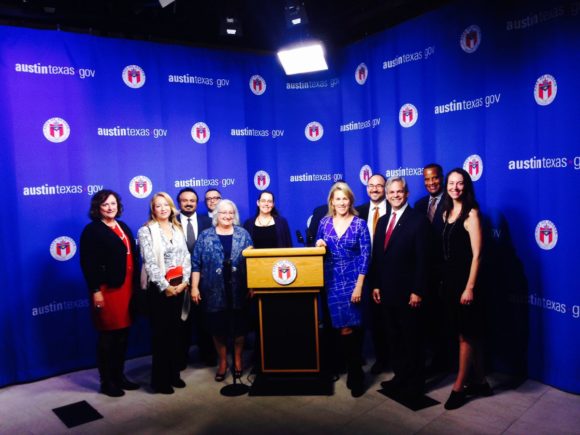
Grant Awardees with the U.S. Assistant Secretary of Commerce Jay Williams and Austin Mayor Steve Adler at Austin City Hall.

Grant Awardees with the U.S. Assistant Secretary of Commerce Jay Williams and Austin Mayor Steve Adler at Austin City Hall.


By LAURA LOREK
Reporter with Silicon Hills News

At Austin City Hall, the U.S. Assistant Secretary of Commerce for Economic Development Jay Williams Tuesday announced $15 million in grants for 19 states including $1.5 million earmarked for Texas with the bulk of that going to organizations in Austin and San Antonio.

“The diversity in programs and regional representation proves that innovation and entrepreneurship are igniting all corners of the country and is a recognized tool for economic growth and resilience,” Williams said during a press conference.

“If we are going to continue to be the most dynamic and prolific economy in the face of the planet, it has to be an inclusive process,” Williams said. “We have to tap into those under served, neglected and often overlooked segments of our population because innovation exists everywhere.”

The largest local grant of $500,000 went to the Austin Technology Incubator, part of the IC2 Institute at the University of Texas at Austin for its Texas Smart Water Innovation Cluster.

The three year grant will allow ATI to establish the Austin H20 Cluster, foster new partnerships, build the water ecosystem and develop a network of talent locally, said Isaac Barchas, director of the IC2 Institute.

“Texas’ traditional strength in the oil and gas industry is giving us a leg up in water,” Barchas said. Every barrel of oil extracted from the ground in Texas, generates eight barrels of water, he said.

The American Society of Civilian Engineers estimates the U.S. needs $3.6 trillion worth of existing water infrastructure work with the primary focus on fixing leaky pipes and preventing contamination like the Flint, Michigan water crisis in which high levels of lead infiltrated the city’s water system, Barchas said. Austin’s ATI water incubator plans to work on solving those big problems, he said.

“What we’re going to need to do as a community is apply technology to an existing infrastructure,” he said.

Austin won two awards which highlights the city’s entrepreneurial spirit and focus on innovation, said Austin Mayor Steve Adler.

The ATI award will help Austin create a digital water cluster, which is going to lead to at least 100 new innovative water technologies, Adler said. It will generate millions of dollars of economic activity for the city and create jobs, he said.

Austin is the perfect location for this cluster, Adler said. The city has been the fastest growing city in the nation for the last five years and projections are that it will continue to be the fastest growing city for the next 25 years, he said.

“We are ground zero for urban areas that are dealing with urban growth,” Adler said.

The challenges cities like Austin face will be solved by small businesses and entrepreneurs, he said.

This grant strengths the partnership Austin has with the Austin Technology Incubator, which has been one of the most successful civic partnerships in the country since 1989. The partnership has resulted in more than $900 million worth of capital being raised for startups in the community, $2.5 billion in value created in companies and more than 7,000 jobs being created.

ATI has already created a clean energy cluster, wireless and IT cluster, biotechnology cluster and “now it’s time for water, let’s add a little water,” Adler said.

The University of Texas at San Antonio’s South-Texas Innovation Partnership Program, known as S-TIPP, received $499,997.

The plan for the grant is to build out regional innovation nodes to foster local entrepreneurship and they will be networked for tech transfer, said Bijo Mathew, principal investigator on the grant and director of the Small Business Development Center Technology Commercialization Center at the University of Texas at San Antonio.

“It’s a focus on building capacity for innovation in South Texas and it’s going to include Austin, Corpus Christi and the valley,” Mathew said. “It’s a way to diffuse knowledge across all these communities.”

And the Gender Lens Impact Fund at the University of Texas at Austin, led by True Wealth Ventures, a venture capital fund that invests in women-led startups, received $250,000.

The only other Texas recipient was the WERX Foundation of McKinney, Texas. It received $345,895.

Overall, the U.S. Secretary of Commerce Penny Pritzker announced 35 organizations in 19 states will receive nearly $15 million focused on startups, early-stage seed capital funds and commercialization programs through the Economic Development Administration’s Regional Innovation Strategies Program.

Sara Brand and Kerry Rupp, co-founders of True Wealth Ventures at Austin City Hall.

Sara Brand and Kerry Rupp, co-founders of True Wealth Ventures at Austin City Hall.

The $250,000 Seed Fund Support grant over two years for True Wealth Ventures will go to marketing the fund to potential investors, sourcing deals and connecting with women entrepreneurs as well as doing due diligence on deals, said Kerry Rupp, partner in the $20 million venture fund focused on investing in consumer health and sustainable consumer women-led ventures in Texas. The grant is not for money to put into the startups. The fund is raising that separately, she said. True Wealth Ventures has closed on $4.7 million of its $20 million fund and made its first investment of $500,000 into UnaliWear, a smart watch maker for older adults led by Jean Anne Booth.

True Wealth Ventures’ fund intends to invest in approximately 12 early-stage women-led companies over the next several years.

The U.S. Military Kicks Off “Hack the Army” Program at Capital Factory in Austin

Secretary of the Army Eric Fanning

Secretary of the Army Eric Fanning

The Secretary of the Army Eric Fanning visited Capital Factory on Friday to announce a new program called Hack the Army, the U.S. Army’s first bug bounty challenge in partnership with HackerOne.

“The largest branch of the U.S. military is preparing to be hacked to enhance its security in the coming weeks,” according to a post on HackerOne.“Working with the hacker community is an effective way to uncover vulnerabilities in even the most powerful organizations.”

In addition to Sec. Fanning, others attending the event included Alex Rice, HackerOne CTO and co-founder as well as HackerOne partner Katie Moussouris of Luta Security.

The Hack the Army program will be run through HackerOne and will provide registered hackers the chance to compete for bounties by finding and reporting vulnerabilities in the information technology infrastructure to the U.S. Department of the Army.

The program comes on the heels of the Hack the Pentagon bug bounty program. During that program, hackers found 138 vulnerabilities during a 24 day period, according to HackerOne. It reports that the Department of Defense plans to run more hacking programs with various departments and the Hack the Army is the first of those to roll out.

More details on how to participate in the challenge will be released soon.

InnoTech Austin Announces 2016 IT Executives of the Year Finalists

innotechlogoThe 13th annual InnoTech Austin, one of the city’s longest running technology conferences, takes place next Thursday at the Austin Convention Center.

The conference organizers announced finalists for its 2016 IT executives of the year awards. The winners will be announced at an awards reception Thursday afternoon at the conference.

The finalists for corporate IT executive of the year include Everett Plante, vice president of IT and Chief Information Officer of Silicon Labs, Christine Rose, Chief Information Officer and head of e-commerce for Kendra Scott, Jeff Smedley, Chief Information Officer of J&J Worldwide Services and Charles Valentine, vice president of technology services of Indeed.

The finalists for public IT executive of the year include Mike Bell, Chief Information Officer of the Texas Department of Criminal Justice, Brad Englert,
Chief Information Officer of the University of Texas at Austin and Blake Holman, Chief Information Officer of St. David’s Foundation.

The finalists for Information Technologist of the Year include Ben Doherty, co-founder of Favor, Mark Magnuson, CTO of Concepture, Thomas Quintana, director of Next Generation Technologies at Inteliquent and Ben Bentzin, founder and CEO of Interactive Health Technologies LLC.

To register for InnoTech Austin, use the discount code NOV6C to receive 20 percent off registration prices for InnoTech or any special event including Women in Tech Summit, HealthTech ATX, DevOps CD summit and more. Check here for the complete agenda.

InnoTech Austin expects more than 1,500 attendees for the one-day conference, sponsored by Austin-based DoubleHorn, a leading cloud services brokerage.

Another highlight of the conference is the “Beta Summit” featuring six standout Austin startups presenting live demos.

“With technology evolving faster and faster all the time, we work hard to ensure that INNOTECH Austin remains relevant for attendees,” Sean Lowery, Director, Innotech, said in a news statement. “This year’s conference has exciting, new sessions on hot topics such as drones, the future of cloud technologies and mobility, cyber security issues like ransomware and the dark web, and much more. Our speakers are among the best and the brightest from organizations at the forefront of technology in their industries – Dell Medical School, RideScout, Charles Schwab, Amazon and Austin Technology Council, to name a few.”

« Older posts Newer posts »

© 2026 SiliconHills

Theme by Anders Noren — Up ↑