Page 245 of 352

Tips on Pitching Billionaire Mark Cuban

IMG_2130
By LAURA LOREK
Founder of Silicon Hills News

At Longhorn Startup Demo Day last week, Bob Metcalfe, inventor of Ethernet, co-founder of 3Com and professor of innovation at UT, interviewed Billionaire Mark Cuban, co-founder of Broadcast.com and owner of the Dallas Mavericks. Cuban also stars on the popular TV show Shark Tank on ABC. This is some of the advice he gave on pitching him.

1. Know Your History. “The biggest error I see in startups that pitch to me is no sense of history” – Not everything is in Google. Companies fail and their servers are no longer online, Cuban said. He gets pitched from entrepreneurs who do not know that their idea has been tried before and failed. He suggests entrepreneurs put their idea in search engines with the word “fail” after it and see what comes up. He also suggests they talk to people who have been around and find out what they know and dig deeper than Google to find out as much information as possible. Cuban said it’s OK if you pitch a deal that has failed before, but just make sure you don’t make the same mistakes and you know how to make it work.

2. Know Your Product and Market Better Than Anyone Else. Cuban looks for “someone who knows their industry cold. Knows their product cold.”

IMG_21323. What’s Special About Your Startup? “I always look to see what’s the special sauce,” Cuban said. They have to have something that differentiates them from everyone else. They need a “special sauce” that sets them apart from the competition. Superlatives don’t benefit the entrepreneur, Cuban said. Anything that ends in “er” or “est” like cheaper, fastest, better – are big red flags because the competition isn’t going to go away, Cuban said. They’ll just improve on their product. “I try to find entrepreneurs that aren’t lying to themselves and that’s very difficult.”

4. Don’t Ask for too Much. He doesn’t invest in deals that require $300 million in venture capital to succeed. His shares get diluted and the founders spend too much time just looking for capital.

5. Work Hard. He likes pitches from hard-working entrepreneurs. “You’ve got to grind, grind and grind” says Cuban. Entrepreneurs only fail because of lack of effort and brains.

IMG_21396. Don’t be a Copy Cat. Everyone thinks the Internet is new. But bits are bits, Cuban said. The servers that YouTube uses are no different than the servers that Comcast uses. If 10,000 people are distributing something on YouTube, why do you want to be 10,001, he said. I try to look where people aren’t looking. I try to look where people think it’s archaic or wrong, he said. That’s why he put his movies made for Magnolia, his production company, on video on demand. For example, he thinks video on demand is growing much faster than Internet viewing of video. It’s going to grow even faster as the satellite and cable companies get their user interface perfected, Cuban said.

7. What’s the best way to pitch him? Send him an email to mcuban@gmail.com. He will at least glance through the first paragraph of them all. He is very quick on the delete button. But he has invested $10 million in companies he discovered through email and at least $6 million of that are entrepreneurs he has never met.

8. Don’t pitch him directly, if you want to be on Shark Tank. If he knows anything about the financial elements of your company, he has to recuse himself from the deal on Shark Tank.

Burpy Expands to San Antonio and Houston

By LAURA LOREK
Founder of Silicon Hills News

Last Longhorn Startup class, Aseem Ali and a team of undergraduate students pitched Burpy, a grocery delivery service.
Now he’s running a quickly growing startup and finishing up his degree as a senior studying mechanical engineering at the University of Texas.
Burpy, which expanded into the San Antonio market on Nov. 25th, plans to launch in Houston on Monday.
That means Burpy will provide grocery service to all major markets in Texas with plans to expand to Dallas-Fort Worth and Bryan-College Station early next year.
Burpy, which used to charge a delivery fee ranging from $15 to $20, no longer charges for delivery. Since it made that move, Burpy has taken off, Ali said.
“We’ve seen amazing adoption,” he said during a recent interview.
In San Antonio, in the last few weeks, Burpy has fulfilled more than 300 orders, Ali said.
“Burpy delivers everything that you can find in a pantry or a refrigerator,” Ali said. “A lot of organic food and a lot of produce.”
The company, based in Austin, has 45 daily shoppers in San Antonio, 50 in Austin, 30 in Houston and 20 in Dallas.
In the next year, Burpy expects to do about $1 million in revenue, Ali said. He graduates in May and plans to work on the business full time.
Burpy gets its grocery items from Wal-Mart, HEB, Costco, Whole Foods. And it recently added office supplies and Office Depot.
Beyond Texas, Burpy plans to expand to Oklahoma City, Tulsa and Kansas City.
Although grocery delivery has been tried before on a large scale and flopped, Ali thinks his business will succeed where others have failed largely because the company crowdsources delivery and uses the latest technology tools to manage its workforce and orders.
Burpy doesn’t have any inventory, warehouses or expensive delivery vans. It taps into existing resources to maximize its efficiency, Ali said. The company does have a few competitors such as Greenling, but it focuses primarily on locally produced organic food.
“We can deliver Oreos and hot Cheetos,” Ali said.
Other Austin competitors include Couch Potato, Munchy Mart and Austin Grocer, but they don’t deliver an extensive inventory of items, Ali said.
Other national competitors include Peapod, Instacart, Amazon Fresh and Walmart to go, but they are not available yet in the Texas market, Ali said. He hopes to establish first mover advantage with the customer base here.
Ali attended the latest Longhorn Startup Demo Day and he said his biggest takeaway came from Billionaire Mark Cuban. It’s best to learn from history, Ali said. Webvan, one of the biggest dot com failures of all time, blew through $1 billion setting up a home grocery delivery network and then filed for bankruptcy. Amazon bought its assets in bankruptcy. It also bought out HomeGrocer, which had gone public and then its stock plummeted.
Burpy has learned from the mistakes made by others, Ali said. The company has raised some angel investment. Sai Ganesh, CTO of Audingo in Austin, is mentoring Burpy. The company is also hiring drivers.

Disclosure: Burpy is an advertiser with Silicon Hills News

Texas Venture Labs Expo Showcases Startups

By SUSAN LAHEY
Reporter with Silicon Hills News

20131205_140838The eighteen companies demonstrating at Texas Venture Labs Venture Expo Thursday ranged from those that had found a better way to harvest antibodies to companies that could increase efficiency and reduce the cost of hybrid cars to a website that aggregates the products used by various celebrities. And one surprise presenter had invented an easy way to strap a grill into the back of your pickup truck.
Dry Vax addresses the issue of vaccines that are degraded by encountering freezing temperatures. Because most vaccines contain aluminum salts, they can’t be frozen without degradation, resulting in loss of nearly half of all global vaccine supplies. Dry Vax converts liquid vaccines to dry powder that isn’t affected by freezing temperatures. The team is looking to begin with animal vaccines and eventually use its technology on human vaccines.
pairfAb has devised a process to extract antibodies from human blood in a process that is much faster than the current system of extracting animal antibodies and “humanizing” it. Presenter Dr. Peter Allen said that six of the ten best selling drugs on the market use antibodies for their manufacture. pairfAb’s process speeds the use of antibodies for research and drug manufacture by eight months. The company is seeking a CEO and $425,000 investment to create an independent laboratory and cover IP costs.
Vobi enables contextual, unified communication that lets a company access the voice, images, text, video, social media and other modalities that may be necessary to successfully complete the call with access to all media.
Amatra has created a platform that automates communication—particularly crisis communication–for institutions. Amatra can manage communications not only for people on an existing network but also in the case of a dynamic workforce of people who come and go to respond during a crisis. The company is focusing at present on the oil and gas industry to facilitate communication in case of disasters including spills, fires and explosions. It is looking for a chief revenue officer and an investment of $600,000 for customer acquisition.
NCarbon has discovered a form of carbon with a surface area per unit of weight that triples the amount of energy that can be stored in supercapacitors. Supercapacitors can store 10-100 times more power than traditional batteries. But most hybrids require six of them. With the new NCarbon, only two are required, saving production costs and increasing fuel efficiency and acceleration power.
Water Lens has developed an easy-to-read, inexpensive, on-site system to test water that is being recycled for hydraulic fracturing. At present, fracking consumes 3 million-to-5 million gallons per frac and though more operators are recycling the water, it must be tested because it requires specific balances of various compounds to be useful and not damage a well. Water Lens can test in minutes what previously took days.
ihiji and Panopticon both automate systems protection. ihiji uses small boxes plugged into a system to remotely detect, diagnose and resolve system problems, often before users interface with the system. Panopticon automatically with systems break-ins when they occur, notifying the system manager that the problem after the intrusion has been dealt with.
Eduvant provides a data dashboard for K-12 teachers to track attendance, grades and other information without a giant, complex enterprise system that large school districts use, provided by companies such as IBM and News Corp.
When one company didn’t show up, it was replaced by The Grill Mobile, a customizable grill you can attach to your pickup truck.
Other companies that presented included TeVido, Aunt Bertha, Ride Scout—which threatened to take its business to Washington D.C. if it can’t find central Texas investors—Set.fm, Equipboard, Primizie, Ten4 Ads, and eyeQ.

Fourteen Startups Pitch at UT Longhorn Startup Demo Day

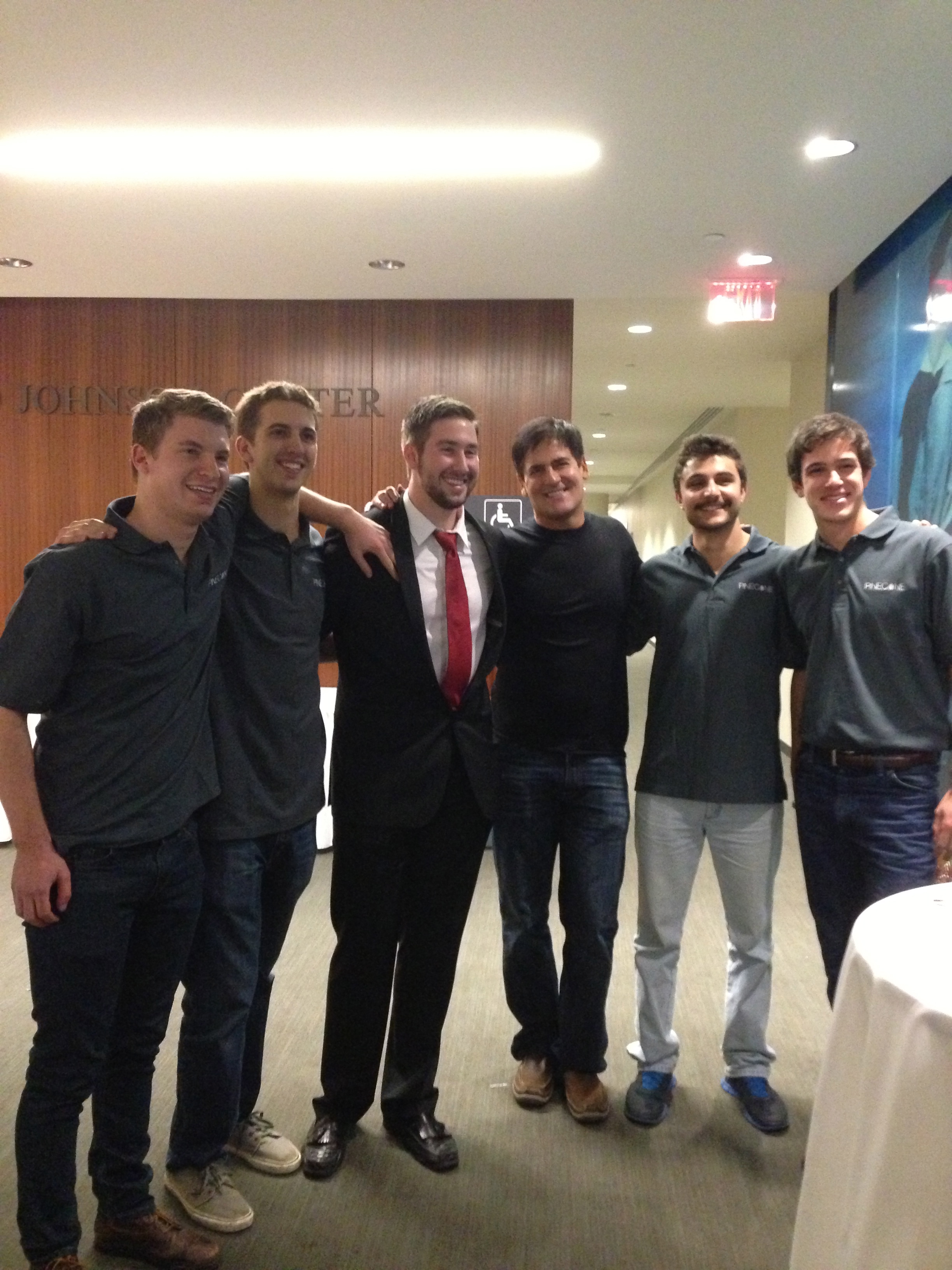
Mark Cuban with the Longhorn Startup team of Pinecone

Mark Cuban with the Longhorn Startup team of Pinecone


By LAURA LOREK
Founder of Silicon Hills News

The fifth Longhorn Startup Demo Day at the University of Texas drew the largest crowd ever.
Close to 1,000 people registered to attend the event and most of them showed up despite the cold front and blustery weather that blew into Austin on Thursday.
The evening featured two accomplished entrepreneurs, Cotter Cunningham, founder of RetailMeNot and Mark Cuban, co-founder of Broadcast.com. The evening also spotlighted pitches from 14 student run startups.
Cunningham with RetailMeNot.com, the world’s largest online coupon site, kicked off the evening with a talk about his entrepreneurial hits and misses and lessons he has learned.
At 46, Cunningham left his job as COO of Bankrate in Palm Beach and founded Divorce360.com. He invested $1 million and raised another $1 million from Austin Ventures. The site failed but Cunningham learned from the experience. He founded a new company in Austin, which came to be known as RetailMeNot.
Following Cunningham’s talk, 14 undergraduate teams pitched their ventures.
This class had the most diversity of any Longhorn Startup class, said Bob Metcalfe, professor of innovation at UT and one of the instructors. It featured a hardware startup – a 3D Printing service: Sinigma, a medical device maker: Austin Thermal, a battery charger embedded in a shoe: Everywhere Energy, mobile apps and some websites, he said.
“What always amazes me is how much the presentations improve in the last two days,” Metcalfe said. “It has happened all five times.”
“We had lots of great companies,” said Joshua Baer, instructor with Longhorn Startup, serial entrepreneur and co-founder of Capital Factory.
Baer and Metcalfe teach the class along with Ben Dyer, founder of Peachtree Software and now Entrepreneur in Residence at UT. Dozens of mentors in the Austin startup community also volunteer to help the students.
This time, the pitches featured four biomedical companies and a partnership with the Texas Medical Accelerator, Baer said.

Mark Cuban with the MicroMulsion team

Mark Cuban with the MicroMulsion team

The students gave great pitches, which impressed Cuban, who said he would consider investing in half of them.
Baer had a favorite too. He liked MSpaces, a hospitality startup that signs long term leases for apartments in Austin in desirable locations. Then MSpaces furnishes them with second-hand furniture and local artwork, and then posts them on AirBnB as short-term corporate and vacation rentals.
Hunter Monk, the company’s founder, said it’s seeking to be like “Uber for AirBnB.” He rents the apartments out at competitive rates from $60 to $139. His apartments generate $10,000 in revenue monthly and $3,600 in profits, Monk said. He’s essentially running a hotel business without having to own any brick and mortar buildings.
Another company, Suit of Clubs, a management platform for student organizations, has merged with InterviewStreet, a Y-Combinator company, said Siya Raj Purohit, its founder. She has taken the class twice. She graduates Friday with a double major in computer engineering and economics. She plans to work with InterviewStreet for a few months and then she’ll join Udacity, an education and technology startup based in Mountain View.
“I have always liked business,” Purohit said. “But this class solidified that. This class has had the greatest impact on my educational experience here. “
Siya Raj Purohit, founder of Suit of Clubs

Siya Raj Purohit, founder of Suit of Clubs

The best part was learning directly from successful entrepreneurs, she said.
“Every week we got to hear from a different entrepreneur,” she said. The professors, Metcalfe, Baer and Dyer, also shared their experiences and provided excellent advice, she said.
The team behind BluSense, an networking app that maps attendees at a convention, also took the class last semester. The startups can take the class again to further develop their ideas, which often results in a pivot or change of course. Last semester, Forrest Dukes with BluSense pitched a wristband with built-in sensors to allow people to network at conferences. Now the device is an app.
Following the event, Cuban visited with many of the startups. He stayed until after 11 p.m. to give them advice. He also took pictures with each team. And he even met the team behind The Zebra, a car insurance aggregation site, which Cuban has invested in but he had not met the team until Thursday night.
In a brief interview, he praised programs like Longhorn Startup and said that anytime startups can get advice from experienced entrepreneurs it’s a good program.
Asked about his failures, Cuban said he had a lot. He tried to market powdered milk. He ran a bar, which went out of business in college.
When asked if Dancing with the Stars was a failure, Cuban said absolutely not.
“That’s hard work,” he said.
Cuban and his professional dancing partner, Kym Johnson, got eliminated from Dancing with the Stars during its fifth season in 2007. Cuban, who is highly competitive, did not like to lose.
The Austin Thermal team of Zi-on Cheung, Ashvin Bashyam and Emmanuel Nunez (photo courtesy of Austin Thermal)

The Austin Thermal team of Zi-on Cheung, Ashvin Bashyam and Emmanuel Nunez (photo courtesy of Austin Thermal)

Following the pitches at Longhorn Startup Demo Day, one of the first startups Cuban spoke with was the three-person medical device team of Austin Thermal made up of Ashvin Bashyam, Emmanuel Nunez and Zi-on Cheung. They created Hot IV, a medical device that warms intravenous fluid before it is injected it into the body. Hot IV is targeted at hypothermia recovery and prevention, Bashyam said. Their initial market is trauma victims and the military, he said. They already have a working alpha prototype, intellectual property, and Food and Drug Administration clearance on a previous version of the device. Cuban liked the idea and told them to email him.
Cuban also met with MicroMulsion, which is creating micro gels for cell cultures. The product has lots of applications in biomedical research, said Anirudh Sharma, one of the four-team members. They all wore white lab coats.
“He wants to give us money,” Sharma said. “We weren’t expecting this. We don’t even have business cards.”
The company, like a few others, doesn’t even have a website yet.
Cuban spent a lot of time answering questions from the Pinecone team. They developed project management software for onboarding new employees.
“It’s a good idea,” Cuban said. “But you’ve got to find that sweet spot.”
One member of the team asked Cuban if he had heard of other startups with the same idea.
“I don’t know of any but I haven’t researched it,” he said.
Selling the product to small businesses to integrate their applications is a huge market but it’s a grind, Cuban said.

The other startups pitching included:

Everywhere Energy – a battery charger embedded in the sole of a shoe – sole charger that can provide up to two hours of charging energy for a cell phone or other device.

Sinigma – a 3-D printing service that can print in five different colors targeted at consumers.

UpNext – a mobile app to replace pagers in restaurants. The idea is to give the user more flexibility on long waits.

Basedrive – onsite data storage for businesses.

Recommenu – a mobile app that provides restaurants with feedback on their food.

SocialToast – a mobile app to help people find their friends at bars.

Aurality Studios – a software program for disabled people to interact with everyday technologies.

DayOf – a mobile app that curates daily events.

Billionaire Mark Cuban likes to “Party Like a Rock Star” and Invest in Startups

Josh Baer, Bob Metcalfe, instructors with Longhorn Startup and Mark Cuban

Josh Baer, Bob Metcalfe, instructors with Longhorn Startup and Mark Cuban


By LAURA LOREK
Founder of Silicon Hills News

Since selling Broadcast.com to Yahoo for $5.7 billion in 1999, Billionaire Mark Cuban has invested in 80 startups.
But his entrepreneurial ventures began as a kid growing up in Pittsburgh.
“As long as I can remember I was an entrepreneur,” Cuban said.
At the age of nine and ten, Cuban packaged baseball cards and sold them to his friends.
At 12, he wanted new basketball shoes. His dad told him that his tennis shoes were just fine and when he had a job he could buy any kind of shoes he wanted. A family friend had some garbage bags he wanted to get rid of and offered them to Cuban. So Cuban sold them door-to-door to earn enough money to buy the basketball shoes.
Cuban recounted the story Thursday night before a packed audience of more than 800 people at the University of Texas Longhorn Startup’s Demo Day. The semester-long course for undergraduates at UT aims to teach them entrepreneurial skills and how to found a startup. One of its instructors, Bob Metcalfe, professor of innovation at UT, Ethernet inventor and co-founder of 3Com, interviewed Cuban at the Lady Bird Johnson Auditorium following pitches by 14 student-run startups.
During the hour-long talk, Cuban provided insights into his entrepreneurial journey and lessons learned along the way.
Early on, if it wasn’t garbage bags, it would have been something else, Cuban said.
At 16, Cuban’s mom introduced him to stamp collecting. He consumed information about stamps. At stamp shows, Cuban would buy a stamp from one dealer for 50 cents and walk down to the other side of the show and sell it for $50. Selling stamps helped him pay for school.

Cuban’s College Years

He left Mt. Lebanon High School early because he couldn’t take business classes. He went to the University of Pittsburgh and took classes. He earned enough credits to finish high school. He ended up transferring to the Kelley School of Business. He researched and discovered it was one of the top ten business schools in the country and it had the lowest tuition. At Indiana University in Bloomington, Cuban earned his undergraduate degree in business. He also did a year and a half of his MBA.
“I wanted to take all the hardest classes that I could my freshman and sophomore years and I promised myself I wouldn’t drink and then my junior and senior years when I was 21 I would take all the easy classes and party like a maniac,” Cuban said. “And that’s what I did.”
He also ran a bar in college, which went out of business.
After he left college, Cuban worked for nine months for Mellon Bank in Pittsburgh. He learned how to program there in Fortran. But he didn’t like banking much so he moved to Dallas.

Moving to Dallas

When Metcalfe asked him why, Cuban said “For fun, sun, money and women.”
He had friends who moved to Dallas. He liked the tropical climate. He lived in the village with six guys in a three-bedroom apartment and he slept on the floor.
“I loved every minute of it,” Cuban said.
He worked as a bartender at night. He bought a Texas Instruments 99/4A computer and taught himself to program. He really liked it. Then he got a job at Your Business Software, a retail store, selling Peachtree software and different applications. He did that for nine months and then he got fired. That’s when he started his own PC and software consulting business called MicroSolutions. They set up PCs and software for businesses and set up local area networks.

The crowd clamoring to get a picture with Mark Cuban and Bob Metcalfe at the end of Longhorn Startup Demo Day

The crowd clamoring to get a picture with Mark Cuban and Bob Metcalfe at the end of Longhorn Startup Demo Day

At the same time Cuban ran MicroSolutions, a kid in Austin was launching a PC business, Metcalfe said. He asked Cuban if he ever ran into him.
That prompted Cuban to talk about the importance of history in understanding the world today.
“One of the things kids are missing today is a sense of history,” Cuban said. They Google something and if it doesn’t come up in Google, it didn’t happen. But there’s a ton of stuff that isn’t in Google, Cuban said. What kids don’t know is if the companies went out of business, their servers aren’t online anymore and they can’t find out about them. Entrepreneurs need to dig deeper to find information on people who have tried an idea and failed at it so they don’t repeat those same mistakes, he said.
Yet one of the most brilliant things Cuban learned from was this kid in Austin who would post the price of generic computer parts in PC Week Magazine. Cuban drove down to Austin and bought a bunch of computer parts directly from him. When he got back to Dallas, Cuban wrote him a letter.
“Michael, if you keep this up, things will go really well for you,” Cuban said. That kid, of course, was Billionaire Michael Dell. Today, they still crack up about it, Cuban said.
“How did you decide to sell your company to CompuServe?” Metcalfe asked.
“They offered, and I said yes,” Cuban said.
He wanted to retire by the time he was 35. MicroSolutions had $30 million a year in revenue and was very profitable, Cuban said. He sold the company to CompuServe for $6 million. After that he worked for them for a little bit. But then he got a lifetime pass on American Airlines, he retired and “partied like a rock star.”

The founding of AudioNet, later to be renamed Broadcast.com

Cuban and his friend Todd Wagner started AudioNet so they could listen to Indiana basketball games on the Internet. They started the company in the second bedroom of Cuban’s house.
Cuban had a $39 Video Cassette Recorder that recorded for eight hours. He would record radio stations and then import that programming into his computer and eventually post it to the Internet. They had 600 to 700 radio stations that they would post online. The company had tens of thousands of hours of audio content online and more than one million visitors daily coming to the site to listen to it.
Cuban and Wagner started AudioNet in 1995, the same year that Netscape went public. They sold it four years later to Yahoo for $5.7 billion in stock.
In 2000, Cuban spent $285 million of his fortune to buy the Dallas Mavericks National Basketball Association team from Ross Perot Jr.
Cuban always loved basketball. He didn’t play in high school though. He said he was five foot eight and weighed 240 pounds in high school. Today, he’s six foot three and weighs 205 pounds.
The Mavs are a different type of entity, Cuban said. The team is unlike any business he has ever run. Even though he writes the checks, the team belongs to the community, he said. In 2011, the Dallas Mavericks became NBA champions. To turn the team around, Cuban focused on putting players in a position to succeed.
In addition to owning the Dallas Mavericks, Cuban also stars on the popular television show Shark Tank on ABC which features entrepreneurs pitching venture capitalists with the hopes of landing an investment.
“It’s a lot of work,” Cuban said.
The so-called “Sharks,” successful businessmen and women who invest their own money, don’t know anything about the people who pitch to them, Cuban said. What takes just 10 minutes of TV time, though, can take two and half-hours of interrogation off camera, Cuban said.
The investors, or Sharks, are allowed to do due-diligence after they invest in the companies. In fact, one time Cuban made an investment in a woman’s company but her husband didn’t believe in paying taxes and hadn’t ever paid them, Cuban said. So he was able to get out of that deal.
Out of the 80 startups Cuban has invested in, 28 came from Shark Tank pitches.

Mark Cuban and the rest of the cast of Shark Tank, photo courtesy of Shark Tank

Mark Cuban and the rest of the cast of Shark Tank, photo courtesy of Shark Tank

“Shark Tank has really ignited the entrepreneurial fire in a lot people,” Cuban said. “It’s really inspired a lot of people to start their own businesses.”
Out of his 28 investments, Cuban has had one company fail and another that should shut down, he said. But the others are either dragging along or doing very well, he said.
“Shark Tank is the most successful one hour selling platform in the world,” Cuban said. Lani Lazzari, owner of Simple Sugars, sold nearly $1 million worth of her body scrub products after being featured on the show for 10 minutes, Cuban said. He invested $100,000 for a 33 percent stake in her company. She recently turned down a buyout offer. She wants to get to $30 million in annual revenue, he said.
Now is an amazing time to start a business, Cuban said. With a laptop, phone, Internet connection and Amazon account, people can create any kind of business, Cuban said.

Entrepreneurs only fail because of lack of effort and brains

“The one thing in our lives every entrepreneur can control is effort,” Cuban said. Companies don’t fail for lack of anything but lack of effort and brains, he said.
The biggest error companies pitching to Cuban make is that they don’t have any sense of history, he said. Some entrepreneurs also underestimate the amount of effort it takes to turn their ideas into reality.
“It takes time, it’s a grind,” Cuban said. “There are no shortcuts. You’ve got to grind and grind.”

Mark Cuban meets the team behind The Zebra, an Austin startup he invested in but has never met in person until Longhorn Startup Demo Day.

Mark Cuban meets the team behind The Zebra, an Austin startup he invested in but has never met in person until Longhorn Startup Demo Day.

Entrepreneurs need to learn from what’s been done before, Cuban said. He likes to retweet articles on business failures so people can learn from them. That information becomes more valuable because it’s harder to find, Cuban said.

The luckiest guy in the world

An audience member asked Cuban what he regrets not doing.
“It’s turned out pretty well – nothing,” Cuban said. “Someone’s got to be the luckiest guy in the world and luck has played a big part in the level of my success. And I’m just glad it’s me.”
To pitch Cuban, send him an email to MCuban@gmail.com. He reads the first paragraph and if he’s interested, he’ll read more and send the entrepreneur some follow up questions. If he likes the answers, then he might invest. He has invested $10 million in startups he discovered through email pitches and with $6 million worth of those investments he has never even met the entrepreneur, Cuban said.

Q &A with Claire England on Her New Role Promoting Startups at Tech Ranch Austin

Claire England earlier this year at RISE Austin, photo by Laura Lorek.

Claire England earlier this year at RISE Austin, photo by Laura Lorek.

Claire England, former executive director RISE Austin, has joined Tech Ranch Austin.
While England has resigned the full-time executive director role at RISE Austin, she will continue to work with the organization in an advisory role and is leading the planning of next year’s conference.
In her new role at Tech Ranch Austin, England will serve as managing director of global expansion and new initiatives. She will also be working with South by Southwest Interactive on engaging international startups for SXSW Interactive 2014.
In addition, England has also volunteered as the Austin Chair for Startup America, a position formerly held by the late Scott Robinson.
She will also volunteer to join the advisory board for the new Austin Global Shapers Hub, a program of the World Economic Forum. James Bilodeau is the founding curator.
“I’m VERY excited about all of this and looking forward to having an even bigger impact on our entrepreneur ecosystem!,” England wrote in an email announcing her new roles.
Upon hearing the news, Silicon Hills News jotted down a few questions to ask England via email about the Austin entrepreneurial ecosystem which she has had an active role in promoting.

Q. Why did you decide to join Tech Ranch Austin?

A. Every organization experiences growth and internal strengthening; Tech Ranch is poised for significant growth and has been strengthening and expanding its core programs to serve entrepreneurs and startups at every level. Now we are developing strong relationships with startup communities in Asia and South America, resulting in new impact on Austin’s startup community. Founder Kevin Koym created a great vision for the future of entrepreneurial activities at Tech Ranch, and he has complemented his skills by adding Managing Partner Sandeep Kumar earlier this year. Sandeep’s strengths as a serial entrepreneur with a focus on strategy and execution are helping accelerate Tech Ranch, as great co-founders and co-leaders do. I joined Tech Ranch because I see the huge potential for what the organization can help startups accomplish, and I bring another set of skills to the organization that complements the existing leadership.

Q. What are Austin’s greatest strengths when it comes to entrepreneurship?

A. I strongly believe our greatest strength with regards to entrepreneurship is our collaborative community. Further, the focus in Austin is not on valuation but on value. The pressure is a little different here than in more “go-go” markets, which means entrepreneurs have more time to explore ideas and market viability fully. Nevertheless, once a company is formed, speed of plan implementation and customer acceptance remain crucial. Austin and Central Texas offer all the core resources that a new company needs, from talented people to test markets for prototypes, products, services, etc; to affordable work space options; to programs that support their work.

Q. What problems do you see that need to be fixed?

A. Investment needs to be expanded — early and later stage options — both in terms of sheer numbers, but also helping investors become more comfortable investing in a wider variety of markets, so that significant investments aren’t focused on just a few sectors. And this isn’t limited to growing our community’s investment capacity; it’s also important that we position Austin’s startups as attractive for outside investment.
Our startups continue to need top developer talent and opportunities for partnership. The more our business and civic communities can do to support startups, the better it is for Austin as a whole. Startups and small business are driving the new economy, and they need our help.
Conversely, our startups should get involved in helping make Austin great, as much as they can. From helping solve our transportation challenges to initiating creative solutions for our wicked world problems by investing time and energy in social innovation and our nonprofit community, there is plenty to be done.

Q. How is Austin viewed in the global economy?

A. Austin is predominantly defined internationally by music and SXSW (and increasingly Formula 1), which means it’s seen as a creative, talented, and fun city. Of course, Austin consistently ranks high on most national and international top 10 lists, but we cannot rest on our laurels. For Austin to be truly great and to really compete in the global economy, we have to take our business community and our infrastructure to the next level. That will require a great deal of collaboration and hard work, but it will absolutely be worth it.
For example, Tech Ranch already has partnerships in Singapore and in Chile, and SXSW brings in startups from all over the world. Both organizations have the opportunity to create significant impact in Austin through their international relationships, and I’m thrilled to be working in this arena. Austin is also poised to be a technology gateway to Latin America, and startup partnerships are beginning to emerge between the two regions.

Q. Anything else you would like to add or make a point of that we haven’t asked you about?

A. My predecessor with Startup Texas/Startup America, Scott Robinson, had a huge vision for Austin, as big as his heart and his strength of personality. He was a dear friend to me and many in the startup and tech communities and is sorely missed. We have a lot of work to do to carry on his vision. My personal goal in all of my work and volunteer commitments is to help make Austin both the best city and the best entrepreneur ecosystem in the world. We need everyone in our community contributing and collaborating to help make that possible.

HomeAway Acquires Australian-based Stayz Group

imgres-2In another move to expand its reach into the Asia Pacific Region, HomeAway announced its acquisition of Stayz Group, the leading online vacation rental marketplace in Australia.
Austin-based HomeAway paid $198 million to Fairfax Digital, owner of Stayz Group, which publishes Stay.com.au, Rentahome.com.au, TakeABreak.com.au and YesBookIt.
Stayz reported revenue of $25.4 million for its fiscal year 2013, which ended in June.
“The acquisition of Stayz adds 33,000 additional Australian-based properties to the HomeAway network,” CEO Brian Sharples said in a news release. “It also provides HomeAway a strong momentum to our newly-launched pay-per-booking business, something Stayz has worked over the years to optimize. Additionally, they have demonstrated that a vacation rental business can generate attractive margins operating on primarily a pay-per-booking model, and we look forward to learning from their team.”
The Stayz Group and its 40 employees will continue to be based in Sydney.

Innovator’s Insights: Spotlight on Michael Wilson, Founder of Small World Labs

By GREGORY WISE
Expert Contributor to Silicon Hills News

Michael Wilson Founder and CEO, Small World Labs

Michael Wilson
Founder and CEO, Small World Labs

Focus, discipline and taking the long view are hallmarks of Michael Wilson’s leadership at Small World Labs. The Austin-based Software as a Service (SaaS) company he founded in 2006 provides an online community platform that helps nonprofit organizations connect, collaborate, and engage with their supporters and members.
“Starting Small World Labs our initial strategy was to focus on non-profits and associations, like alumni associations,” said Wilson. “But when we went out we learned it was too early for those markets.” It had become quickly apparent that in 2006 non-profit organizations weren’t yet ready to incorporate online community into their communications.
This realization and the founder’s desire to self-fund Small World Labs forced a quick – albeit temporary – shift from the original vertical strategy. “We needed to make a decision whether we were going to raise a lot of money to carry us past this point in the market, or refocus away from non-profits to early adopters instead, so that we could continue to bootstrap the company.”
Having recommitted to bootstrapping the business rather than take outside funding, Small World Labs aggressively pursued business in any number of markets.
“For three years we worked with everyone from big corporations like AT&T to small entrepreneurs who were tricking-out cars,” Wilson said. “But as time went by it became difficult to be all things to all people, especially for a company our size.”
By 2009, information about the effectiveness of online communities had spread and decision makers inside non-profit organizations were ready to take another look.
“We felt the market had matured and we could refocus on our original customer target, which was the non-profit sector,” said Wilson. “And since that time we’ve been 100 percent focused on that market.”
That focus has served as Small World Labs’ true north, guiding its most important decisions. “When we had to decide between investing resources in platform quality, like adding capabilities and constantly improving the user experience, versus putting money into sales and marketing to fuel growth, we chose to invest in the platform. Our view was that the long-term game is going to be based on client experience and client success. So even if we had to lose out on some early opportunities, that would be a better outcome than over-investing in sales and marketing and underinvesting in delivery.”
Today, that investment and focus is paying off as Small World Labs counts UNICEF, American Heart Association, the United Nations Foundation, American Cancer Society and many more not-for-profit organizations as customers.

Executive Q&A with Michael Wilson

Q. What does a “typical” day look like for you?

A. Not sure I can describe a single, typical day, but I can tell you what they look like in aggregate. I conduct one on ones with direct reports in strategy, HR and more where we go over what’s happening and what’s coming up. I’ll likely doing something with marketing, primarily around thought leadership, like helping finalize a conference presentation based on a client we’ve worked with. If there’s a deal we’re working on and the sales team wants feedback or input on the approach we’re taking I’ll work with them. I’ll also meet with product and technology teams.

Q. What part of your job gives you the most satisfaction?

A. I love building things that last. Investing, or even over-investing, in the up-front part to create something that can continue on its own. That includes culture; it starts with the interview process to attract and bring in the right kind of people. The team that you’re building is more than half the battle. On the product side, investing time in usability and feature capability, then you can deploy a solution that can be used by a large audience for a long time.

Q. What are the qualities that make someone good at your job?

A. Have the courage to make a lot of mistakes and have the wisdom not to make the same mistake twice.

Q, What’s the most difficult part of your job?

A. The hardest part right now is getting it all done. We’re at that size, 25 people, where I’m still directly involved in a lot of areas. Days are not short. Anytime I find myself doing something that’s a repeat of what I’ve done before and it’s not an investment in making other people better, or scale, it’s an activity with no return outside of doing it that one time. I want to focus on what takes us to the next level, what helps people around me, more than just getting point activities done.

Q. What experience, or experiences, best prepared you for your job?

A. I swam competitively from age seven to 20, through part of college. The way competitive swimming is set up it’s a high commitment level. Starting in 8th grade I was already doing two-a-day practices three days a week and practicing every day except Sundays, year-round. That rigor, that commitment that it instills in you carries you forward because at some level, when you’re starting and running a company, you have to have the will to just keep going. Challenges present themselves and it sometimes take a lot of work to get there. Having mental stamina helps.
And my first job out of school, in Palo Alto, I worked for a spin-out of McKinsey and BCG. I was fortunate to have an opportunity to work with a wide variety of tech companies and a wide variety of challenges. It felt like it was paid business school.

Q. Why do you choose to live and work in Central Texas, as opposed to other tech-centric parts of the country?

A. This decision was very explicit. Prior to starting Small World Labs I went to South America for two years. When I came back I thought, OK I’m gonna’ start a company, I want to try and minimize the number of new variables involved so I’ll pick a place I’d already been. That narrowed it down to the Bay Area; Austin, where I’d lived while working for Coremetrics; the New York-Connecticut area, where I went to school; and Kansas City, Missouri, where I grew up.
I knew I also wanted a place with an existing network, where there was available tech talent, so I focused more narrowly on the Bay Area and Austin. Coming down to those two areas, I asked myself, if you’re going to live there, how much do you enjoy the place? Austin won hands-down; it was a no brainer.

Q. What’s the one piece of technology you couldn’t live without?

A. I have two. The first is the smartphone because I can read and research anywhere. When the family is on a road trip we often just drive in a particular direction and research as we go. Another one that I’d add for very different reasons is Microsoft Excel. In my opinion, Excel enables you to break things down into its component parts and build something that is a model, which can serve as the root for repeatability and scalability, regardless of what you’re doing.

Q. Outside of your current position, what’s your dream job and why?

A. I would love to be the head of the Sunlight Foundation. It focuses on increasing transparency in government. My perspective is, across the board, sunlight is the best disinfectant. If you’re adding transparency to what people are doing they tend to want to do the right thing.

Q. What’s the best advice you’ve ever gotten?

A. Don’t take any job just for its salary before the age of 30. Take the job that will give you the best experiences for later on.

Q. Who is your role model?

A. There are lots of people I look up to in terms of what they’ve accomplished. But I’m looking for a mentor so if anybody’s interested …. To fill that gap I try to get together with people in a similar situation. I participate in the “Boot Board” that meets once a month. It’s a sort-of bootstrapped board of directors, spun out of Bootstrap Austin. The intent is to create a quasi-board of directors of other CEOs where you can really open the kimono. I also have lot of entrepreneurial friends and we’re always talking about our businesses.

Q. What was your first computer?

A. It was an Apple IIe. But it was actually my neighbors. We’d go over there and play with the green screen.

Q. What’s your favorite mobile app?

A. I guess my favorite is probably “This American Life.” I don’t listen to radio very much anymore so I listen to “This American Life” or “Planet Money” audio applications. I’ll listen to those every day.

Q. What do you think is the most important technology in use today?

A. It’s a little old now but the fact that there exists the Internet is everything. Prior to the Internet, access was the biggest limiter in terms of information. The Internet as a vehicle for breaking down barriers to access just continues to change people’s lives. It had a tremendous impact on my deaf parents by breaking down these previous barriers, which were much more pronounced for them.
Beyond that would be wireless access because it’s even less expensive and more accessible. You see this a lot when you travel to developing countries, which I like to do.

Q. What’s the most underrated technology today? (It doesn’t generate a lot of buzz but provides significant value.)

A. The spreadsheet.

Q. What’s the most overrated technology today?

A. Technologies that have a short life span. They enable other technologies, but they tend to be subsumed because they don’t’ have critical mass or size of audience. In the beginning they provide new capabilities and you get a burst of usage, but over time the installed base of providers catch-up and it’s the size of audience that starts to matter more. So if you don’t become immensely big, the long-term value for the marginal feature is a difficult game to win. They’re cool in what they do but the expected life span is short.

Gregory Wise, vice president with Weber Shandwick

Gregory Wise, vice president with Weber Shandwick

Greg Wise is an Austin-based marketing and communications professional with the PR firm Weber Shandwick. He can be reached at Gregory Wise

Editor’s Note: Gregory Wise will write the Innovator’s Insights column for Silicon Hills News on accomplished technology experts in Austin. To be considered for the column, please contact him at Gregory Wise

Pitching to VCs and The Entrepreneurial Bible to Venture Capital

By SUSAN LAHEY
Reporter with Silicon Hills News

Krishna Srinivasan of LiveOak Venture Partners, photo by Susan Lahey

Krishna Srinivasan of LiveOak Venture Partners, photo by Susan Lahey

If you, as an entrepreneur, email a VC firm, it’s a crapshoot whether they’ll even open it, much less read it. If you’ve got some heavy hitter, celebrity entrepreneur or investor making the introduction for you, your chances improve astronomically. So start making friends with the right people. That was one of the key takeaways from a panel of venture capitalists, led by Andrew Romans, general partner at Silicon Valley’s Georgetown Angels and author of the book: The Entrepreneurial Bible to Venture Capital: Inside Secrets from Leaders in the Startup Game.
The venture capital roundtable book event was hosted by Romans at the offices of DLA Piper. Panelists included Krishna Srinivasan of LiveOak Venture Partners, Pat Noonan of Austin Ventures, Lou Marchetti of Vista Equity Partners and Eric Garcia of Harvest Growth Capital.
In researching his book, Romans tapped his huge network of VCs, Angels, CEOs, and attorneys and wound up with dozens of contributors. The main point he raised Tuesday night was that entrepreneurs need to seek advisors with clout who can connect them with investors and help them understand what they need to know to make a solid pitch.
Andrew Romans, general partner at Silicon Valley’s Georgetown Angels and author of the book: The Entrepreneurial Bible to Venture Capital: Inside Secrets from Leaders in the Startup Game, photo by Susan Lahey

Andrew Romans, general partner at Silicon Valley’s Georgetown Angels and author of the book: The Entrepreneurial Bible to Venture Capital: Inside Secrets from Leaders in the Startup Game, photo by Susan Lahey

“The network around your company is your company’s best asset,” Romans said. It’s preferable if an advisor has some skin in the game in terms of cash or equity. But the most important thing is that they love the founders and are willing to open doors. Noonan of Austin Ventures agreed that the best route to getting a meeting was an introduction from someone they know and trust.
The right advisor, VCs added, will ensure that an entrepreneur doesn’t go into a meeting with gaping holes in his or her information.
“You’ve got to make sure you know your numbers,” Romans said. “If someone asks what’s your revenue and you stutter on that one, that’s a no-no. You’ve been there since the beginning you should know…if you don’t know what pre-money valuation is and you’re going to run into trouble it’s the advisor’s job to get you out of the meeting before that happens.”
Srinivasan of LiveOak Partners, though, said his company was happy to be contacted by entrepreneurs without a formal introduction. LiveOak is still new enough that it doesn’t have much of a legacy portfolio. And since theirs is a geographical strategy for Central Texas, they’re not too focused on themes either.
“We’re delighted to receive emails and are trying to be as helpful as possible and as responsive as possible. It feels like part of giving back to the market to raise institutional money…. We’re looking for smart guys who are hard working who want to work with us…. Other people who have these giant maps are looking for something specific—bitcoin meets gaming segments—we’re looking for something with recurring revenues and high growth segments, motherhood and apple pie stuff.”
“It’s hard to do thesis driven investing in a state like Texas,” said Noonan. “You’re at the mercy of the entrepreneurs.” AV, he said, is beginning to invest in oil and gas, since the technology component has become so much more crucial to the industry’s future. Health care and big data are other areas they’re dabbling in.
Garcia of Harvest Growth Capital said that company often helps founders of companies with $20 million to $30 million in revenues who haven’t arrived at an exit point yet and struggle with liquidity.
“The time to liquidity has gotten longer and longer,” he said. “It used to be four-to-five years. Now it’s north of 10 years…. A lot can change in that time; kids go to college, divorce, and taxes…. We can shorten that time to liquidity. We underwrite to two-to-three times money for a two-to-three year window.”
Romans krishna noonan marchetti garcia by Susan Lahey

Andrew Romans, Georgetown Angels, Krishna Srinivasan, LiveOak Venture Partners, Pat Noonan, Austin Ventures, Lou Marchetti, Vista Equity Partners, Eric Garcia, Harvest Growth Capital, photo by Susan Lahey

Two interesting dynamics have emerged in recent years, roundtable participants said. The quality of companies and ideas has gotten steadily stronger; and the amount needed to startup a company has gotten steadily smaller. In Austin, the number of big exits is growing, but still small. So VCs are being careful where they put their money, but there are few hard and fast rules about who will walk away with funding.
“We have funded companies pre-revenue, pre-product where they found the right market fit, some of our companies have revenue,” said Noonan. “It’s hard to pin down the exact magical formula. Every investor will target a different thing: ‘We invest in markets; we invest in people.’ You can make a mediocre idea truly exceptional with the best execution. All the time we get questions like ‘I’ve got an app, how many downloads do I need and how many active users? If you’re not growing 10 percent week over week, you’re doing something wrong. You need some kind of stickiness or growth. If on the enterprise side, you need customers to validate you.”
One approach Romans took, as an entrepreneur was to have a team sign an employment contract contingent on getting a specific investment. That way, he could present a sterling team to investors without anyone having to quit his job until the money was available.
Srinivasan said, from LiveOak’s perspective, companies needed to be able to articulate, “what is the next hill they want to take? What is the next inflection point for this company?”
In the end, Noonan said, “a lot of it comes down to gut feel.”

Lessons of a First Time CEO at SA New Tech

By ANDREW MOORE
Reporter with Silicon Hills News

Jay Miltor presents XYN Technologies, photo by Andrew Moore

Jay Miltor presents XYN Management, photo by Andrew Moore

At SA New Tech Tuesday, Pressable’s Founder Vid Luther shared tough lessons learned as a CEO.
Originally named ZippyKid, Pressable, a WordPress hosting startup, got a new name following an eight hour meeting, scheduled to last 30 minutes, in June with Rackspace Hosting founder Dirk Elmendorf and a few others. After much consideration, Luther decided that the “Kid” in ZippyKid targeted the wrong demographic and didn’t leave a professional and reliable impression.
Now named Pressable, the startup has changed its web layout and pricing to target a more professional demographic – namely other web developers. The rate is now $25 to manage up to five sites, instead of only one, so web developers can use Pressable on the backend for website stability, speed, and security on their client’s websites.
“Rather than us managing a client one by one, they manage clients and we make them look good,” Luther said.
Five days after the changes, Pressable began to see more customers sign up and has enjoyed a brisk signup rate ever since. To date, Pressable boasts more than $1 million in yearly revenue and has around 1,200 customers.
Luther also gave advice on what a CEO should, and should not, do to have a successful business.

  • Raise more money than you think you need.
  • Hire smart people and then get out of their way.
  • Have a mission, a vision, and a value proposition, and make sure your employees share them.
  • Learn to speak to investors, marketers, and non-technical employees in language that they will understand.
  • Be personable and smile! Your face is the face of the company.
  • Spend more money on things that generate revenue, like marketing.
  • Have confident body language.
  • How you think about your customers is how your employees will think about your customers.
  • Don’t make self deprecating jokes as a CEO, important listeners might not know you are joking.
  • Don’t use sarcastic humor as a CEO; new employees may take you seriously.
  • Don’t assume that you are 100 percent responsible for your employee’s livelihood; they should know what they are getting into with a startup.

In addition to Luther’s presentation, Michael Girdley touted his Codeup boot camp, XYN Management employee explained its statistics solution for hospitals organ transplants and a Southwest Research Institute engineer shared an open source robotics code.

Codeup

Codeup is a nine week in-person web development boot camp that guarantees to either get their graduates a job or refunds half of their tuition. The boot camp was created by Entrepreneur Michael Girdley because, well, he “got mad”.
“I’m mad that our educational system is so broken,” Gridley said. “I’m mad that people like Vid and all my friends who run companies can’t hire good people. And then I was mad that I had all these friends that wanted to be programmers but kept failing. I also like teaching.”
Teaching oneself to be a programmer is difficult, and Girdley found that most people either did not know where to start or were unsure what to teach them.
The boot camp, which begins on Feb. 3, costs $7,985 and will cover Linux, Apache, MySQL, PHP, and JavaScript. The classes will be from 9 a.m. to 5 p.m. Students will spend only 45 minutes to an hour in lecture each day and will devote the rest of the time to applying what they learned. Girdley has already received 50 applications and has accepted 17. His first class still has a few more spots left. To get more women involved in web development, Codeup is offering three half-off women’s scholarships.
There will be a Codeup info session at Geekdom on Thursday, Dec. 12.

XYN Management

Pronounced “Zen Management” and presented by COO Jay Miltor, XYN Management has created a cloud based application which helps hospital solid organ transplant programs keep up with their patient outcomes and predict what the outcome will be for future transplant procedures.
According to Miltor, all transplant centers in the United States get a report card twice a year which grades them on their transplant outcomes. This includes how many patients survived and how many kept a functional donated organ. If the hospital falls below standard, they must undergo a rigorous and expensive corrective action plan.
XYN Management has created a system that allows hospitals to keep up with their report cards in real time and predicts what future report cards will look like with statistical analysis. The system will also calculate the risk for a transplant based on a patient’s medical record.
The startup has been in business for a year and a half and has 15 current clients. Miltor says the company is profitable but is also looking for additional investments.
XYN Management is currently looking to hire a high level statistician (has a college degree in statistics) who can also code. Additionally, they need an interface designer, an Apex programmer, and a programmer.

Southwest Research Institute’s ROS industrial software

Southwest Research Institute Sr. Research Engineer Shaun Edwards presented the ROS industrial software – open source software for industrial robotics programming.
Edwards is working to create a community for the software and hopes someone will be able to create a breakthrough in the industrial robotics industry. A robotics programmer, Edwards is frustrated with the current state of industry technology which has been largely resistant to change and has been lagging behind other robotic applications with 10-year-old technology. Edwards hopes more users will build up the software base and ultimately be a resource for SWRI, opening the door for greater robotics possibilities in the industrial area.
“They build up the code base. People actually give software back to the ROS industrial program. Then we can leverage that,” Edwards said.
In a demonstration of the software, Edwards showed how it can identify visible objects such as a bag on the floor. He hopes that one day industrial robots will be able to look at and interact with objects intelligently.

« Older posts Newer posts »

© 2026 SiliconHills

Theme by Anders NorenUp ↑