Page 111 of 352

EverlyWell Lands $2 Million More in VC Funding

Julia Cheek, founder and CEO of EverlyWell, courtesy photo.

EverlyWell, the Austin-based healthcare testing platform, announced Wednesday that it has received $2 million more in venture capital funding.

The company, founded two years ago by Julia Cheek, the company’s CEO, has received $5 million in total funding.

NextGen Venture Partners led the round with participation from Jack Novak, SoGal Ventures, Full Tilt Capital and other venture capital funds.

The company has already surpassed $1 million in revenue, according to the company. It now has 15 employees and serves customers in 46 states. The company makes and sells at 12 home lab testing kits for sexual health, thyroid, metabolism, men’s health, and breast milk DHA testing, which the company is the exclusive provider of in the U.S.

EverlyWell plans to use the latest funds raised to expand and enhance its product line, hire key executives, most recent round of funding will help the company expand its suite of tests, hire key leadership positions and launch new partnerships.

“Our vision is to make healthcare services like lab testing accessible, simple, and meaningful for consumers. This additional funding enables us to accelerate our growth even more,” Cheek said in a news release. “We’re leading a major shift in the consumer health marketplace by bringing the lab to consumers’ doorsteps, and we are moving quickly to expand our channels, launch innovative tests, and deliver a world-class customer experience.”

Cheek is one of a few women-led startups that have received venture capital funding locally. Also, digital health companies with a female CEO received just 9 percent of total digital health funding in 2016, according to the company.

“Amid uncertainty in the healthcare landscape, people are taking control and becoming proactive and informed healthcare consumers. Julia Cheek and EverlyWell have reimagined the lab testing experience – providing customers an affordable, convenient, personalized solution – without having to navigate a complicated healthcare system,” EverlyWell investor Lisa Cuesta, Vice President at NextGen Venture Partners, said in a news release. “EverlyWell distinguishes itself as a reliable brand that customers can trust to deliver high-quality, consistent service so they can feel more confident making decisions about their health and wellness.”

Bitfusion Lands $5 Million in VC Funding

Bitfusion, an Austin-based startup, announced Tuesday that it has received $5 million in venture capital funding.

Vanedge Capital led the Series A round with participation from new investor Sierra Ventures and existing investors Data Collective, Resonant VC and Geekdom Fund.

Bitfusion, which participated in the 2015 Techstars Cloud program in San Antonio, makes specialized software that brings supercomputing performance to a variety of hardware devices to allow them to run any kind of application.

In addition to the funding, Bitfusion announced the beta availability of its software, Bitfusion Flex. The software lets artificial intelligence developers work quicker and more efficiently by scaling and sharing on-demand compute power.

Bitfusion co-founder and CEO Subbu Ram, courtesy photo.

“The promise of AI and deep learning is immense, but in practice, leveraging GPUs, FPGAs and other compute architectures for performance presents huge challenges for AI developers,” Subbu Rama, co-founder and CEO of Bitfusion said in a news release. “By providing an end-to-end solution focused on the unique needs around AI development and deployment, we are enabling companies to leverage these efficient architectures with very little effort. This massively accelerates time to business value for AI initiatives.”

Bitfusion raised a seed stage round of $1.45 million in 2015. The company also has offices in Silicon Valley.

CTAN is the Most Active Angel Network in the Country

The Central Texas Angel Network, known as CTAN, is once again one of the most active angel investment networks in the country, by number of deals done in 2016, according to the 2016 HALO report.

The Angel Resource Institute, along with PitchBook, released the annual report last week.

In 2016, the most active angel groups included CTAN, Houston Angel Network, Hyde Park Angel Network, Alliance of Angels, Launchpad Venture Group, New York Angels, Blu Venture Investors, RTP Capital, Queen City Angels and St. Louis Arch Angels, according to the HALO report.

“CTAN’s position in the ARI national rankings reflects the intense time and effort our members commit to startups,” Claire England, Executive Director of Central Texas Angel Network, said in a news release. “Beyond increased funding levels, we saw record investor participation in 2016, with a 40% growth in the number of members writing checks.”

CTAN, a nonprofit organization with more than 160 accredited investor members, reported its members invested $14.2 million into 43 companies last year.

CTAN also made the HALO list of the most active angel networks in 2015.

Overall, in 2016, direct investments reported from U.S. angel groups more than doubled from 2015, according to the HALO report.

The report identified the trend of pre-money, early stage valuations declined from $4.6 million in 2015 to $3.7 million last year.

“The median round size for deals where angel groups co-invest with other investors in first round deals dropped to $950,000 from $1.6 million,” according to the report. “Median deal size from angel groups reached $127,000.”

In 2016, follow on funding accounted for 50.4 percent of deals funded by angel groups, according to the HALO report.

Texas, California, the Northeast and Southeast are the regions where new deals outpaced follow on rounds, according to Tony Knauss, co-chairman of the research committee for the Angel Resource Institute.

California accounted for 30 percent of all angel funded early-stage deals in 2016, followed by the Southeast, New York and the Northeast, all at about 10 percent, according to the report. Texas accounted for 5.4 percent of all angel deals.

Most of the deals were in the software industry with 34.3 percent, followed by healthcare with 17.3 percent, business to business with 13 percent, Internet and mobile at 11.2 percent and business to consumer at 10.3 percent.

Overall, male founders represented the bulk of funded deals with 58 percent led or founded by white male entrepreneurs, according to the HALO report, followed by 25 percent of deals led or founded by minority male entrepreneurs and 14 percent of deals led or founded by white female entrepreneurs and 3 percent of deals led or founded by minority female entrepreneurs, according to the report.

In Texas, investors wrote checks to male entrepreneurs 85 percent of the time, according to the report.

Entrepreneur Louise Epstein Shares her Secrets to Success on Ideas to Invoices

By LAURA LOREK
Publisher and reporter with Silicon Hills News

In 1994, Louise Epstein launched Charge-Off Clearinghouse after serving on the Austin City Council.

“I went on a shameless search to find out what was happening in the world,” Epstein said.

There was an explosion in credit card debt and an explosion in debt that went unpaid, she said. That’s where she saw an opportunity.

She was one of the first women investment bankers in Texas and used her experience to create Charge-Off Clearinghouse, a distressed debt company that valued, purchased and sold $1 billion of charged-off credit cards. She led the company from 1997 to 2008.

Today, Epstein serves as managing director of the Innovation Center in the Cockrell School of Engineering at the University of Texas at Austin.

Epstein shares her secrets to success in this latest episode of the Ideas to Invoices podcast.

Epstein found a partner and convinced him to hire her for his debt collection agency. She ended up spinning her company out of that venture focused on buying and selling buy debt.

“Like most great ideas I latch on to, they are not mine,” Epstein said.

Her company was profitable from the first month.

One of the big lessons she learned in business, is it doesn’t matter if you’re right.

“Being right doesn’t mean you just made a sale. You can be right all the way to bankruptcy,” Epstein.

The key is to present something in a compelling way and to know how to sell, she said.

She built relationships with her customers on the phone.

“The way to sell is to know how to listen,” she said. “And when you listen, you really learn what your customer is looking for and what’s important to them…..you don’t build a relationship by talking.”

Great entrepreneurs must have an incredible amount of energy, the ability to prioritize and focus, Epstein said.

“If you want to be successful there is no work, life balance,” Epstein said.
“You have to have the ability to delay satisfaction, delay gratification, focus and commit.”

Her favorite thing about being an entrepreneur is creating something from nothing.

“I believe that when we create, we are doing what we are supposed to be doing,” Epstein said. “That’s how we are being the closest to the greatest we can be. The most elevated existence we can have.”

Epstein also advises entrepreneurs to learn first before launching their ventures.

“It really helps to know something to be successful,” Epstein said.

Getting paid to learn is called a job, she said.

“Get a job, learn, because you need to know more about so many things before you begin something,” she said.

Entrepreneurs are driven and not everyone can be an entrepreneur, Epstein said.

At the Innovation Center at the University of Texas at Austin, Epstein shares an office with Bob Metcalfe, the executive director, inventor of Ethernet, founding CEO of 3Com and professor of innovation at UT.

The Innovation Center is using startups as vehicles to change the world, Epstein said. At UT, two robotics company are doing great work, she said. Professor Luis Sentis is heading up Apptronik, a company that makes robots and exoskeletons.

Professor Andrea Thomaz is heading up Diligent Droids, a company that makes robots for healthcare providers. And Mechanical Engineering Professor Chris Rylander is heading up several commercial ventures, she said.

Listen to the full Ideas to Invoices podcast to learn more.

Editor’s note: Silicon Hills News launched on Patreon this week. Please visit the site to pledge just $1 a month to support the Ideas to Invoices podcast and other work we do at SiliconHillsNews.com. Thank you in advance for your support!

FemtoMedical, Coffee Roasting Tech and GenXComm Present at UT Austin’s StARTup Studio

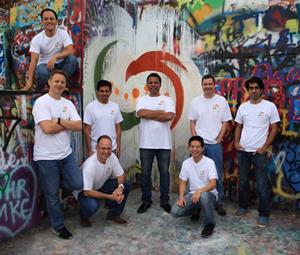
The team at GenXComm, a spin out of UT Austin, courtesy photo.

By LAURA LOREK
Publisher and reporter with Silicon Hills News

The latest presentations at the Innovation Center’s monthly StARTup Studio at the University of Texas at Austin show the variety of problems professor led startups are tackling.

They included an acoustic monitoring technology to improve coffee roasting, a handheld laser device to shape bones and a wireless communications company with technology that doubles the world’s available frequency spectrum.

The innovation Center hosts the monthly invitation-only meetings at the Ernest Cockrell Jr. Hall in the Cockrell School of Engineering to showcase the latest professor led startups commercializing technology at UT Austin. The Austin Chamber of Commerce sponsors the events along with the UT Office of Technology Commercialization, the Innovation Center and WeWork.

At the event, Bob Metcalfe, inventor of Ethernet, professor of Innovation at UT Austin and director of the Innovation Center, mentioned that there are two UT Austin teams entered in Elon Musk’s Hyperloop competition.

“Unlike any other university in the country, we have two teams in this competition,” Metcalfe said.

Musk created the competition to get teams to create pods to transport people on a hyperloop at speeds of more than 700 miles per hour. The pods levitate on the track and travel using magnetic technology and kinetic energy through a high compression tube.

Next Wednesday, the UT Cockrell School of Engineering and the Innovation Center will host an event featuring presentations from the two student led engineering teams: 512Hyperloop and TexasGuadaloop. The competition is this summer in California.

The Innovation Center also supports the Longhorn Startup Demo Day which takes place next Thursday, May 4th from 5 p.m. to 9 p.m.at the LBJ Auditorium, Metcalfe said. It features student-led startups pitching their companies before a live audience.

The Innovation Center also runs an entrepreneurial advisory program in which it matches experienced professionals with professors to help them with their startups, said Louise Epstein, managing director of the Innovation Center.

“We’re always looking for new, experienced entrepreneurs who want to help our companies,” she said.

At the latest StARTup Studio, Mechanical Engineering Professor Adela Ben-Yakar presented FemtoMedical, which created a platform for making laser based surgical tools. At the event, she showed a medical device for arthroscopic bone reshaping using lasers to remove tissue.

“Ultrashort laser pulses have been shown to ablate both hard and soft tissues precisely, with no or minimal thermal damage to the surrounding tissue,” according to her presentation.

Next up, Mechanical Engineering Professor Preston Wilson presented technology for the acoustic monitoring of coffee roasting by analyzing the sound profile produced by the beans.

“During the roast, beans produce two audible cracks that determine the roast flavor and intensity,” according to the presentation. “A microphone records the cracks, and the control system software changes the roasting chamber temperature accordingly. Improved quality control leads to increased customer satisfaction and less wasted batches from over-roasting. Monitoring the roast using time or temperature is the current industry practice, but these methods are not true indications of the roast intensity.”

The last company to present was GenXComm, led by Electrical and Computer Engineering Professor Sriram Vishwawath. He was not able to attend the event, but his cofounders Hardik Jain and Stephen Gartside did. Founded in 2016, GenXComm is “bringing to market reliable, scalable full duplex or the ability to simultaneously transmit and receive in the same channel. This new powerful technology doubles the usage of the world’s available frequency spectrum,” according to the presentation.

GenXComm, earlier in April, closed on its first round of venture capital financing. It did not disclosed details of the funding.

Techstars Austin 2017 Demo Day Spotlights 10 Startups

Rohan Mathur, Guy Goldstein and Josh Ullman with WriterDuet

By LAURA LOREK
Publisher and Reporter at Silicon Hills News

At South by Southwest, Guy Goldstein came up with the idea for WriterDuet when meeting with screenwriters and filmmakers.

Goldstein created a platform, similar to Google Docs, to allow writers to collaborate on projects. Today, WriterDuet has more than 25,000 monthly users with 2,000 new members joining every week. The Austin-based company also recently branched out to new international markets like China.

WriterDuet was one of ten companies that pitched their ventures during the 88th Techstars Demo Day held in Austin at the Palm Door on Thursday.

“I think this class is phenomenal and dare I say it, I think the best Austin class that has been assembled,” said Jason Seats, now managing partner of Techstars and in charge of its venture investments.

In 2013, Seats founded the Techstars Austin Accelerator program. Amos Schwartzfarb, a mentor and serial entrepreneur, took over as managing director in 2015.

David Brown, one of Techstars cofounders

Overall, Techstars, founded in Boulder, Colorado in 2006, runs 30 accelerator programs worldwide, a venture capital fund and an enormous global network of mentors and business partners, said David Brown, one of its co-founders who attended the Techstars Austin event. It receives more than 18,000 applications annually for 300 spots in its programs, he said.

The 2017 Techstars Austin program included four international companies from France, Canada, Uruguay and Colombia. It also had companies in the U.S. from Texas, Arizona, California and North Carolina.

“Today is a celebration of the last 13 weeks of really intensive work these guys have been doing on their businesses,” Schwartzfarb said.

In the two days leading up to the program, the startups had one to one curated meetings with investors from all over the world, Schwartzfarb said. They had more than 200 meetings, he said.

“Three companies have already closed their rounds with more than $4 million in financing already,” he said.

Amos Schwartzfarb, managing director of Techstars Austin.

Techstars Austin put on two pitch sessions Thursday. The early one aimed at investors and VIPs and the later one for the community followed by a party.

At the later event, Schwartzfarb acknowledged the 130 mentors that volunteer in Austin. And in particular, he recognized the top six mentors for the latest class: Keith Casey, Erik Huddleston, Nate Pruitt, Bill Kennedy, Monique Maley and Josh Jones-Dilworth.

During the pitch session, a mentor or customer introduced each company and then the founder had two and a half minutes to present.

Sarah Azan and her sister, Hannah Oiknine, cofounded Babbler

In an interview before her pitch, Hannah Oiknine, CEO and co-founder of Babbler, based in Paris, France, said she joined the Techstars program to expand its product in the U.S.

“Techstars was the best way for us to accelerate the business strategy and expand our network,” she said.

Oiknine and her sister, Sarah Azan, cofounded the company and raised $2 million in venture capital in France. They hired two more employees in Austin and they have 14 employees in Paris.

“Every company needs media coverage regardless of the size of the industry. Because it builds visibility, credibility and sales,” Oiknine said during her pitch. “That’s why companies spend more than $160 billion a year on PR.”

PR is hard because PR is broken, Oiknine said. So, she created Babbler as the best way for reporters to receive trustworthy information from sources. Babbler connects reporters with public relations professionals at companies to provide relevant information to the beats that they cover.

More than 1,000 companies like Yelp, Edelman and Pinterest use Babbler and more than 6,000 reporters are on the platform. More than 1,200 stories get picked up every week, Oiknine said. Last year, Babbler generated $645,000 in revenue.

“Our product is now live in the U.S. and we can hit a much bigger number in expanding in the rest of the world,” she said.

The four cofounders of Invomatic

The head of another international startup, Javier Martinez, CEO and cofounder of Invomatic, an online invoicing company aimed at large businesses, met Schwartzfarb at a coworking space in Bogota, Colombia.

When they were accepted into the Techstars Austin program, all four co-founders moved to Austin from Bogota.

“We are a completely different team from the team that arrived here,” he said. “They gave us the tools to think about our business in entirely new ways…It changed us very radically.”

Invomatic landed a large travel agency in Colombia as a customer. It is helping them process 200,000 invoices a month and they are saving money by using Invomatic, Martinez said.

Marcus Carey, CEO and founder of Threatcare

“The mentors and startup community in Austin have been fantastic,” Martinez said.
Marcus Carey, CEO and founder of Threatcare, based in Austin, wanted to participate in the Techstars Austin program to learn more about running and scaling his software as a service platform that spoofs hacker attacks on a computer network to help companies guard against malicious attacks.

“The Techstars network, the training and the mentorship helped me out on my journey as a CEO,” Carey said. “Techstars has affected every aspect of our business. It’s been a great experience.”

Threatcare now has seven full time employees and plans to bring on two more in the next month, Carey said. The company has also raised $2 million in funding.

“Companies spend $90 billion annually on customer security,” Carey said during his pitch.

“Now these are all great companies,” he said. “But the problem is there is no such thing as a silver bullet when it comes to cybersecurity so their customers are still going to get hacked. At Threatcare, we help our customers constantly diagnose gaps in their cybersecurity through people, process and products.”

Last month, ThreatCare did $68,000 in bookings, Carey said.

Josh Jones Dilworth, a serial entrepreneur in Austin and a long-time mentor in the Techstars Austin program, introduced Prospectify, based in Scottsdale, Arizona. Dilworth is already a customer.

“If you are a sales person…Prospectify is the thing we’ve been waiting for a decade or more. It’s the closest thing to a Holy Grail for sales that I’ve seen,” he said.
Noah Spirakus is the CEO and co-founder of Prospectify and Matt Ekstrom is cofounder.

“Because of bad data, sales reps are only spending 30 percent of their time selling,” Spirakus said.

So, they created Prospectify to allow sales reps to target the right customers at the right time, Spirakus said. The platform uses artificial intelligence and data to provide business to business sales staff with correct and timely information.
Since Prospectify launched, the platform has been growing at more than eight percent week over week, Spirakus said.

“The market isn’t static so let’s stop buying lists or sales data that are,” Spirakus said.

The other startups presented included:

NUKERN – Phil Rivard, CEO and founder of Montreal, Canada-based Nukern, which is making billing automation tools for web hosting resellers.
“With three clicks, we automatically bill our clients, the right amount at the right time,” Rivard said.

Lisa Ganderson, cofounder of The Wed Clique

THE WED CLIQUE – Lisa Ganderson and Rachael Classi, are the founders of The Wed Clique, based in Charlotte, North Carolina.

Ganderson spent more than 500 hours with 16 vendors to recreate an image she found online for her wedding.

“As a bride, I only dealt with this one time,” she said. “Vendors and venues, they deal with this problem every single day.”

The Wed Clique provides a platform for wedding venues to sell curated vendor packages to their clients. The site takes care of all the backend payments. The company makes money on a monthly subscription fee and a 10 percent transaction fee on every wedding booked.

In the last month, The Wed Clique has already acquired more than 400 vendors. It is now rolling out throughout the rest of the Southeast, she said.

CITYCOP – Nadim Curi, CEO and Marcelo Dotti founded CityCop, based in Montevideo, Uruguay. It is a social platform for community watch that enables you to fight crime and protect your loved ones by actively reporting crimes in your community and the areas you care about. CityCop currently has more than 200,000 users.

Shreyas Karnik, founder, David Lemphers, CTO and founder and Chris Couhault, CEO and founder of Super.


SUPER – Super, based in Palo Alto and Austin, uses machine learning to help homeowners save time and money on pool cleaning. It handles scheduling, payments and logistics.

Chris Couhault, CEO and founder and David Lemphers, CTO and founder and Shreyas Karnik, founder, launched pilots across San Antonio and Austin and in the last month grew revenue from $800 a month to $15,000 a month. Right now, it is catering to the $8 billion pool maintenance and repair market. But it plans to apply its approach to the home maintenance industry.

SCALEFACTOR – ScaleFactor, based in Austin, is run by Kurt Rathmann, CEO and founder and Corey Bach, CFO and founder.

“Poor cash flow is the number one killer of small businesses,” Rathmann said.
ScaleFactor is an automatic bookkeeping and cashflow management platform that analyzes everyday financial operations for the 29 million small and medium sized businesses and 55 million freelancers in the U.S.

Last year, ScaleFactor had 135 customers and $1.8 million in revenue.

Kurt Rathmann, CEO and cofounder of The ScaleFactor

Optimizely Buys Austin-based Experiment Engine

Claire Vo, cofounder and CEO of Experiment Engine, courtesy photo

Optimizely, based in San Francisco, announced Wednesday it has purchased Austin-based Experiment Engine.

The financial terms of the deal were not disclosed.

Experiment Engine, a graduate of the Austin Techstars program, creates tools and services that help companies test products online.

Claire Vo, Experiment Engine’s CEO and Founder, will join Optimizely and continue to manage the product and team through the integration; several Experiment Engine team members will also join Optimizely full-time.

In November of 2014, Experiment Engine raised a $1 million seed stage round from Founder Collective, Mercury Fund and Austin angel investors Dan Graham, cofounder of BuildASign and Rony Kahan, cofounder of Indeed.com.

Optimizely creates platforms for companies to experiment with customers. Experiment Engine worked as a technology partner with Optimizely. It used Optimizely’s open developer platform to build its solutions.

“Together with Experiment Engine’s tools for experimentation project management, reporting and analysis, and program oversight, Optimizely will be even more powerful for organizations to run experiments, share information more efficiently and iterate faster than ever before,” according to a news release.

“Enterprises become leaders by embracing experimentation in every aspect of their business, from product development to customer experience,” Dan Siroker, co-founder and CEO of Optimizely, said in a news release. “As the pace of experimentation increases, there’s a greater need for coordinating and managing programs across multiple stakeholders and various levels within the organization. Several of our customers are already using Experiment Engine, so it’s a natural fit to integrate our products. With Optimizely and Experiment Engine joining forces, our enterprise customers will be able to enable thousands of collaborators to work together to deliver tens of thousands of experiments per year.”

Optimizely’s customers include ABC, Atlassian, eBay, FOX, IBM and The New York Times.

CM First Group Raises $1.2 Million in Funding

CM First Group, a software company, announced it has raised $1.2 million in funding.

The Austin-based company plans to use the funds for the expansion of its software tools and services.

The Central Texas Angel Network and Lone Rock Technology Group with Capital Factory participating led the investment.

CM First appointed Clint Whitaker of CTAN and Joel Trammel of Lone Rock to its board of directors.

“Over our successful six-year history, we’ve helped more than 400 clients modernize billions of lines of code,” John Rhodes, managing director of CM First, said in a news release. “The additional funding supports our continued growth and will enable us to help thousands more enterprises confidently modernize through the best possible understanding of their applications.”

CM First’s software enables information technology architects to understand and migrate the business rules and systems of large complex software applications.

“We are excited to be involved with helping CM First take the next step,” Trammel, deal lead for Lone Rock Technology Group said in a news release. “The hardest challenges in IT often revolve not around doing new things but in upgrading existing systems to meet new business challenges. We believe CM First has the best solution for solving these difficult problems.”

CM First’s products include “CM evolveIT, which automatically analyzes and mines business rules from mainframe applications, and CM M3, which automates the transformation of CA 2E applications to modern platforms using CA Plex, Java/.Net and the cloud,” according to a news release. Its customers include T. Rowe Price, Foot Locker and others in financial services, insurance, healthcare, retail and government.

Austin-based Factom Raises $8 million in Venture Capital

Factom, a blockchain technology company, announced Tuesday that it has closed on $8 million in funding.

The Austin-based startup closed its Series A round with additional investment from Peeli Ventures, Harvest Equity and a number of Austin investors.

In October, Factom announced it had closed its Series A round with $4.2 million in investment from Draper Associates, Stewart Title, Overstock, Fenbushi Capital, and Plug & Play.

Factom also just recently launched its mortgage product, Factom Harmony.

“The Factom Harmony launch was such a resounding success that we extended the Series A round for additional investors,” Peter Kirby, Co-founder and CEO of Factom said in a news release. “We’re very appreciative of our early investors who doubled-down on their participation and the new investors who are helping us strategically extend our reach.”

Factom creates software and systems that are secure and shareable through the power of innovative blockchain technology.

CTAN Members Invest $14.2 Million in 43 Companies in 2016

Claire England, executive director of Central Texas Angel Network, courtesy photo.

The Central Texas Angel Network reported its members invested $14.2 million into 43 companies in 2016.

CTAN members made 15 new investments and 28 follow on investments into existing portfolio companies. That compares to $13.3 million invested in 43 companies in 2015.

The nonprofit organization also saw a 40 percent increase in 2016 in the number of members writing checks. The size of those checks also increase 100 percent to $674,000.

In addition, seven companies in the CTAN portfolio had exits in 2016, bringing the groups’ total to 23 exits.

“I’m pleased with the investment activity the last several years, but I’m most excited to see the 40 percent rise in the number of CTAN members writing checks, which is a key metric of investor activity for entrepreneurs and the community,” Claire England, executive director of Central Texas Angel Network, said in a news release.

Since 2006, CTAN members have invested more than $82.6 million into 142 companies. Its top investments are in information technology, mobile and software, life sciences, pharma and medical devices and consumer products, food and beverage.

“Our goal is to connect our members with quality early-stage investment opportunities and help accelerate our region’s growth into a major hub for business innovation,” Rick Timmins, board chair of CTAN, said in a news release.

CTAN represents more than 160 individual accredited investors. CTAN members have invested more than $82 million in more than 140 companies since 2006.

The deadline for CTAN’s third funding cycle is May 3rd.

« Older posts Newer posts »

© 2026 SiliconHills

Theme by Anders NorenUp ↑