Page 109 of 352

The Process of Restructuring at The Daily Dot

Nicholas White, photo by Susan Lahey

By Nicholas White
Co-Founder, Editor-in-Chief and CEO of The Daily Dot
Reprinted with permission from ATLAS, a quarterly publication on entrepreneurs from Acton School of Business

If you don’t live by your values even when doing so can hurt you, then you don’t really have values.

I don’t remember where I first read that, but when we were recently forced to restructure the Daily Dot, it was something I thought about a lot.

When we started the Daily Dot in 2011, we operated under the assumption, informed by plenty of industry research, that the best business model for a premium publisher was advertising sold directly to clients, and that in order to sell advertising, a media company first needed an audience. By the beginning of 2015, we thought the Daily Dot had reached sufficient critical mass and we staffed up big and fast. Our burn was huge, but we expected that to be temporary: we believed that revenue would ramp quickly.

We had the usual frustrations of tweaking the details of our pitch and sales staff turnover, which extended our timeline. By mid-2016 though, it had also become clear that the market had moved and direct sales were simply not the best strategy any more. In response, we had found two other strategies that could work, and identified several other models worth trying, but the shift could only happen with some tough decisions.

THE NEW MEDIA REALITIES

We came to the conclusion that we needed to dramatically restructure, laying off about half of the company in the process. It was painful because we’d built a great team that we believed in, but also necessary in order to organize ourselves around the strategies that were working and put ourselves on a cost structure that could be profitable in the near term.

I did not sleep through the night for months as the problems with our direct sales strategies were becoming clear, but as difficult as it was to have to lay so many people off, I also knew that it was the right move for the company. We carefully made our plans and we had every expectation that we were shifting our strategy with enough time to make the transition and come out the other side as a sustainable, profitable company.

Then, three days before the restructuring was to take place, I got a call from my CFO. She had only joined the company about a month before and she had to tell me that our cash position was much worse than either of us had understood it to be. It was so bad that she thought we only had just enough cash to wind down the company.

I felt like the rug had been pulled out from under me and it was bad. I felt slapped by fate. I felt like I was an utter fool.

I had poured six years of my life and all my money into this company. If it failed, I would have wasted the money of people who believed in me and have lost more myself than I could afford to lose.

And I was terrified.

Naturally, I could not allow myself to give up. I owed every last idea I had and every last bit of effort in me to my employees and the friends and family who had invested in the Daily Dot, and invested in me. I worked as hard as I could to figure out how to stretch cash, and by the time we announced our restructuring, we figured that we had about six weeks of funding left.

BREAKING NEWS

When you’re forced to make layoffs, the staff is naturally freaked out, and your instinct is to reassure everyone. And when you have just six weeks to find some new investment, you need the entire team in their seats, doing their jobs and producing the best possible results so that you have the ammunition to convince investors that you’re on the right track. You only have one chance at that moment and if everyone’s scared and looking for other jobs, then being honest with people feels like you’re going to harpoon your company. That would leave you and your investors blown up, and your most loyal employees will end up the most screwed.

I have rarely in my life so strongly felt the urge to lie, or at least prevaricate in the extreme.

But as a news organization, our first and most important value is what we call “the relentless pursuit of the truth.” And that includes being transparent and open, because not telling the whole truth, as Ben Franklin put it, is often a great lie.
So in our all-hands meeting, after explaining why we were making the strategic shift and why I thought it was the right thing to do for the company and why I thought it set us up for a successful future, I also told everyone exactly how much runway I thought we had.

This was of course not what anyone wanted to hear. Rather than being able to say that the worst was behind us, we had to admit that we were staring into the abyss. Most people responded by working very hard. Many people started looking for jobs. My best guess is that the majority did both. I don’t blame them, of course—they have families too.

This situation did not relent. We met two weeks later, and I had to tell the group that we now had a month of runway. We were all on edge, burning the candle at both ends. Every member of the company was waiting for me to tell them that it was going to be okay.

And I couldn’t.

CONTROL ALT DELETE

We had a great October, and that extended our runway. We doubled revenue over the previous month and increased it by 25% over the previous year. How often can a company cut itself in half and then immediately turn in its best revenue month ever? It was an extraordinary feat, and yet no one felt much like celebrating. We had six weeks again. We had gotten a brief reprieve, but we were all fully aware of how brief it was.

I wanted desperately to reassure people. We continued to lose great team members when we needed them most, and the people who were staying were living in constant worry and uncertainty.

They also wished I would just give them a straight answer. The reality is that fundraising is not a straightforward process and runway is a function of a lot of changing and interdependent factors. So I couldn’t tell people exactly how it was going to work, exactly how much time we really did have left, or make clear how much progress we’d actually made. Being open about what was really going on made it sound like I was being wishy-washy.

I certainly wasn’t perfect, but I did my best to tell them exactly what I saw. It wasn’t pretty, but I also saw a way through. It was narrow, and it was precarious, but there was a path and I tried to show that to everyone as well.

Finally, in the second week of November, we got a bridge loan that should enable us to reach profitability.

VALUES DURING VOLATILITY

I wish I could simply say that we held to our values and it all turned out hunky-dory. It didn’t. Because I was honest with people, we lost some valuable members of the team when we could least afford to lose them. Being honest put the company and all the jobs of the people who were most committed to it at risk.

You start a company because, in some variety of ways, you want your company to be different. You want it to be better than all those companies you worked for in the past or that you see in the world around you.

But being “better,” whatever that means to you, can’t be a luxury item. It can’t be something that you worry about only when you have all the profit in the world. If you don’t maintain your version of “better” when you know that it’s going to hurt you, when no one is going to tell you that you’re doing the right thing or how noble you are, then you don’t really believe in it. Then your “values” are really just so much marketing, and all you’ve succeeded in doing is creating another company like all those that you wanted to be better than.

There is a certain kind of recompense. When we laid off so many people, I was expecting to deal with a few nightmares. Yet every single person that we laid off was extraordinary in response. They were lovely and inspiring. Many told their managers how sorry they were that they had to do this, and waited to give me a hug before they left. Many posted on social media that it was the best job they’d ever had. And former employees rallied to help people find new jobs.

I’d like to think that none of that kind of thing would happen if we weren’t the kind of company that lives our values.
Sticking to those values may not have materially improved the ensuing weeks of uncertainty, but it provided the sense, even in that most difficult time, that as much as things had not worked out as we had wanted, we had spent the time we did have together well.

No one was sorry they’d come to work at the Daily Dot. What people always say is that they love working here because it is a great group of people. In the end, your values are about how you treat each other. And if you can’t say you go to work every day with people that you like and respect, then all the money in the world can’t justify the time you spend there.

Editor’s note: This article first appeared in Atlas, a magazine published by the Acton School of Business in Austin. White is the co-founder, Editor-in-Chief and CEO of The Daily Dot.

Digital Pharmacist Raises $6.5 Million

Digital Pharmacist announced Tuesday that it has closed on a $6.5 million round of financing.

Activate Venture Partners, based in New York, and LiveOak Venture Partners in Austin led the Series B financing round. The Austin-based startup plans to use the money on marketing and product development.

Digital Pharmacist, founded in 2012, provides digital, communications and other services for 6,000 pharmacies, national pharmacy wholesalers, hospital systems and pharmaceutical brands. The company, previously known as RxWiki, merged with TeleManager Technologies, a communications solutions company based in Newark, New Jersey, earlier this year and rebranded as Digital Pharmacist.

Last week, Digital Pharmacist was one of the 17 companies that made the Austin Chamber’s 2017 Austin A-List of the Hottest Startups. It won in the growth or mid-stage category.

“Seventy-five percent of patients want to manage their health provider relationships via their mobile device. Our solutions help pharmacies meet these patient demands,” Chris Loughlin, chief executive officer said in a news release. “With this new round of funding, we are inspired to work even harder on behalf of the thousands of pharmacies and millions of patients that use our products.”

“Pharmacists play an important role in value-based healthcare,” Todd Pietri, Managing Partner, Activate Venture Partners, said in a news release. “Digital Pharmacist empowers pharmacists and their patients to leverage technology and data to improve outcomes at a lower cost. We feel fortunate to be in business with an experienced and accomplished management team addressing a large and attractive market with a powerful value proposition.”

“The company has grown over five-fold since our initial investment a little over 18 months ago,” Krishna Srinivasan, General Partner at LiveOak Venture Partners, said in a news release. “This is a testament to both the size of the opportunity and to how well the team has executed over the past year. We are excited about building a dominant company that leverages the pharmacy ecosystem to positively impact patient lives.”

Everfest Raises $3.6 Million in VC Funding

Everfest team, courtesy photo.

Everfest, a festival aggregation and promotions site, announced this week it has raised $3.6 million in funding.

Live Nation co-led the series A round along with ATX Seed Ventures. Other investors included Red Frog Events, Chip Conley and Bob Kagle.

The company plans to use the funds to hire key employees and on product development and marketing.

To date, Everfest has raised $6 million.

“We’re thrilled to have Live Nation and ATX on board,” Everfest Co-founder and CEO Jay Manickam said in a news release. “These are the perfect partners for our space, and we truly have an opportunity to leave a lasting mark on the global festival industry.”

Everfest, founded in 2014, lists more than 15,000 festivals worldwide on its site that is easily searchable. It offers a premium product to subscribers that includes exclusive experiences and discounts at its more than 100 partner festivals. It also publishes a magazine.

Everfest also plans to move into new headquarters on South Lamar, near Oltorf, in a space formerly occupied by Mockingbird Domestics.

As part of the deal, C3 Presents (Lollapalooza, ACL) co-founder Charlie Walker and Chris Shonk of ATX will join Everfest’s board.

“We love what Everfest is doing to give festivals a true online home,” Shonk said in a news release. “This is a massive, growing industry, and Everfest is providing a technology layer that to date has been lacking. We see enormous potential to build efficiencies in connecting the entire festival network, such that the whole industry is driven forward.”

Lightning in a Bottle festival, courtesy photo from Everfest

Chris Taylor Built Square Root into a Thriving Software Company in Austin with no Outside Investment

Chris Taylor, CEO and founder of Square Root

By LAURA LOREK
Publisher and Reporter with Silicon Hills News

As a kid growing up in rural West Virginia, Chris Taylor launched his first entrepreneurial venture, ranching turtles.

In the summertime, he would capture turtles from the woods and create a “Turtle Ranch” that people would pay $1 to visit. At the end of the summer, he would let the turtles go. And do it all again the next year.

Today, Taylor is one of Austin’s most successful bootstrapped entrepreneurs. He founded Square Root, which ranked number two on Fortune Magazine’s list from Great Places to Work of the 25 Best Small Workplaces in the country.

Before launching Square Root in 2006, Chris held operational and strategic roles in several Internet and software companies, including TrueCar, US Digital Gaming, Pricelock, CarOrder, Wayfare Interactive, Brighthouse and Trilogy Software. He graduated Phi Beta Kappa from Carnegie Mellon University with degrees in Computer Science, Mathematics and Psychology.

“I started Square Root in 2006 and at that time I was an entrepreneur looking for an idea,” Taylor said.

He was 10 years into his career and he had some money in the bank. He had a lot of experience. But he didn’t have that big idea.

Initially, Taylor went to Nissan and they agreed to hire him to solve a problem for them in order management.

“The first idea ended up not to be a very good idea,” Taylor said.

But it did provide cash flow to build his team. And in 2009, the company started working on solving a problem for the electric car market, Taylor said.

But in 2010, four years after he started the company, Taylor hit on the big idea: Square Root makes store relationship management software for Nissan and other customers. Its software helps automotive sales managers run their dealerships. And the company has recently entered other markets in the retail industry.

Square Root not only pivoted a few times on its way to find the right product with the big idea, but it also changed its name from Oceanus to Square Root around 2009.

“Everyone thought we were an oceanography company,” Taylor said.

Square Root emotes math, data science and all the right things, Taylor said.

Today, Square Root has 55 employees and $12 million in revenue.

To date, Square Root has not needed outside capital, it’s been completely bootstrapped, Taylor said. Now it’s exploring options around raising growth equity money to really increase the size of the company, he said.

Austin is known for its scrappy, bootstrapped culture.

Taylor gives a talk on the three terrors of bootstrapping. The first one is coming up with the idea, Taylor said. The second is learning how to spend money to hire great talent and making the right investments, he said. And focus is the most important one.
Focus is one of the hardest things for a young entrepreneur to figure out, Taylor said.

It’s something he has struggled with too, Taylor said. Square Root had a product aimed at the electric vehicle industry, which is a personal passion of Taylor’s. When the new line of business, store relationship management software, started to take off, he made the decision to shut down that line of business. He fired 80 customers. He had to shift the company’s full attention to its flagship product. That’s when he first began to feel like a real CEO, he said.

At Square Root, Taylor has also focused on building a great company culture which has gotten the company national recognition.

One of Square Root’s five Craftsman-style bungalows that serve as its corporate headquarters in Austin.

Square Root’s campus is unique. It consists of five 1920s Craftsman-style houses, about a mile from downtown Austin. It’s dog friendly and the workplace has a “home away from home work” and family environment, Taylor said.

Maintaining its great company culture as it grows is extremely important, Taylor said. The big way to do that is to communicate regularly with everyone and empower the team to take over the culture and participate in it, he said. Square Root also writes down its values and its mission statement.
He also recommends entrepreneurs read Scaling Up and Traction. Those books are about how to get everything written down about mission and goals and how to put a framework in place to manage that, he said.

And Taylor is president of the Entrepreneurs Organization of Austin. As a sole founder, the organization has helped him to network and learn from other CEOs and founders in Austin.

“Surround yourself with people you can talk to,” Taylor said.

For more about how Taylor built Square Root into a profitable bootstrapped company in Austin, listen to the podcast.

Gov. Abbott Signs Law Governing Uber, Lyft and Other Ride Hailing Companies in Texas

Governor Greg Abbott on Monday signed House Bill 100 which provides statewide regulation of popular ride-hailing companies.

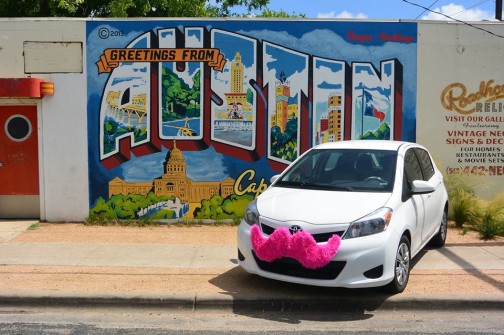
And Lyft and Uber both began providing rides in Austin once again.

The law is effective immediately. It overrides local laws passed by cities like Austin to govern ride hailing companies.

“Texas has longtime been the home for innovation and economic growth, but a patchwork quilt of compliance complexities are forcing businesses out of the Lone Star State,” Gov. Abbott said in a news release. “My goal as Governor is to remove the barriers of government to encourage competition, and empower consumers to choose. This bill increases economic liberty while still ensuring customer safety, and I thank Representative Chris Paddie for his work on this legislation.”

The new law requires drivers to undergo an annual criminal background check, provide information to the consumer before each ride, provide electronic receipts to passengers and a zero-tolerance intoxication standard for drivers will be strictly enforced.

Lyft did a blog post on its return to Austin and is offering discounts at select local restaurants to its riders.

“Today’s bill signing creates a ridesharing network in Texas that benefits consumers, expands transportation options, maximizes access to safe, affordable rides and creates expanded earning opportunities for Texans,” said Chelsea Harrison, Lyft’s Senior Policy Communications Manager. “Riders and drivers are the real winners today. We want to thank Governor Abbott and the Legislature for their leadership on this important issue.”

17 Companies Named Winners of the 2017 Austin A-List of the Hottest Startups

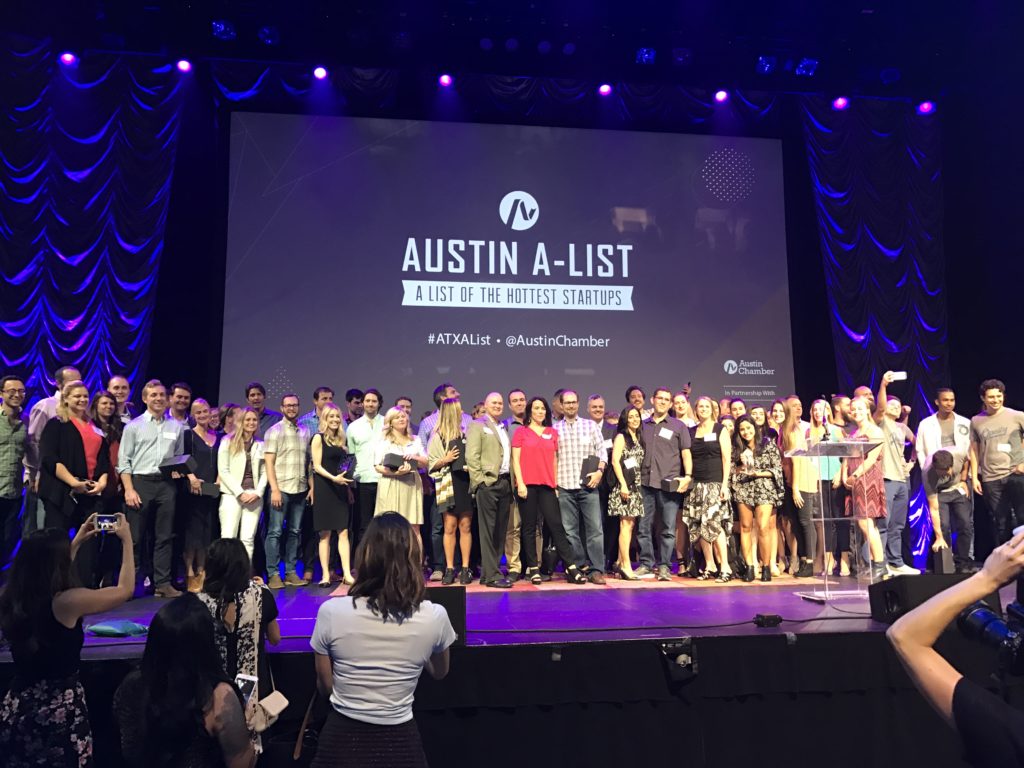
The Austin A-List Winners on stage following the event.

By LAURA LOREK
Publisher and Reporter with Silicon Hills News

More than 800 people turned out Thursday night at ACL Live at the Moody Theater to celebrate 17 companies that made the Austin Chamber’s 2017 Austin A-List of the Hottest Startups.

“In many ways, A-List is a lot like SXSW in that it helps shine a very bright spotlight on all the creativity and all the out of box thinking that originates in our amazing city,” said Hugh Forrest, chief programming officer with SXSW, which co-sponsors the awards with the Chamber.

This year, the Austin A-List received 176 nominations, he said.

“The quality was some of the best I’ve ever seen,” Forrest said.

A panel of independent judges chose the winners in three investment stage categories: emerging, growth and scale.

“High growth startups play an important role in Austin’s economic success,” Jonathan Packer, Interim Senior Vice President, Global Technology and Innovation, said in a statement. “Through entrepreneurship, Austin has become an established center of innovation, with companies operating in myriad traditional and emerging industries.”

Now in its seventh year, the A-List is a chance for the city to show off its best and brightest young companies. Doreen Lorenzo, Director for the Center of Integrated Design at UT Austin and former president of Frog Design and Quirky, served as master of ceremonies for the event.

In the emerging category for early and seed stage companies, the winners included Banyan Water, Convey, data.world, EverlyWell, Maggie Louise Confections and Orca.

In the growth or mid-stage category, the winners included Aceable, Digital Pharmacist, Dropoff, High Brew Coffee, Opcity and Tenfold.

In the scale or later stage category, the winners included Certain Affinity, Drillinginfo, FloSports, Pivot3 and Tiff’s Treats.

A new feature this year, several Austin business leaders gave five-minute lightning talks on a variety of topics including artificial intelligence, gaming, empowering women, venture capital, healthcare and cultivating ideas.

Also, new this year, Southwest Airlines gave certificates worth 10,000 bonus reward points to the first 800 people at the event. Other sponsors included Google, Facebook, AT&T, SkylesBayne, DellEMC and Merrill Lynch.

Mike Smerklo, Co-founder and Managing Director of Next Coast Ventures, delivered the first lightning talk.

He advised entrepreneurs to think big, think of disruptive ideas in large markets, create amazing customer experiences and build a phenomenal company culture.

“It’s never been a better time to start a business as an entrepreneur,” Smerklo said. “It’s never been less expensive, there’s never been more capital available, there’s never been ease of things like AWS in terms of compute power.”

Akshay Sabhikhi, CEO and founder of CognitiveScale, gave an overview of artificial intelligence and the applications his company is developing.

The convergence of cloud, mobile, data and digital natives are driving the adoption of artificial intelligence, he said.

Burnie Burns, Co-Founder of Rooster Teeth, started his company in 2003 in a spare bedroom in his house with his friends. Their goal was to create videos that would make their friends laugh.

Today, the company has 300 employees and it regularly produces 40 different shows.

“And we get asked all the time, why build this company in Austin. Why not build an entertainment company in Los Angeles? Why not move it to New York?” Burns said.

Austin has provided inspiration and opportunity to Rooster Teeth, Burns said.

Burns showed a video clip from a show Rooster Teeth produces. For the shot, the company closed Congress Avenue. In Hollywood, it would have cost hundreds of thousands of dollars or millions of dollars to do the same shot, he said. But Rooster Teeth did the shot for $10,000 in Austin, he said. That’s a huge competitive advantage to being in Austin, he said.

Other speakers included Ruben Rathnasingham, Assistant Dean for Health Product Innovation at Dell Medical School, talking about improving healthcare delivery in Austin and creating new startups through its Texas Catalyst program. And Ingrid Vanderveldt, Founder, Chairman & CEO at Vanderveldt Global Investments & EBW2020, with her mission to empower women through entrepreneurship.

Lastly, Roy Spence, Co-Founder and Chairman at GSD&M, showed a picture he took of a double rainbow from his backyard in Austin. He told people it was a sign to double down on their dreams. He gave an inspirational talk about America being the land of opportunity and he implored everyone to focus on ideas and to appreciate hard work done in factories, farms and cities. He even thanks TSA agents, he said. People need to value the hard work of others, he said.

“We are the people who create the answers and the solutions to the wicked problems,” Spence said.

The next big challenge for entrepreneurs in Austin is to help America become the nation of ideas again, Spence said.

In an interview following the event, Bob Metcalfe, professor of Innovation at the University of Texas at Austin and Ethernet Inventor, served as a judge for the A-List Awards and said it was fun reading all 176 nominations.

“You get what you celebrate,” Metcalfe said. “And what we need are startups.”

The A-List Awards is a great opportunity to showcase all the talented entrepreneurs in Austin, Metcalfe said.

“I would give a round of applause to all 176, not just the winners,” he said. It was very hard to choose the winners, he said.

And although many of the startups are tackling big ideas, Austin still doesn’t have enough big ideas – those ideas that are non-apps, Metcalfe said. And the city doesn’t have enough CEOs to run the big idea startups here, he said. A lot more venture capital will come to Austin when the city has seasoned CEOs that can provide a return to investors, he said.

“We have to develop our talent base for CEOs in particular,” he said.

The startups in Austin are the training ground for the next generation of executives and entrepreneurs locally, Metcalfe said. That’s why they are so important to the city’s technology ecosystem, he said.

In an interview following the event, Chris Skyles, partner of SkylesBayne, an Austin-based Commercial Real Estate firm founded in 2006, said he sees the technology industry as the lifeblood of Austin. And the growth is not slowing down, he said.

“We’re early in the game,” Skyles said. “I’m very impressed with the caliber of the entrepreneurs.”

As a result, the city’s deal flow is expanding, Skyles said. Technology is now, by far, the largest industry in Austin and it was not that way 15 years ago, he said. And the emerging life sciences industry is also going to contribute significantly to the city’s growth, he said.

“My biggest concern is that developers get more product out faster, more buildings up faster,” Skyles said.

Forrest with SXSW said Austin is still growing and developing.

“If you look at this show, we’ve grown significantly over the five years I’ve been involved,” he said. “There is still a ton of buzz, a ton of momentum about Austin on a national and international scale. People are still coming here and wanting to be involved in the startup ecosystem so I think we’re still growing.”

Austin’s best days are still ahead of the city, Forrest said.

Uber and Lyft Announce Plans to Return to Austin on Monday

Photo courtesy of Lyft

Uber and Lyft, the ride hailing companies, that rode off into the sunset a year ago when they couldn’t reach agreement with local officials, have announced plans to return to Austin on Monday.

“Austin is an incubator for technology and entrepreneurship, and we are excited to be back in the mix. Our local team is focused on making sure that Uber works for Austinites and helping our driver-partners earn,” Travis Considine, Uber spokesman, wrote in a statement. “We know that we have a lot of work to do in the city, but we couldn’t be more excited for the road ahead.”

The return to Austin comes on Monday as Governor Greg Abbott is expected to sign HB 100, a statewide law governing transportation network companies, also known as ride hailing or ride sharing companies, in Texas. The law overrides existing regulations enacted by cities across the state, including an Austin ordinance requiring fingerprint background checks on all ride hailing company drivers.

“We’re excited to return to Austin on Monday,” according to a statement from Lyft. “As we’ve said for months, we will relaunch in the city as soon as Governor Abbott signs HB 100 into law.”

The statewide law requires the ride hailing companies to conduct an annual criminal background check on each of its drivers. And it stipulates that each driver is a contractor for the company and not an employee. But it does not require a fingerprint background check.

The law also requires drivers not to discriminate against passengers based on race, age, disability or area of town. The law would take effect Sept. 1st.

Billionaire Mark Cuban Leads $1.5 Million Investment into Austin-based Meta SaaS

Arlo Gilbert, CEO & Co-Founder at Meta SaaS, courtesy photo.

Billionaire Mark Cuban is leading a $1.5 million seed round investment into Austin-based Meta SaaS, which runs a platform for managing software as a service subscriptions for companies.

The startup announced the investment this week which also includes Bazaarvoice and data.world Founder Brett Hurt and participation from Barracuda Networks, Capital Factory, Deep Space Ventures and other investors.

“SaaS has solved numerous business problems, but it has also created a whole fresh set of pitfalls that can cost companies tens of millions of dollars annually,” Arlo Gilbert, CEO and co-founder of Meta SaaS said in a news statement. “The traditional method of tracking SaaS subscriptions and contracts via spreadsheet (if at all) isn’t going to cut it. In many cases, companies have absolutely no idea how many SaaS applications they’re paying for or using.”

“We’re generating and processing more data than ever due to the likes of artificial intelligence, machine vision and deep learning,” Mark Cuban, entrepreneur, investor and Meta SaaS advisor said in a news statement. “That tidal wave of data has been inextricably tied to an explosion of SaaS vendors supporting the industries advancing these complex technologies. Meta SaaS has an incredible opportunity to navigate those costly vendor waters and save companies serious money.”

Meta SaaS tracks company online subscriptions and find the ones that are not being used frequently or have been abandoned altogether. It ultimately saves a company time and money.

In addition, the Meta SaaS software can notify a company when an employee leaves to end their access to subscription applications.

Meta SaaS, founded in 2016, plans to use the funds on product development, to hire software engineers and on sales and marketing. Its customers include RetailMeNot, Spredfast, Indeed, BenefitMall and Civitas Learning.

“Gilbert and CTO Scott Hertel co-founded the company after Gilbert realized what a money pit SaaS can be while bootstrapping and rapidly growing both iCall, the first VoIP provider for iPhone (acquired in 2012) as well as affiliate marketing powerhouse Click Feel Media,” according to a news release.

Opcity and Yodle Co-Founder Ben Rubenstein Recounts his Entrepreneurial Journey on Ideas to Invoices

Ben Rubenstein, CEO and Co-Founder of Opcity and Co-Founder of Yodle.

By LAURA LOREK
Publisher and Reporter with Silicon Hills News

At a funding pitch to a venture capitalist, Ben Rubenstein, co-founder of Yodle sketched out a business plan on a napkin.

He showed the potential investor how Yodle was going to raise millions to capture the small to medium sized business market as customers for its marketing software.

At one point, he ordered a drink and the waitress requested to see his I.D. She didn’t believe the 21-year-old Rubenstein was old enough to drink.

“Here I am asking for millions of dollars and I can’t even order a drink,” Rubenstein said.

In 2005, Rubenstein launched Yodle out of the University of Pennsylvania with his childhood friend Nathaniel Stevens. They initially targeted the automotive industry. They also brought on John Berkowitz as a co-founder. For two years, they bootstrapped the company. Rubenstein slept on a AeroBed Air Mattress in his friend’s house.

In the beginning, they went door to door pitching their product to small businesses. It took them two years to get to one million dollars in recurring revenue. And at that point, they raised their first round of investment and moved the company from Philadelphia to New York.

They created the term Yodle because they wanted to create a Yodel or shout out for small businesses. They couldn’t buy the Yodel domain name but they could buy Yodle.com.

Rubenstein and his co-founders pitched more than 50 VC firms before they landed their investment. They were able to deal with the rejection because they had faced so much of it making cold calls on small businesses, Rubenstein said.

“With cold calls, if you make 100 phone calls and make one sale, you’re a hero, you’ve had a good day,” Rubenstein said.

To get customers, Rubenstein and his co-founders spent the weekend at trade shows demoing their software and pitching to customers. They eventually spent more time on the phone and hired a large inside sales team to cold call small businesses. With the advent of WebEx and GotoMeeting, they were able to effectively demonstrate the software online.

Sales were integral to the success of Yodle.

And Yodle recruiters would ask people when they hired them to talk about the first time they sold something, Rubenstein said.

Rubenstein launched his first business venture in fifth grade. He would buy Airheads candy and sell them for 25 cents a piece to his classmates. He only had 25 people in his class so soon he enlisted his friends to sell the candy in their classes and bring him the proceeds. At one point, a kid decided to launch his own candy business selling his product for 15 cents. But Rubenstein resisted dropping his prices. He sold out every day so he kept selling his candy at 25 cents despite the new competition.

“I learned at an early age how to sell things,” Rubenstein said.

Throughout scaling Yodle, Rubenstein learned a lot about how to hire great sales people and how best to sell the product.

Today, Rubenstein is putting all the lessons learned from Yodle to work at Opcity, a real estate technology platform that provides real estate leads to vetted brokers. He is using data, analytics and pattern identification to make the best matches that will lead to brokers closing deals.

Recently, Opcity raised $27 million to roll out the company nationwide. It is hiring. It plans to go from 100 employees to 300 employees by the end of the year.

For more on how Opcity is going to create an even bigger company than Yodle, which Web.com bought in 2016 for $342 million, listen to the podcast.

Editor’s note: Silicon Hills News recently launched on Patreon. Please visit the site to pledge just $1 a month to support the Ideas to Invoices podcast and other work we do at SiliconHillsNews.com. Thank you in advance for your support!

Austin Chamber to Host the 2017 A-List Hottest Startup Awards

Austin is known for innovative startups.

And the Austin Chamber of Commerce shines a spotlight on the best and brightest every year at its annual A-List Of Hottest Startups Awards.

The event, which takes place next Thursday from 4:30 p.m. to 7:30 p.m. at ACL Live at the Moody Theater, is one of the city’s biggest events to showcase the startup talent locally.

“The program is different this year,” said Jonathan Packer, who currently leads tech and innovation initiatives at the Austin Chamber.

The program features seven Austin technology and business leaders who will each give lightning talks, lasting about five minutes, on the future of business innovation in Austin.

“Austin could be a platform for multiple versions of innovation in software, consumer products groups and healthcare,” Packer said. The Austin Chamber chose the speakers to represent a diverse mix of what it means to do innovation in Austin, he said.

The speakers include Ingrid Vandervelt, Founder, Chairman & CEO at Vanderveldt Global Investments & EBW2020, Burnie Burns, Co-Founder of Rooster Teeth, Mike Smerklo, Co-founder and Managing Director of Next Coast Ventures, Doreen Lorenzo, Director for the Center of Integrated Design at UT Austin and former president of Frog Design and Quirky, Roy Spence, Co-Founder and Chairman at GSD&M, Ruben Rathnasingham, Assistant Dean for Health Product Innovation at Dell Medical School and Akshay Sabhikhi, CEO CognitiveScale.

This year, the Austin Chamber received 176 nominations for its A-List awards and a final selection committee chose the 17 winners in the following categories: emerging, growth and scale.

“It’s a really good set of companies representing a diversity of industries,” Packer said.

Also new this year, Southwest Airlines is giving 10,000 bonus reward points to the first 800 people to register for the event. As of Friday afternoon, there were only a few spaces left, Packer said. Tickets are $25 in advance or $35 at the door.

« Older posts Newer posts »

© 2026 SiliconHills

Theme by Anders NorenUp ↑