
Silicon Hills News Reporter Andrew Moore interviews Wimbo Music’s Chief Technical Officer Greg Cerveny in the first episode of Slice of Silicon Hills. The show is recorded and produced at the Silver Fox Studios at Geekdom in downtown San Antonio.
If you’re interested in being on a future show, please send us an e-mail. The goal of the show is to shine a spotlight on Austin and San Antonio technology companies and entrepreneurs and those visiting the area to participate in local incubators.
Category: San Antonio (Page 38 of 62)
 Austin’s top technology company, Dell announced today that it has signed a deal with Founder Michael Dell and Silver Lake to acquire the company and take it private in a deal valued at $24.4 billion.
Under the agreement, Dell stockholders will receive $13.65 in cash for each share of Dell common stock. The price represents a 25 percent premium over Dell’s closing share price of $10.88 on Jan. 11, the last day of trading before rumor slipped out about the company going private.
The buyers will acquire for cash all of the outstanding shares of Dell not held by Mr. Dell and certain other members of management.
The transaction is expected to close before the end of Dell’s second quarter pending regulatory and shareholder approval.
“The Special Committee and its advisors conducted a disciplined and independent process intended to ensure the best outcome for shareholders,” Alex Mandl, lead director of Dell’s Board of Directors, said in a news release. “Importantly, the go-shop process provides a real opportunity to determine if there are alternatives superior to the present offer from Mr. Dell and Silver Lake.”
Dell said the transaction opens “an exciting new chapter for Dell, our customers and team members. We can deliver immediate value to stockholders, while we continue the execution of our long-term strategy and focus on delivering best-in-class solutions to our customers as a private enterprise. Dell has made solid progress executing this strategy over the past four years, but we recognize that it will still take more time, investment and patience, and I believe our efforts will be better supported by partnering with Silver Lake in our shared vision. I am committed to this journey and I have put a substantial amount of my own capital at risk together with Silver Lake, a world-class investor with an outstanding reputation. We are committed to delivering an unmatched customer experience and excited to pursue the path ahead.”
At BlogItSA on Saturday at Geekdom in downtown San Antonio, I gave a presentation on ways to tell stories using online tools.
I’ve embedded the slideshare presentation here because these tools are also helpful for startups to blog events and news in their industry.
 San Antonio-based TrueAbility made the finalist list for the SXSW Accelerator in March.
TrueAbility, one of the TechStar Cloud companies based at Geekdom, is the only startup from Central Texas to make the list. A few Austin companies made the alternates list including Clay.io and Spot On Sciences.
TrueAbility will compete in the Innovative Web Technologies category on Monday, March 11 and Tuesday, March 12 at the Hilton Hotel in downtown Austin.
“TrueAbility helps companies hire only the best technical talent by assessing a job candidate’s technical skills in a live server environment–from anywhere in the world,” according to its description on the accelerator page. “TrueAbility shortens the recruiting process and delivers objective, easy-to-use pre-hire data that helps businesses hire great techs.”
 TrueAbility’s team is made up of Luke Owen, Frederick “Suizo” Mendler, Marcus Robertson and Dusty Jones. The company recently closed on $750,000 of seed-stage funding.
SXSW reported that more than 500 companies applied for the fifth annual SXSW Accelerator.

BY ANDREW MOORE
Reporter with Silicon Hills News
Start-up companies are crucial to the San Antonio economy, said San Antonio City Manager Sheryl Sculley.
“We recognize that new and young companies and the entrepreneurs that create them are the engines of job creation and critical to economic recovery,” she said. “In fact, studies indicate that net job growth occurs in the US economy primarily through startup firms.”
Sculley spoke at the Texas Technology Development Center – or T3DC’s first quarterly luncheon held last Tuesday. T3DC is part of the Texas Research and Technology Foundation. Headed by H. Randall Goldsmith, T3DC helps incubate and fund new medical companies in the San Antonio area.
Sculley said one of the key parts of San Antonio’s economic development is forging partnerships with T3DC, Geekdom, the UTSA CITE incubator, the San Antonio Clean Energy Incubator, and the TechStars Cloud program.
At the event, three local biotechnology startups presented their companies.
GenSpera
First up, GenSpera gave an overview of G202, its lead drug, which is in Phase 2 clinical studies for treating liver and prostate cancer.
The drug has a molecule called a peptide that acts as a grenade pin – only releasing when it comes in contact with a solid tumor formed within a patient’s body. This allows the drug to release an extremely powerful cancer killing agent at just the right time to only kill the cancerous cells nearby without re-entering a patient’s bloodstream and damaging other parts of the body.
According to Dr. Craig A. Dionne, GenSpera’s president and CEO, the drug has some decisive advantages over the competition. While patients taking the drug may suffer from nausea, rashes, and fatigue in the first few days of treatment; the drug avoids more damaging side effects. Patients taking G202 suffer no hair loss, no effect on the cardio vascular system, no effect on the liver, and no effect on their bone marrow – all of which are problems encountered with other cancer treatments. The drug can also be used for a longer term than other treatments. Dionne sees a major opportunity in the current market to sell the drug to bigger pharmaceutical companies.
“Drugs in the oncology space with positive phase two data commonly go for a billion dollars,” Dionne said. “It seems like an absurd number but it illustrates how desperate large pharmaceuticals are for drugs to fill their pipeline.”
Dionne claims that GenSpera could get to that point in 18 months to a year.
GenSpera has raised $18 million since 2007 and has only $2.5 million left in the bank. It is currently looking for funds to complete its phase 2 studies.
Evestra Inc.
Emerging biopharmaceutical research and development company Evestra Inc. presented second at the luncheon. It received a $50,000 check from T3DC.
CEO Dr. Ze’ev Shaked said its mission is “to develop and commercialize high-value innovative women’s health products.
Established in 2008, Evestra originated as part of the Organic Chemistry Department of Texas Biomedical Research Institute. The company has raised $8 million since 2008 and expects to have raised $12 million by 2015. Evestra is working hard to put its products on the market as soon as possible. Its leading product is the E112 vaginal ring contraceptive.
“We are putting all our resources to commercialize this as quickly as possible with our European partners,” Shaked said.
The E112 product is going into phase one and will have clinical trials later this year. The company is starting early-stage trials with other products as well. Evestra is planning to move to the Texas Research Park – another extension of the TRTF — later this year to conduct more research and development.
“We are poised to become a major player in women’s health,” Shaked said.
Invictus Medical

Daniel Mendez of Invictus Medical, photo by Andrew Moore
The device was invented by UTSA graduate Daniel Mendez, who entered and won the UTSA CITE entrepreneurship and technology competition with his invention in 2010. He later won Top Honors at the 2011 Innotech Beta Summit conference as well. Mendez now serves as the CTO of Invictus Medical in addition to pursuing an MBA at UTSA.
Presenter and company CEO Tom Roberts says 25 percent to 30 percent of babies a year develop this condition, and the risk is even higher with premature births.
“The reason we exist at Invictus Medical is to improve the lives of new born babies and healthcare providers that take care of them,” Roberts said.
Roberts said Invictus will start by focusing on the 500,000 babies in the neonatal intensive care unit – or NICU – market. He claims that the company can break even by hitting as little as 2% of this market and is confident about the future.
T3DC is the lead investor for Invictus Medical. The prototypes will be produced by Globe Medical in Houston Texas and the clinical partner for the device is the University of Texas at San Antonio. The company needs to raise $500,000 to commercialize their product. According to Roberts, the company started raising money in January and is already half way there.
 Nick Longo, director of Geekdom, provides this insight into Geekdom, a year-old collaborative coworking space in downtown San Antonio. It is Texas’ largest co-working site. Geekdom, which is a sponsor of Silicon Hills News, has expanded from the 11th floor to the 10th floor. It’s home to the TechStars Cloud.
Geekdom 2.2 video from The IMG Studio on Vimeo.
 Admittance Technologies has received $1.99 million investment from the Texas Emerging Technology Fund.
The San Antonio-based company created the CardioVol technology platform to measure blood volume measurement using pacemaker to detect disease and treat patients with the devices.
“We are thankful for the investment from the ETF and the expertise that Startech provided during the process,” Dr. Marc Feldman, Founder and CEO of Admittance Technologies, said in a news release.
Dr. Feldman is a Professor of Medicine & Engineering at UT Health Science Center at San Antonio as well as the co-winner of the 2010 Chancellor’s Entrepreneurship Award for the University of Texas system.
Funding from the Texas Emerging Technology Fund allows researchers at the University of Texas Health Science Center at San Antonio to take “their ideas from concept to commercialization,” said David Weiss, vice president for research at the university.
 Adometry, formerly Click Forensics, announced it has completed an $8 million round of financing.
The Austin-based company plans to use the money to develop products, recruit employees and expand into new markets.
Shasta Ventures led the financing round which included participation from Austin Ventures and Sierra Ventures. In addition, Shasta Venture’s Jason Pressman will join Adometry’s Board of Directors.
The company plans to further develop its Adometry Attribute™ platform, which provides marketers with analysis of the performance of their cross-channel marketing campaigns.
“Our focus has always been to deliver the best possible products for advertisers so that our customers and agency partners around the world are better able to understand and make decisions about their marketing spend,” Paul Pellman, CEO of Adometry, said in a news release.
Click Forensics, originally founded in San Antonio, bought Adometry in 2011 and changed its name.
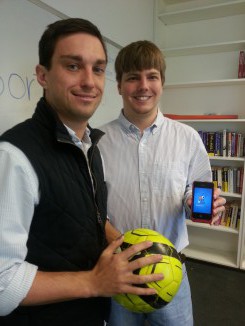 Want to keep track of your kids’ soccer stats throughout the season and years?
SportyBird.io, a new San Antonio-based startup, has created a mobile application for that.
Founded by Josh Swank, 28, and John Trenholm, 27, SportyBird has created a cloud-based platform for community soccer teams to collect player stats throughout the season.
One parent at each game uses the mobile app to compile stats and then they are uploaded to a database for all the parents, players and the coach to access. The company plans to make money by charging a subscription fee up to $70 a year.
SportyBird is the latest recipient of a $25,000 investment from the Geekdom Fund. The pre-seed stage funding will help the startup to create their product, Swank said. They plan to conduct a beta test for the next two months and then launch publicly, he said.
“I am impressed with Joshua’s tenacity,” said John Mosher, a member of the Geekdom Fund’s selection committee. “He was initially rejected by the Geekdom Fund but did not give up. He worked very hard and came back with a very focused product. This is exactly the type of company that Geekdom and the Fund should be supporting. They are developing a very interesting niche product that I know from personal experience is very needed.”
Swank went to college on a soccer and academics scholarship at Duke University and ended up transferring to Georgia State. He currently works as a commercial real estate investor and coaches soccer at night.
Trenholm, who ran a web hosting business in high school in Houston, started working at Rackspace in 2006 while attending the University of Texas at San Antonio. He recently left Rackspace to finish his degree and launch SportyBird.
Trenholm and Swank first met at 3 Day Startup San Antonio. They had a much broader soccer-based idea they first tried to pursue. But they decided to focus instead on compiling stats on players and community games.
“My favorite part about SportyBird is that as a 3 Day Startup team they kept going afterwards,” said Nick Longo, director and co-founder of Geekdom. “From the original idea and their passion about kids and soccer, they found a great tool to make parents and coaches to track how well the kids do and how the games go. Can’t wait to see the first launch and all the other sports they can do next.”
Geekdom is a sponsor of Silicon Hills News
 Rackspace claimed the 34th spot on Fortune’s annual list of the 100 best companies to work for in the United States.
Rackspace has quickly grown from a startup web hosting company founded in 1999 to a $1 billion cloud computing company with more than 4,500 employees, the bulk of which occupy a refurbished old mall which serves as its headquarters on the Northeast side of San Antonio.
“The IT cloud company’s stock jumped from $43 to $74 in 2012—good news for employees, all of whom get stock options upon being hired. The company also rewards top sales performers with free weekend trips,” according to the article. Last year, Rackspace claimed the 74th spot.
 National Instruments, founded by a UT engineering graduate students James Truchard, Bill Nowlin and Jeff Kodoskyin a garage in Austin in 1976, has also grown into a $1 billion company with 6,200 employees. The company makes testing equipment and software. It ranked 35th on Fortune’s list.
“This developer of test and measurement tools enjoy its sense of equality and collaboration. “My cubicle is bigger than the CEO’s,” gloats one. The company gym offers 16 classes a week and two sand volleyball courts,” according to the article. Last year, National Instruments claimed the 45th spot.
Other San Antonio companies on the list included NuStar Energy, 38 and USAA, 40. Whole Foods Market in Austin claimed the 71st spot.