Category: Austin (Page 264 of 318)

We Are Austin Tech Shines the Spotlight on Chuck Gordon of Sparefoot

sparefoot-logo-200-2This week, We Are Austin Tech shines the spotlight on Chuck Gordon, co-founder of the world’s largest market for self-storage: Sparefoot.
The company, founded in 2008, is a graduate from Capital Factory accelerator and has raised $4.5 million.
Gordon and Mario Feghali founded the company during their senior year at UCLA. Today, SpareFoot has 60 employees.
“The best advice I have for up-and-coming tech entrepreneurs is something that was ingrained very early on in Capitol Factory: fail fast, fail quickly,” Gordon says in the video. “You have to understand that everything you try is not gonna work. And you need to just keep trying stuff until you find what does. We changed around what we were doing all the time at the beginning — we still do all the time.”

Door64 to Host Startup Showcase on March 8th

austin_showcaseDoor64 is putting on a startup showcase next Friday, March 8th.
The event is designed to shine the spotlight on local startups right as South by Southwest Interactive kicks off.
Already, 200 people have signed up to attend the event, says Eve Richter, Door64 spokeswoman.
The event takes place at the Norris Conference Center at 2525 West Anderson Lane from 10 a.m. until 2 p.m. It’s free to register.
The Startup Showcase will feature a series of talks on funding along with a pitch event.
To participate, fill out the Showcase Startup Application.
To have a table at the event, fill out the Showcase Service Provider Application.

Austin-based Click Security Lands $17.7 Million in Financing

provide real security value and leverage the security expertiseClick Security a real-time security analytics company, has received $17.7 million in Series B financing.
The Austin-based company raised a Series A round led by Sequoia Capital of $7 million in 2011, bringing its total funding raised to $24.7 million.
Lightspeed Venture Partners led the round of financing with other investors including Citi Ventures and Sequoia Capital. Click Security plans to use the money to expand sales, marketing and engineering.
Click Security has customers in financial services, higher education, and retail. The company’s products alert companies to a cyber attack potentially hidden in big daa.
“Click’s core technology and solution approach has the potential to reshape the manner and speed of modern threat detection, analysis and early stage response. There still remains a significant gap in the way organizations safeguard against sophisticated attacks, and Click is approaching this with a very interesting solution model,” Mike Goguen, Managing Partner, Sequoia Capital, said in a news release.
“The business of global cybercrime, by some estimates, now exceeds $300 billion annually. Traditional security defenses are clearly not getting the job done. We believe Click Security has developed a unique approach to providing real-time visibility into the unknown – representing a game changer for organizations looking to take back their networks,” John Vrionis, Partner, Lightspeed Venture Partners, said in a news release.

Texas State University’s STAR Park keeps High-Tech Companies in Texas

BY ANDREW MOORE
Reporter with Silicon Hills News

STAR park Executive Director Stephen Frayser in the STAR one labs. Photos by Samantha Davis

STAR park Executive Director Stephen Frayser in the STAR one labs. Photos by Samantha Davis

How does a small or mid-sized company create a product on the cutting edge of material science or nano-technology? Not only would they need to acquire or rent multi-million dollar equipment, but they would need access to dedicated lab space and support staff. Traditionally, companies would need to relocate to Silicon Valley to access these resources – but soon, those same companies will have the option of going to Texas State University.
Texas State University has just opened its new Science, Technology, and Advanced Research Park – or STAR Park for short. The park is 38 acres and about five minutes from campus. The university dedicated the first facility of the park — STAR One– on Nov. 9, though the building is not yet ready for occupancy. The park is funded by Texas State University, the Economic Development Administration of the U.S. Department of Commerce, and the city of San Marcos. It is a $7 million investment, and a central part of Texas State’s plan to move toward becoming a tier one research university.
Texas State University’s Associate VP for Research and Federal Relations Bill Covington says that the STAR Park benefits the university and its students as well as the local economy.
“Any time we bring in a company that gets started and starts hiring people it’s good for the economic development for the area,” says Covington.
STAR Park Executive Director Stephen Frayser says the goal of the park is to create a technology incubator and a collaborative community of startups and mid-sized companies that will be able to grow quickly by using Texas State’s unique resources.
“The whole purpose of an incubator is time-to-market,” says Frayser. “What you are trying to do is help companies get the assistance that they need at the time they need it so they can get into the market more efficiently than a competitor that had no assistance.”
STAR One will be ready for occupancy by April. The 20,000-square-foot facility has office space, a conference room, and five lab areas that include chemical labs and clean rooms. When completed, it will be 38,000-square-feet, hold six additional labs, and will host up to 11 companies. Labs in STAR One come with de-ionized water, nitrogen, and compressed air. The facility is also equipped with back-up power and provides waste removal services on site at a reduced cost.
Three companies are already scheduled to move into the new facility in April. MicroPower Global, one of these companies, has already been collaborating with the university research faculty for three years and will now be able to move ahead with their product.
“We have identified an ideal situation where our technology can be finally developed as an embedded company on the campus of Texas State University,” says MicroPower Global’s Chief Technology Officer Tom Zirkle. “STAR One provides us an opportunity to pull that developed technology into pilot production.”
Multi-functional Materials Laboratory

Multi-functional Materials Laboratory

MicroPower Global will also have access to the $7 million Multi-functional Materials Laboratory located on the Texas State University campus. Startups and mid-size companies alike will have access to this top-of-the-line equipment — in addition to STAR Park faculties — once they sign research agreements with the university. The laboratory gives Texas Statue University a major advantage in attracting companies that are on the cutting edge of semiconductor technology.
“Our niche right now in the market is material sciences, nano-materials, and semi conductors — and we have a core staff of people and some fairly deep facilities here that let us stand out from anybody else in the U.S.,” says Frayser.
The different material laboratories at Texas State University currently allow companies to do research at almost the same level as in Silicon Valley. Texas State’s Molecular Beam Epitaxy machine — or MBE – allows them to do advanced research on nano-sized semiconductor materials for extremely small and versatile computer chips. The labs can also create membranes, adhesives, and very simple nano-machines. Companies and startups working at STAR One will be able to use this advanced equipment at the university to do their research and produce prototype technologies – all at a greatly reduced cost versus renting the equipment on the open market.
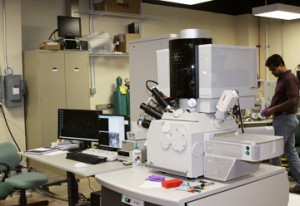
Labs have equipment that can create Nano-sized objects.

Labs have equipment that can create Nano-sized objects.

These resources are not available to just any interested company, however; there are two requirements for companies that use the facility. First, the company must be developing a unique technology – or one that is not an extension or addition to another technology already on the market. Secondly, the company must have an arrangement that is mutually beneficial to Texas State University, such as a partnership with university faculty or an agreement to utilize Texas State University students as interns.
MicroPower Global has already hired several full time employees from inside the university and currently has six TXST interns doing research for the company. CTO Zirkle says the interns play a major role in the companies’ research.
“They actually have hands on experience doing the very precise processing of the semi-conducter devices that we’re developing,” says Zirkle. “They have an opportunity to have exposure to how a small business operates — how an entrepreneurial environment feels. As we are developing new ideas to solve problems, they actively participate with us in those problem solving sessions.”
Putting students in these hands-on research roles is a key part of the STAR Park’s mission. TXST has already established a Material Science, Engineering and Commercialization PH.D. program — or MSEC — for the purpose of educating students in both the science side and business side of creating a technology company. Park Director Frayser says these students will be ideal candidates for internship positions with companies staying at STAR One.
“One of the biggest complaints businesses have of people they hire from universities is that they have no concept beyond theory of how things really work,” says Frayser. “This intention is to get our graduates to a point where they can become key individuals with firms. One of our Ph.D.s has already been hired by MicroPower to be one of their chief scientists. ”
Frayser says the STAR Park has already generated interest with several other parties besides the three firms coming in April. All companies and startups accepted to the park will pay the market rate for similar lab and office space. Frayser says that the park will try to admit companies that can complement each other as the park develops. Administrators will also help facilitate collaboration between their tenant companies by assessing the strengths and needs of their tenants to help them form mutually beneficial partnerships.
“We have individual companies but then we are going to encourage collaboration where it makes sense to work together on things,” says Frayser. “We want to create a community.”
Though not all research parks are successful, both Frayser and Covington are very optimistic about the future of technology in the San Marcos area.
“I think we are doing this at the right time and in the right way, and we are certainly in a great location in the state of Texas,” says Covington.

From Cloud to Crowd: Nuboso Feeding SiteB Growth

BY RANDY LANKFORD
Reporter with Silicon Hills News

fred1-1SiteB Data is becoming larger by thinking smaller.
Founded in 2009, SiteB Data in San Antonio is primarily a colocation data storage service. Businesses that don’t have the wherewithal to build the infrastructure to securely manage and store massive amounts of data, use SiteB’s data center instead.
“Colocation is usually used by small organizations with specific storage needs, like educational systems or medical providers, that have some infrastructure but don’t want to invest in everything that goes into a data center like air conditioning and backup power,” explains Fred Reyes, CEO of SiteB.
There’s also the environment to consider. Not what the business is doing to the environment, but what the environment can do to the business. Companies located along Texas’ gulf coast, for example, don’t want to store precious data in the path of a hurricane. It’s much safer to store that information in San Antonio and then access it remotely.
Eric Elliott, chief information officer of the Texas Organ Sharing Alliance (TOSA), agrees. One of only 58 independent, federally-designated Organ Procurement Organizations in the United States, TOSA has massive and critical data storage and processing needs. With locations in San Antonio, Austin and McAllen, TOSA chose SiteB’s colocation services because of service and reliability.
“We’ve been very satisfied,” Elliott says. “They give us that personal touch that other colocation services are just too big to provide. There have been times when I’ve had to call someone in the middle of the night and SiteB has always been there. They’ve been very responsive, very reliable.”
But what about even smaller businesses, startups, companies with a great idea and little more? Where do they store their critical data? Where do they get the processing power to run their often one-of-a-kind applications? That’s a question SiteB is answering with its Nuboso Cloud-based hosting brand.
Nuboso was introduced at Austin’s South By Southwest (SXSW) Festival in 2011. Focused on art, music and interactivity, SXSW explores emerging technologies and is a breeding ground for new ideas. That’s the grassroots market Reyes wants to be a part of.
“When we launched Nuboso, we got about 50 users right out of the gate,” says Reyes. “And things have been going fast and furious since then. One of the things we do a little bit differently is we don’t sell virtual machines. We sell resources. The reason we did that was when we first looked at the Cloud offerings out there, there are a lot of people offering virtual machines, or Cloud servers, but the end user didn’t gain the benefit of the Cloud. If you needed a virtual machine, you paid one price and then, if you needed another one, you paid that price again.”
Reyes’ model of the Cloud is built on providing a suite of options enabling users to configure their service to best meet their unique needs.
“We sell you a number of CPUs, a certain amount of drive space and a certain amount of RAM. Then you allocate it as you need it. You can cut it up anyway you want. Let’s say you buy five CPUs, seven gigabytes of RAM and 100 gigabytes of drive space. You can slice that into 20 machines or you can make it one machine. So the end user can utilize the Cloud the way they want to.”
Reyes believes providing that flexibility to entry level businesses through Nuboso will build relationships that will grow. “As those businesses start to grow and reach a point where they need dedicated or specialized services, they naturally grow into our colocation services with SiteB.
“We really get in there with our customers, ‘what do you need, what are you looking for?’ We build that initial relationship when they’re using our Cloud computing service and then, as they grow, we provide them additional, more sophisticated services. And, since we’ve been partnering with them from the start and seen how they’ve grown and how their needs have changed, we’re ready to help them take it to the next level.”
SiteB, and its Nuboso product, are located on the near west side of San Antonio in a 27,000-square foot building owned by the Reyes family, a location Reyes says is ripe for growth.
“We’ve developed the first 7,000 feet so we have room to grow. When we looked at this building we realized the surrounding infrastructure was already there. The long-haul fiber ‘railway’ is right behind us and the connection point is only two buildings away. The power grid this building is in is only 40 percent utilized and the building itself was an empty shell so it was sort of screaming to be a data hub.”
Nuboso’s development was completely self-funded by the cash flow of SiteB. “It wasn’t easy,” says Reyes, “but we were able to do it. Once you have the datacenter, you can do a lot of things with it.
“The initial investment, building a datacenter, was huge. That’s not a cheap project. Just the value of the building itself has probably tripled since we started construction in ‘08. We’re probably at 60-70 percent of our current capacity and we expect to reach 100 percent of our current capacity in the next year. We should pay off the initial investment in four years. What’s probably going to happen, obviously, is we’re going to keep investing in growing our facilities and our capabilities. That’s not a hard sell. It’s pretty easy to raise capital when you’re investing it in growth.”

Infochimps Raises $2.78 Million

urlInfochimps raises $2.78 million of a $3 million offering, according to a filing with the U.S. Securities and Exchange Commission.
The Austin Business Journal reported the “filing is an update to an April 2012 report in which the company received $305,000 of a planned $1.3 million financing from six investors.’
“In 2010, about a year after it started, Infochimps got $1.2 million in funding from venture capital firm, DFJ Mercury. This followed $375,000 in seed financing from angel investors,” according to this profile Susan Lahey did on the company last year.
In addition to the financing, Infochimps also announced that it added Burke Kaltenberger as vice president of worldwide sales and Dave Spenhoff as vice president of marketing.
Infochimps started out as a data marketplace but has since pivoted and now provides data management products to companies.

MetroHi.com Embraces a Unique Approach for Reputation Management

BY IAN PANCHEVRE
Reporter with Silicon Hills News

Screen Shot 2013-02-22 at 8.46.17 AMMetroHi.com , a San Antonio based startup in the review management space, started with humble beginnings but is now picking up momentum, and it’s all thanks to a unique approach to an enduring problem.
Radu Istrate, the founder and CEO of MetroHi and a Boston College graduate, first came to San Antonio in 2006 to start a viral marketing company with his sister, a Trinity University grad. His experience with the promotional aspects of online marketing got him thinking broadly about analytics, reviews and reputation management. And he spotted an opportunity.
At the time that MetroHi was founded – in the ever-so-distant era of early 2011 – a wave of interest and excitement was building in the social media analytics space. But the review analytics space was still relatively nascent, and thus afforded an abundance of opportunities for growth and disruption.
“Now there are a lot of ‘Reputation Management Companies’,” explains Istrate. “But a lot of those companies don’t have a technology, they make claims about managing reviews, but they don’t have an application or any…” Istrate pauses to search for the right term, “technical gravitas.”
MetroHi, on the other hand, has plenty of gravitas, both technical and otherwise.
In pursuit of a core mission to provide local businesses an easy and convenient solution for reputation management, MetroHi offers several key services. The first, Review Site Placement, gets a business placed on all the top review sites. The second, Review Boost, drives new reviews for the business from existing customers. Additionally, MetroHi offers a review aggregator dashboard that allows businesses to monitor activity across a number of different review sites, while generating regular reports that capture broad trends.
Despite building an impressive engine for reputation management, MetroHi believes its role transcends the web and includes offline approaches to building reputation.
“MetroHi boosts reviews through a process that combines online approaches with physical materials and in-store promotions,” Istrate elaborates. By producing and distributing materials (e.g. cards and display stands that contain QR codes, which in turn link to a custom landing page) MetroHi makes it easy for customers to post reviews on behalf of brick-and-mortar businesses.
Wait a minute, a review management company that encourages more reviews? This approach may seem counter-intuitive because it cuts against the grain of most reputation management companies, which promote their business by spreading fear of negative reviews.
But MetroHi doesn’t see it that way.
“If you give your customers an easy and convenient way to post a review, the people that will most likely post are your satisfied customers” notes Istrate. Seen another way, if it’s inconvenient to post a review, only the unsatisfied customers will go out of their way to post about their experience.
“By addressing the convenience issue, you give a voice to the satisfied customers and impact the broader conception of the business.”
In turn, MetroHi has adopted a philosophy that values feedback and embraces public chatter. And it just so happens that the lone, disgruntled customer has his voice drowned out by a chorus of overwhelmingly satisfied customers. This contrasts with the approach of traditional reputation management companies, which are more reactive in nature, offering after the fact solutions for businesses once negative reviews appear.
And it seems that MetroHi’s approach is working shockingly well.
Gina Umana, a Financial Advisor at Waddell & Reed, initially engaged MetroHi in the fall for review site placement but ended up subscribing for additional services. The results? “We weren’t even on the sixth page of Google and now the website shows up right away!” proclaims Umana. “We’ve received at least one client who said she was searching online, found our website, and decided to come in and do business.”
Ah, behold! The marvels of the web, and the accomplishment of a local reputation management company that managed to double its client’s monthly web traffic. Yes, gravitas is something MetroHi does not appear to lack. And this non-traditional approach towards review management may no longer be so counter-intuitive, now that it has had endured and proven itself.

Xtreme Power Raises $5.7 Million

Xtreme Power has raised $5.7 million of a $10 million offering, according to papers on file with the Securities and Exchange Commision.
The Austin-based company, founded in 2004, designs, manufactures and installs batteries and power management systems for utility companies. It has 100 employees, according to the Austin Business Journal.
Since launching, Xtreme Power has received $36 million from investors, the Austin Business Journal reports.

SureScore Buys Campus2Careers

-2SureScore, which prepares students for college, announced Thursday its acquisition of Campus2Careers.
Terms of the deal were not disclosed.
Campus2Careers, founded in 2009, matches college students and recent graduates with companies for internships and entry-level jobs.
With the acquisition, SureScore plans to add high school job opportunities and internships.
“C2C has a passionate vision of helping college students make effective decisions about their career opportunities,” Roy Nieto, Founder and Chief Executive Officer of SureScore, said in a statement. “C2C matches each student with career and internship opportunities based upon their unique skills, preferences, and interests. We view it as Match.com meets Monster.com for jobs and internship opportunities.”
Nathan Green, Co-founder and President of Campus2Careers will join SureScore.
“We have been working in the higher education space for the last four years, and the acquisition will enable C2C to expand nationally and increase the services we provide our students,” Green said in a news statement.

« Older posts Newer posts »

© 2026 SiliconHills

Theme by Anders NorenUp ↑