Author: LauraLorek@gmail.com (Page 109 of 354)

LauraLorek@gmail.com

True Wealth Ventures’ Sara Brand and Kerry Rupp Seek to Change the Landscape of Venture Capital Investing

Sara Brand and Kerry Rupp, general partners of True Wealth Ventures

The general partners of True Wealth Ventures want to see more female led companies get venture capital investment.

And they want to see more female venture capitalists making investments in the industry.

The $20 million True Wealth Ventures fund invests in women led companies in the sustainable consumer and consumer health industries.

Sara Brand and Kerry Rupp, general partners of True Wealth Ventures, founded the VC firm after identifying problems in the VC industry. They recently sat down with Silicon Hills for an interview for its Ideas to Invoices podcast.

Brand, who has three degrees in mechanical engineering, spent 20 years in the semiconductor industry and owns a brewery, (512) Brewing Company with her husband. She spent time in venture capital, in technical roles, operational roles and management consulting.

“Looking back, I was pretty much the only woman,” Brand said. “Mechanical engineering, beer, semiconductors, VC at my last role at Advanced Micro Devices I was asked to be the executive sponsor of the global woman’s forum. It was at that point that I realized that I was the only vice president that was a woman that had any technical or operational background and I had not realized that and was very surprised to find that out because I had been so used to being pretty much the only woman. But I couldn’t believe that that was the case.”

That’s when Brand began considering the numbers behind what it means to have more women in leadership positions. She documents an extremely high correlation between women in leadership positions and outstanding financial performance, Brand said.

“So, I started getting really interested in what companies could do to improve or increase the number of women in leadership positions,” Brand said. “And then knowing I wanted to get back into venture capital already, I started looking at the venture capital space and saw that it was a humongous gap in the venture capital space.”

Because of the state of where things were and the opportunity, Brand co-founded True Wealth Ventures with Rupp.

“At the time, I had been the CEO of DreamIt Ventures, a startup accelerator operating in multiple cities with a $20 million fund,” Rupp said. “They had done a program specifically focused on woman entrepreneurs because there was an underrepresentation of women, compared to men in all the accelerators.“

“I had some really strong woman entrepreneurs that had gone through my Dream It programs, but had struggled to get funding,” Rupp said. “And I know it was explicitly in some cases because they were female because they had instances where they met with venture capitalists who told them we don’t invest in women.”

Overall, True Wealth Ventures will invest in 12 companies during the next four years with initial investments ranging from $250,000 to $500,000.

So far, True Wealth Ventures has looked at hundreds of companies and has invested in two: UnaliWear and BrainCheck. UnaliWear is a smart watch for seniors created by Jean Anne Booth, a serial entrepreneur, in Austin. BrainCheck is a mobile brain health tracking solution that was the result of 20 years of research at Baylor College of Medicine and later spun out of the TMCx Innovation accelerator in Houston. Yael Katz is the CEO of BrainCheck.

“One of the things that is pretty fascinating about our investors is that 80 percent of them to date are women and that is really pretty unexpected and unheard of in the venture capital industry,” Rupp said.
Somewhere between four to six percent of venture capital partners today are women, but if you look at who is making investment decisions is might be closer to one percent of the venture capital investors, Rupp said.

“We are bringing a different audience to VC investing,” Rupp said.

A lot of the investors are women in a couple or family office or foundation that made the investment decision, Brand said. Today, women are said to hold 40 percent of the U.S.’s investable assets, but that is projected to go up to two-thirds of all U.S. investable assets by 2030, Brand said.

“Women haven’t been investing very much in venture capital or even as angel investors – having those numbers increase is really exciting on making sure we’re sustaining the innovation economy in this country,” Brand said.

True Wealth Ventures’ isn’t promoting a feminist manifesto, but its investing strategy is rooted in a deep statistical analysis that shows businesses and startups with women in leadership positions outperform ones that don’t have women.

A McKinsey & Co. study called “Women Matter” showed that in their database of Fortune 500 publicly traded companies, the top quartile of companies in that database with women in leadership positions saw 41 percent higher return on equity and 56 percent higher return on earnings, Brand said.

Looking at the venture capital industry, Brand saw there was a massive disconnect even more than the corporate world, she said.

“If you look at who is getting the money in venture capital, less than 3 percent of all VC backed companies are women led and women CEOs and about two percent of overall VC dollars are going to companies with women CEOs,” Brand said. “Yet there are similar studies that show similar outperformance for women led companies.”

Kaufmann Foundation did a study that showed women-led VC backed companies saw 35 percent higher returns and 12 percent higher revenues using a third less capital, Brand said. Yet if you look across the entire country, there are very few funds that have women general partners that have any kind of gender diversity strategy, Brand said.

“There are about a half dozen,” she said. “And they are generally in New York and California so we’re the whole strategy for the central part of the country.”

Unconscious bias exists in the venture capital world in the pitch process, Brand said.

There are crowdfunding platforms like Kickstarter in which 35 percent of the successful deals are led by women, compared to 2.7 percent of venture backed VC companies are led by women, Brand said.
There’s been a bro culture in the technology industry for a long, long time and it still exists, but the reactions to it are changing, Brand said.

“A year ago, the Ellen Pao trial to now where firms are taking investors out of leadership positions within 24 hours of alleged harassment accusations becoming public,” Brand said. “That is unprecedented.”

Pao, a female venture capitalist, filed a gender discrimination lawsuit against her former employer Kleiner Perkins Caufield & Byers. She lost the lawsuit but the case did draw massive attention to the lack of women in the venture capital industry. Earlier this year, a former Uber Engineer, Susan Fowler, wrote a blog post outlining alleged sexual harassment at Uber during her time there. Recently, Uber’s board fired its CEO Travis Kalanick stemming from allegations of a workplace hostile to women. And an Uber board member also resigned in June after making a sexist comment during a board meeting.

“We need more women in VC firms,” Rupp said.

“There are so many all men VC firms, why can’t there be some more all women VC firms?” Rupp asked.

The lack of female VCs and the lack of female led companies getting funding is a systemic problem that we need to think about more broadly, she said.

For more listen to the Ideas to Invoices podcast and please rate and review us on iTunes.

Austin Tech Alliance Hosts its First Tech Town Hall at WeWork Domain with District 7 Council Member Leslie Pool

Austin District 7 Council Member Leslie Pool with David Edmonson, executive director of the Austin Tech Alliance, at the organization’s first tech town hall meeting at WeWork at the Domain.

The biggest challenge for Austin and the Texas Legislature is tackling school finance, according to Austin District 7 Council Member Leslie Pool.

“More than half of the property taxes that are paid by Austin homeowners, commercial properties and businesses go back to the state under recapture,” Pool said.

That’s more than $400 million this year and $536 million next year that goes back to the state under the Robin Hood Law, passed in 1993 that redistributes money from “wealthy” districts to poorer ones, according to Pool.

“The school districts here are suffering from that,” Pool said.

Pool spoke Tuesday night at WeWork at the Domain during a Tech Town Hall organized by the Austin Technology Alliance.

About 40 people turned out for the event which featured Austin Technology Alliance Executive Director David Edmonson asking Pool questions along with audience members. Pool is also concerned with the anti-sanctuary city law, Senate Bill 4, that the Governor signed earlier this year. THe law, which goes into effect September 1st, allows state law enforcement officers to ask about immigration status and residency when they detain someone and to work with federal immigration authorities.

Adam Wacenske, general manager of WeWork South Region.

WeWork hosted the event because it’s important to engage its 1,200 plus members at the Domain location with local government and issues that related to them, Adam Wacenske, general manager of the WeWork South region said. WeWork at the Domain opened in December of 2016. Overall, WeWork has 3,000 members at its three locations throughout Austin.

“WeWork’s mission is to help people create a life and not just a living,” Wacenske said. “Part of that is to get away from only work and to connect people with the issues that matter to them. Council Member Pool talking about what affects their day to day lives is really important to members and the community.”

Council Member Pool said it’s important to reach out to the tech community to get them engaged.

“I would meet with any group to help them understand what we do and to demystify the workings of municipal government,” she said. “I help people negotiate and navigate and get involved.”

Pool has also seen explosive growth in the tech community in her district.

The Austin Tech Alliance was formed last year as a nonprofit organization focused on forging relationships between the tech community and policy makers, said Edmonson. The organization has several hundred members including companies as well as individuals, he said. Its company members include Data.World, WP Engine, Silicon Labs, BazaarVoice, Google and others, he said.

The event Tuesday was the first in a series of town hall meetings designed to bring the technology community face to face with policy makers, Edmonson said.

“There is always something to be said for meeting someone in person, and hearing them talk about what they are working on and what’s important to them,” he said.

The tech community, traditionally, has not been civically engaged, he said. The next meeting is August 24th at Capital Factory with Mayor Steve Adler.

One of the major issues the tech community is concerned about is the so-called Bathroom Bill being considered in the special Texas Legislative Session that began last week. The Austin Tech Alliance put together a letter in opposition to the legislation with 433 people signing it and presented it to the Gov. Greg Abbott and Lt. Gov. Dan Patrick, Edmonson said. The bathroom bill would regulate what public and government restrooms people could use based on the gender listed on their birth certificate or another form of government ID.

“This is legislation that will make it harder to recruit the best and brightest and most talented individuals to Austin,” Edmonson said.

The Texas State approved the bathroom bill early Wednesday morning, according to the Dallas Morning News. It is now in the hands of the Texas House, and House Speaker Rep. Joe Straus is reported to be in opposition to the bill, according to the Dallas Morning News.

CodeNext, the rewriting of Austin’s land development regulations, is another big issue on the agenda for Austin Tech Alliance, Edmonson said. It sounds boring, but it’s really important because it regulates who gets to build what and where he said.

“That is going to have a huge impact on Austin’s tech sector’s ability to compete with other tech hubs,” he said.

Affordability for real estate and mobility for efficient transportation are other big issues, he said.

Five Events to Attend in San Antonio This Week

TUESDAY – The Future of Work Panel discussion at Geekdom put on by Freelance Conference. The panel discussion kicks off at 3 p.m. and runs until 4:30 p.m. at the Geekdom Events Centre at 131 Soledad Street, San Antonio. Register here.

WEDNESDAY – Second Annual Coding Challenge Luau starting at 6:30 p.m. at the Geekdom Events Centre at 131 Soledad Stree, San Antonio, TX. The event features five coding challenges with two divisions for amateurs and professionals. Prizes will be awarded. Register here.

THURSDAY – Tech Talent Texas: Code & Effect at 6 p.m. at the Geekdom events center at 131 Soledad Street, San Antonio. The event focuses on programming and software development. Kay Jones, CEO of Codeup and Luke Filipos, CEO of Austin Coding Academy, will share their knowledge with the community. Register here.

FRIDAY – Fermented Friday Sponsored by San Antonio Angel Network and Alamo Beer. The event kicks off at 4 p.m. at Geekdom and is a great way to start the weekend.

SATURDAY – BlogItSA Four kicks off at 10 a.m. and runs until 3 p.m. at the Geekdom Events Centre at 131 Soledad Street, San Antonio, TX. The event is a day-long blogging conference. It’s the fourth time it’s been held at Geekdom. This event is sponsored by Geekdom, San Antonio’s collaborative coworking space, WebTegrity, which builds remarkable WordPress websites, San Antonio Charter Moms, Steven R. Nivins Ph.D. Economic Research and Consulting and Silicon Hills NewsGet a ticket here.

Five Events to Attend in Austin This Week

It may be the heart of the summer and the Texas heat is going strong, but that doesn’t mean technology activity has slowed down in Austin. Silicon Hills News has highlighted five events to attend in Austin this week.

TUESDAY– WeWork and the Austin Tech Alliance will host a tech town hall meeting with Councilwoman Leslie Pool on July 25 at WeWork Domain. The discussion will focus on the Texas State Legislature’s agenda and its impact on Austin, her priorities for the city, and how Austin’s tech community can best engage on neighborhood and policy issues. The event starts at 5:30 p.m. at WeWork Domain, 11801 Domain Blvd., 3rd Floor, Austin. RSVP here.

WEDNESDAY – The Human Capital Series at Galvanize kicks off at 6:30 p.m. and runs until 8:30 p.m. The free event features Kay Oder of Insperity, a human capital firm, talking about good processes for recruiting, onboarding employees as well as productivity, retention and employee engagement. At Galvanize, 119 Nueces St., Austin. Register here.

THURSDAY-Austin Founder Institute Information Session at Galvanize. The free event kicks off at 6:30 p.m. and is for people to meet local directors, ask questions and get information on launching a startup in Austin. At Galvanize, 119 Nueces St., Austin. Register here.

FRIDAY – An event put on by the Technology Advisors Group (TAG) for hardware entrepreneurs focused on the enterprise Internet of Things platform. This breakfast meeting kicks off at 7 a.m. and runs until 8:30 a.m. on Friday at Tech Ranch at 183 and Mopac. Eric Simone, CEO of ClearBlade is the featured speaker. The event costs $17.50 in advance or $20 at the door. Get your ticket here.

SATURDAY and SUNDAY – Expedition Hacks – a two-day hackathon that kicks off at 9 a.m. on Saturday and focuses on design solutions that use GIS, imagery information, and other big data sources. “Develop an application, platform or process that represents useful ways you envision technology will have a real world impact in Austin, and beyond.” The grand prize is $5,000. The event costs $10 and requires registration. It takes place at Gather Ventures, 5540 North Lamar Blvd., Austin. Get your ticket here.

ExpeditionHacks Austin promo 2 from Blue Compass on Vimeo.

Vast’s John Price Talks About the Evolution of Austin’s Technology Industry on Ideas to Invoices

John Price, CEO of Vast, courtesy photo.

John Price went to the University of Texas in the early 1980s before there was a tech scene in Austin.

He left for a job at Shell and ended up in Silicon Valley. But he always wanted to return. Price spoke about the evolution of Austin’s technology industry with Silicon Hills News for its Ideas to Invoices podcast last week.

He remembers thinking “I want to get back here someday and be in a software company on the river.”

And in 1990, he joined Joe Liemandt, CEO and Co-Founder of Trilogy, a business software company, in relocating the company to Austin. There wasn’t a tech scene here at that time.

“There was almost nothing in software,” he said. “It was mostly semiconductor and hardware.”

By 1994, Liemandt and Price had grown the company’s revenues but they weren’t able to recruit talent to Austin. Liemandt thought the problem might drive the company out of business. He made Price, who was the vice president of marketing at the time shift focus and become the vice president of recruiting. Price traveled around the country working to recruit the best and brightest young engineers graduating from the top tech schools. They started Trilogy University, which brought 1,000 new graduates into Austin.

Today, the alumni network from Trilogy occupy top positions in some of Austin’s most innovative companies like WP Engine, Square Root, BazaarVoice, Capital Factory and Vast.

“We had a bunch of amazing people, “ Price said.

Price doesn’t see Austin evolving into the next Silicon Valley.

“I’m the contrarian to all that noise,” Price said. “I don’t believe Austin’s goal should be to be the next Silicon Valley.”

Austin should be building more bridges to San Francisco, but not try to be the next Silicon Valley, Price said. Austin never can be San Francisco on the basis of the sheer investment capital alone.

Austin’s secret sauce is its music scene combined with the creative tech industry and media.

“Austin has more to offer than just a booming tech scene,” Price said.

Look at the growth of South by Southwest to understand Austin’s global appeal, Price said. It is an organic movement that appeals to a creative audience, he said. SXSW defines Austin, he said.

“We are the tech, media, music and film city,” he said…”No one does it all better than Austin and that’s why we are all here.”

Today, Price leads Vast, which makes search and analytics tools for homes and autos. He brought the company, founded in 2005 in Silicon Valley, to Austin in 2011. Vast is a technology platform that uses artificial intelligence, algorithms, big data and analytics to match buyers and sellers in the automotive and real estate markets. Its two main products are CarStory and HomeStory.

Vast now is the key tenant in LZR, the former La Zona Rosa music venue in downtown Austin. Vast is a creating an inviting place for its employees to come to work, Price said. It’s also running an events business which will include live music performances, he said. Its first private venue client, Apple, rented out the facility for SXSW and brought in the Chainsmokers, Lana Del Rey and other bands and artists.

Also, March Capital Partners, a venture capital firm based in California, recently opened an office in the same building, according to the Austin American Statesman. March Capital Partners is also an investor in Vast.

Price also sees the entire workforce changing and employees are becoming more like free agents that need to take ownership of their careers. Employees should be paid above market and they should be given opportunities to do amazing things at their company, Price said. Tech companies need to work closely with UT to give students opportunities. At Vast, UT interns are creating a pop-up car lot this summer powered by Vast software, Price said.

Bob Metcalfe, professor of innovation at UT, and Josh Baer, founder of Capital Factory and instructor at Longhorn Startup, are doing outreach efforts to the local tech community, Price said. But there needs to be more collaboration, he said.

With Austin Ventures gone, Austin funding is broken, Price said. Austin needs more California venture capital firms opening offices here, Price said. March Capital is doing that and others need to follow, Price said.

It’s a bit of a chicken and an egg problem, Price said. There aren’t enough great companies here to attract capital, he said.

“Money follows great companies,” he said.

Austin has not had a lot of great companies that were started here, Price said. Dell is one, he said. But Austin needs more, he said.

For more, listen to the full Ideas to Invoices Podcast.

Austin-based Telestax Lands $4.7 Million in VC Funding

Telestax announced this week it has raised $4.7 million in funding.

Austin-based LiveOak Venture Partners led the funding round. The company plans to use the money on product development, customer support and marketing.

“We are thrilled to bring Telestax into our portfolio of promising companies. The exceptional team, high-value technology and resulting customer adoption of Telestax’s offerings made this a compelling investment for us,” Krishna Srinivasan, General Partner at LiveOak Venture Partners, said in a news release. “We look forward to helping Telestax with their market and product expansion.”

The Austin-based company makes a communications platform called RestcommOne, which blends telecommunications applications with enterprise applications to “deliver real-time communications business solutions that scale,” according to a news release.

Telestax, which launched its RestcommOne platform in 2011, has more than 170 commercial customers including Avaya, MetTel, Ping An Bank, T-Mobile, Unifonic and NTT-AT. The platform supports 900 million calls daily and 200 million messages.

“The last 12 months have been remarkable for Telestax,” Ivelin Ivanov, Telestax CEO and co-founder, said in a news release. “We launched RestcommONE, our CPaaS enablement platform, and our RestcommONE Marketplace; and today we have added another business partner with strong proven expertise in telecom and infrastructure software”.

Telestax, founded in 2011, has raised $5.9 million in two rounds to date, according to its Crunchbase profile.

Investor and Entrepreneur Michael Girdley Featured on Ideas to Invoices Podcast

Michael Girdley, managing director of the Geekdom Fund, courtesy photo.

Michael Girdley, an entrepreneur, and investor, is one of the people actively working to establish San Antonio as a technology hub.

Girdley, who earned a computer science degree with honors from Lafayette College, worked as a programmer in Silicon Valley. He is also the author of several books on Java programming with a focus on web applications.

Fifteen yearas ago, Girdley moved back to San Antonio, his hometown, because his wife wanted to live in the sunbelt.

“We liked how easy life is in San Antonio,” Girdley said. “The slowness of San Antonio sometimes has a big benefit which is it’s really easy to live a really nice life here.”

San Antonio’s leaders have worked hard to develop its downtown area and foster the presence of established tech companies like USAA along with startups like Codeup, Parlevel, Merge Virtual Reality, Filestack, Help Social, Infocyte and more.

San Antonio is a tech hub in progress. And Graham Weston, former chairman and co-founder of Rackspace, has played a huge part in that, Girdley said. Weston co-founded Geekdom, a collaborative coworking space for tech startups, with Nick Longo.

Weston realized that if you want to transform a city into a startup city, it must be led by the entrepreneurs, Girdley said.

Before becoming immersed in the tech scene, Girdley served as the CEO of his family business Alamo Fireworks. Today, he is the Chairman of Codeup, a coding bootcamp company he cofounded. And Girdley is a venture capitalist and the managing director of the $20 million Geekdom Fund and a partner at RealCo, a seed fund program.

Girdley’s entrepreneurial skills reach back to when he was a teenager working at Alamo Fireworks, which leases stands to contractors and sells fireworks. As a 16-year-old, Girdley was the CEO of his own fireworks stand and had to deal with customers, employees, inventory, sales, and more.

“Fireworks is an amazing training ground for business,” Girdley said.

He also learned how to sell to people – a skill which he says is essential for technology entrepreneurs.

Fireworks is still a business that hasn’t been disrupted by the online world because of government regulations regarding explosives. But the industry is being disrupted by laser light shows and drones and other ways to deliver entertainment to consumers, Girdley said.

At Geekdom, Girdley co-founded Codeup in 2013 with Jason Straughan and Chris Taylor to train people through a bootcamp on how to be programmers. More than 500 students have gone through the program and the placement rate for people getting a better job is in the 90 percentile, the job placement as software programmers is in the 70 percent range, Girdley said.

“We’re not an education company, we’re a life change company,” Girdley said.

One of Girdley’s favorite Codeup success stories involves a coffee barista that worked nearby Codeup’s offices downtown. He ended up joining the program. He graduated and now he’s got a six-figure job at a San Antonio corporation, Girdley said.

San Antonio’s ecosystem has grown dramatically since Geekdom’s launch in 2011. Today, the city is home to the San Antonio Angel Network, the $20 million Geekdom fund, Geekdom, Realco, and dozens of startups. It also was home to Techstars Cloud.

“We have all of these winds of change that I think are blowing in San Antonio’s favor,” Girdley said.

San Antonio is also part of a mega-region rather than separate cities, Girdley said. Austin and San Antonio are working more closely together. Girdley is also spending time in Houston and Dallas looking for investments for the Geekdom Fund.

“I’m looking less at San Antonio versus the world,” Girdley said. “Or Austin versus the world. Or Houston versus the world. And more about how do we leverage all the magic happening in this state and all the resources we do have at our disposal.”

Autonomous buses and cars will solve Texas’ transportation woes, Girdley said. He’s more concerned about the state’s education spending. The state ranks near the bottom of all the nation’s states when it comes to education performance and spending on the K-12 level.

“The underinvestment we’re making in public education in this state is a travesty,” Girdley said.

San Antonio has the CAST High School, a magnet school for tech skills, coming online in the Fall and there are other magnet schools aimed at targeted skills such as healthcare, aerospace and Science, Technology, Engineering, and Math. Yet more needs to be done to improve public school education statewide, Girdley said. Texas is importing a lot of talented workers from other states to fill critical jobs here, he said. It needs a better pipeline to create its own educated workforce, he said.

Recently, the Geekdom Fund announced it had raised $20 million to primarily invest in early-stage business to business Internet companies nationwide, with a focus on Texas, Girdley said.

“Texas is chronically underfunded,” he said. “There is not enough funding for the activity going on here.”

Geekdom Fund does one investment deal a year, but it examines eight to ten closely and it will have looked at up to 800 companies, Girdley said. The best way to approach the fund for investment is through a warm introduction from a trusted source, Girdley said.

Girdley is also involved with San Antonio’s Realco, a seed fund program based at Geekdom, that is currently accepting applications.

For more, listen to the full podcast:

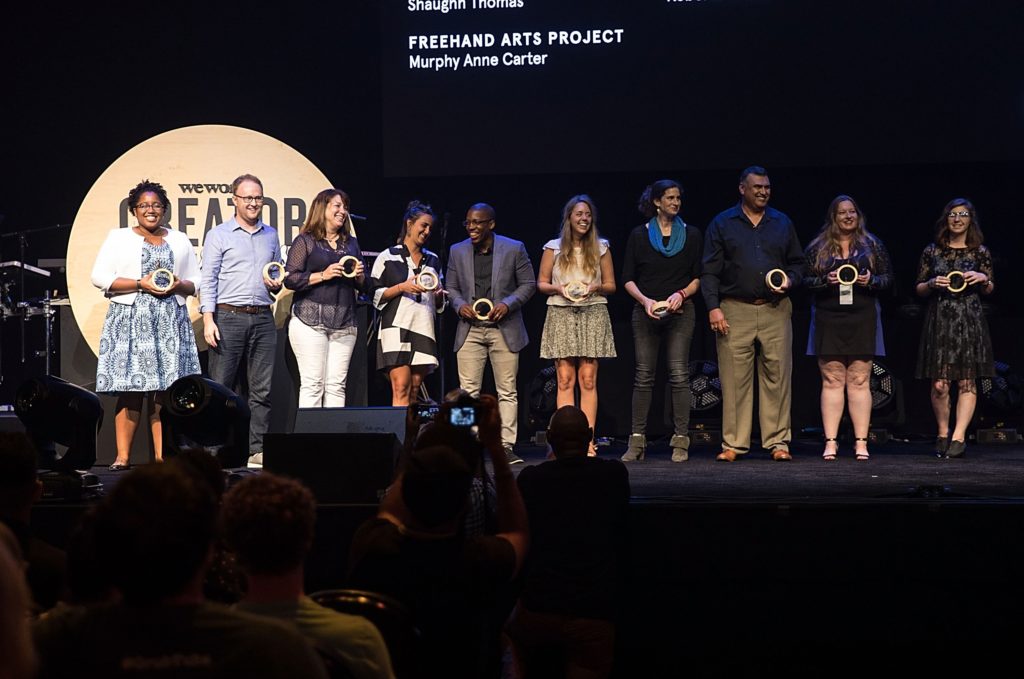
Seven Austin Entrepreneurs Win Big at WeWork Creator Awards

AUSTIN, TX – JUNE 27: WeWork Creator Awards Austin at ACL Live at The Moody Theater on June 27, 2017 in Austin, Texas. (Photo by Rick Kern/Getty Images for WeWork)

In the first ever Austin WeWork Creator Awards, seven Austin entrepreneurs won $845,000 in financial grants and now head to New York City fo the final event.

The biggest winner, GrubTubs, took home $360,000 in the scale category, the top prize at the event held at Austin City Limits Live at Moody Theater Tuesday night.

Other winners included re:3D Inc., CatSpring Yaupon, Kwaddle, Freehand Arts Project, Rancho Alegre Radio and Successful Smiles of Texas. In all, 34 finalists pitched before a live audience.

Winners from the scale and launch category will compete for additional financial grants at the global finals at Barclays Center in New York City on November 30.

SCALE: Businesses/nonprofits with proven success, ready for next level

Robert Olivier, GRUBTUBS – $360,000
Samantha Snabes, re:3D INC – $180,000
Abianna Falla, CATSPRING YAUPON – $180,000

LAUNCH: Businesses/nonprofits launched and still learning

Deven Hariyani, KWADDLE – $72,000

INCUBATE: Ideas/projects that need funding

Murphy Anne Carter, FREEHAND ARTS PROJECT – $18,000
Piper LeMoine, RANCHO ALEGRE RADIO – $18,000
Roberto Rivera, SUCCESSFUL SMILES OF TEXAS – $18,000

Austin-based Mood Media Completes Deal to Become a Private Company

Austin-based Mood Media Corp. announced Wednesday its acquisition by several investors including Apollo Global Management and GSO Capital Partners.

Mood Media, the parent company of Muzak, is now privately-held and its stock will no longer trade on the Toronto Stock Exchange. The investors paid 17 cents per share Canadian for Mood Media’s stock. The deal allows Mood Media to refinance its existing $650 million debt. The company paid for Chapter 15 bankruptcy protection in federal court last May, according to a Wall Street Journal story.

“The completion of this transaction will improve Mood Media’s financial position and allow us to further bring to life our long-term growth and market leadership initiatives and invest in new, strategic opportunities that strengthen our business,” Steve Richards, President and Chief Executive Officer of Mood Media said in a news release. “We look forward to working with Apollo, GSO and partners to further strengthen Mood’s position as the global leader in delivering Customer Experience solutions. This is an exciting next chapter for the Company, our clients and our partners.”

Mood Media has more than 500,000 client locations worldwide. The company provides sight, sound, scent and social mobile technology systems for restaurants, hotels, banks, retailers and small businesses.

AT&T Launches Second Trial of its Ultra-Fast 5G Network in Austin

AT&T on Tuesday announced the second trial of its ultra-fast 5G network throughout more locations in Austin.

Last year, the Dallas-based company completed the industry’s first wireless 5G business customer trial in Austin.

The company’s second trial delivers “an ultra-fast internet connection to residential, small business and enterprise customers using Ericsson’s 5G RAN and the Intel 5G Mobile Trial Platform,” according to a news release. “The trial participants can stream premium live TV via DIRECTV NOW and experience faster broadband services—all over a fixed wireless 5G signal. The trial benefits from the resources and capabilities of our 5G testbeds in Austin.”

AT&T expects the trial will deliver speeds up to 1 gigabit per second. It tested the technology earlier this year by delivering DIRECTV NOW using mmWave technology at our Middletown, New Jersey lab. It was the first time DIRECTV NOW had been delivered over a 5G connection.

AT&T plans to roll out its 5G wireless service to more customers later next year.

“The technology behind 5G is important. But it’s also about advancing social trends like mobile video streaming,” Marachel Knight, senior vice president, Wireless Network Architecture and Design, AT&T, said in a news release. “In Austin, we’re testing DIRECTV NOW over ultra-fast Internet speeds at a variety of locations. The network of the future will help redefine what connectivity means to both consumers and businesses. This trial helps show that the new reality is coming fast.”

AT&T has seen tremendous growth in data traffic on its mobile network and video now makes up over half of it. Video traffic on its smartphones grew more than 75 percent last year.

« Older posts Newer posts »

© 2026 SiliconHills

Theme by Anders Noren — Up ↑